

By Stephen McGowan
Eighteen years since his first match as a football referee, it’s the loneliness Paul O’Neill remembers most.
His first game was an under-13s fixture between Hamilton and Dundee at Laigh Bent Sports Ground watched by a posse of coaches, parents and dog walkers. For a 28-year-old man working as a nurse in a prison, the experience should have been as daunting and intimidating as dipping a toe in the shallow end at Blantyre baths. Yet the isolation was something he had never experienced before or since.
“It was the most nervous I was for any game,” says O’Neill after stepping down from his role as a specialist assistant referee in May.
“Years later, I ran the line at Ibrox in front of over 40,000 fans when Rangers won League Two. But there was nowhere near the nerves I felt for that first under-13s game. You are basically given a whistle and after that it’s only you.
“I just felt really vulnerable. You desperately want to do a good job and you don’t want to embarrass yourself. There was an experienced referee watching me and I remember thinking, ‘I wish he wasn’t here….’”
He still has the first observer’s report tucked away in a drawer somewhere, containing the remarks that his whistle tone was off and that his positioning left a bit to be desired.
The early years, at grassroots level, were the hardest. In a BBC Radio Five Live survey launched in 2023, hundreds of grassroots referees told of fearing for their safety, reporting physical abuse by spectators, players, coaches or managers. Some described being punched, headbutted and spat at. Almost all of them had experienced some form of verbal abuse.
Last summer, the Scottish FA launched a ‘Let Them Ref’ campaign in a quest to tackle behaviour on the sidelines and abuse of referees. Despite calling a halt to his career after 835 games, O’Neill plans to keep his hand in by leading a new drive to recruit officials for Scottish Para Football and helping out with new entrant training courses.
In March, the National Referee Introductory Course was launched allowing people from any part of the country to take part in live tuition on the laws of the game, delivered by the country’s top match officials. While new courses run every six-eight weeks, the task of persuading young referees to come forward becomes more challenging when parents, coaches and players are screaming foulmouthed abuse from the sidelines.
“I have a suspicion that at grassroots level we have a real problem in Scotland and beyond,” O’Neill observes. “I have been a new entrants coach in Lanarkshire and we take 20 or 30 people through the referees’ course twice a year. But we are losing more than that.
“Sometimes at these kids’ games the level of abuse from parents, spectators, coaches and the players themselves is beyond acceptable.”
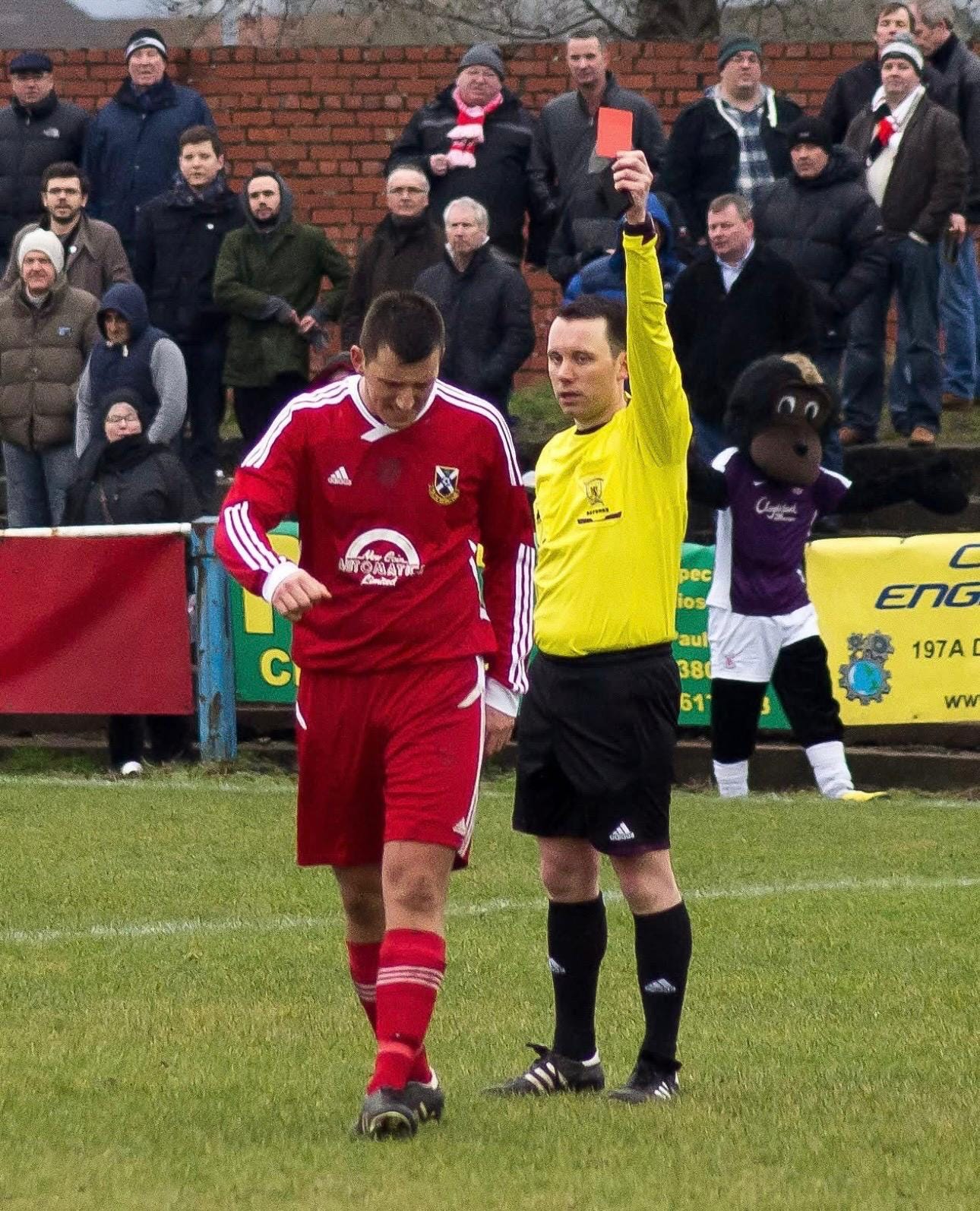
To encourage new entrants, the SFA Referees’ Department are launching the Youth Referee Introductory Course, with an initial 25 young people signed up to become officials. The entry age will be lowered to 14 to encourage teenage officials to develop confidence, leadership and communication skills.
In partnership with Qualifications Scotland, those undertaking the Level 7 Refereeing Course at school are now being encouraged to make the leap into active refereeing. Currently 120 schools have signed up, with over 1200 16-18-year-olds scheduled to sit the course in the next academic year.
“If I was sitting as a 16-year-old aspiring referee, would I be able to take the level of abuse I have heard?” ponders O’Neill. “I don’t think I would have at that age.
“I was a nurse in a prison and my bar was probably set quite high. Did I take abuse during my refereeing career? Yes I did. Was that abuse sometimes unacceptable? Yes it was. I was always lucky that the level of respect I got from guys in the game was reasonably high. But I had horrible things said to me at games. Mainly in the junior game.”
For the aspiring Scottish referee, ‘the juniors’ has always been a notorious testing ground. A footballing bearpit where nerve ends are pushed and pulled for signs of weakness or fragility.
Last season, the senior game managed to match the bowel-loosening attributes of a clash between Auchinleck Talbot and Cumnock when the SFA were forced to condemn the online leak of personal details belonging to referee John Beaton. A lengthy statement condemned the ‘hysterical media narrative’ around refereeing decisions and warned of an environment of intimidation and fear. Scotland’s governing body also confirmed plans to strengthen rules aimed at protecting match officials and their families.
Grassroots clubs are now expected to appoint a designated referee Liaison Officer as a ‘safe person’ to offer support. As in the senior game, head of referees Willie Collum has warned that only the team captain can approach officials to communicate during a match. All teams must introduce a technical area open only to team officials to discourage encroachments onto the pitch. Spectators should also be positioned at two metres back from the sidelines in a quest to foster a ‘culture of respect’.
At grassroots games, O’Neill always found the shouts and the noise more difficult to block out than they ever were at Ibrox or Parkhead.
“You would hear the voices of a small number whereas, in the senior game, a lot of noise is in the background. It’s very rare that you hear individuals. But there is something about people going into a football environment which makes them behave in a way they would never do somewhere else.
“I have had colleagues who have received horrendous abuse in regards to religion, sexuality, appearance and it’s not acceptable in society. I don’t know why it’s acceptable at football. There were grounds you would go to that were really intimidating. But there was never a ground where I actively feared for my safety in my career.”
The presence of his late father at games probably helped. Before Brian O’Neill passed away last March, he became his son’s personal refereeing observer for the best part of 18 years.
A late starter, O’Neill went on to take the decision to become a specialist assistant referee rather than push for the category one status earned by the likes of Nick Walsh, Don Robertson and John Beaton. He was never short of free advice on that score.
“When I became an assistant referee, my dad came and watched me officiate at every senior ground in Scotland, except Bonnyrigg Rose. That was the only ground he never got to see me in. That was massive for me. That ability for my dad to come out to games and to talk in the car.
“My dad wasn’t a referee, he was an armchair football fan and a lot of the times going back in the car he would be telling me what I did wrong and I nearly dropped him off the Forth Road Bridge a few times.
“But there was so much time talking about more important things and when he passed away people were reaching out to me making sure I was alright. Other referees like Callum Spence and Lloyd Wilson got in touch because they had met my dad at games. I think back to a picture I have of me and my dad at the Scotland-England Leigh Griffiths game in 2017 and days like that were an opportunity to spend time you never get back. Refereeing gave me that.”

Refereeing could also be a demanding mistress. Retirement will mean more time with his wife Danielle and daughters Abbie (15) and Erin (four). His other half now welcomes the chance to arrange nights out three weeks in advance with no fretting over the possibility of a Championship game in Dingwall and a return home at 10pm.
“It’s incredibly difficult when you are juggling two careers,” says O’Neill, a senior manager with the NHS in South Lanarkshire. “There’s what you do in the day job and then there is refereeing.”
English football runs a pool of 20 to 21 full-time referees, but O’Neill remains unconvinced by the notion of a similar system in Scotland, describing it as a ‘double-edged sword’.
“If you decide to make refereeing full-time you are going to lose some of your top officials. My career is with the NHS. Others will be lawyers or police officers and they would be walking away from a career they had spent years building up as well as a pension and the security that comes with it. They would also have to ask, ‘How many years am I going to be a referee?’
“There is also that risk because, like being a footballer, it’s performance-based and injuries can creep in. It’s an easier decision to make for young referees to embark on a career.”
O’Neill still asks himself if he should have taken up refereeing before the age of 27. For all the hassle and abuse and grief he took at grassroots level he has no regrets over the choice to attend a training course run by former referees Brian Winter and George Drummond at the Bellshill Hilton hotel around 2008.
“I never did an Old Firm game. I never did a Scottish Cup final or a League Cup final, but I’m not bitter about that in any way. I back myself and I think I was a good assistant referee. I take pride in the fact that I did do a Scottish Cup semi-final, I did an Edinburgh derby, I did the Junior Cup final and I was trusted by the SFA to take on appointments that were important.
“Some people finish their career and look through a glass half empty at what could have been. I’ve never been that kind of person, I look on my glass as being half full. I look at what refereeing gave me. It’s easy to look when you are leaving and point at the SFA and say, ‘Here’s what they could have done.’
“I don’t have that approach. I think those 18 years allowed me to develop myself as both a referee and as a person. And for that I will be forever thankful. All those hours I spent with my dad. The chance I have now to help para football.
“And what I would say to any young person looking at refereeing as a possible career or hobby is that they should grab it with both hands. They might do two games and decide it’s not for them or they might travel the world for the next 30 years.”