

This article first appeared in Issue 19 of Nutmeg which was published in March 2021.
By Craig Easton
“EASTY!” I hear my name reverberating down the corridor just as I put my hand on the players’ entrance door. I pause for a couple of seconds before stepping through into the bowels of the old corner stand at Tannadice Park — this is the last thing I need. I pass Steven Fallon, one of my teammates, on his way to the kit room. “Easty, the chairman’s looking for you,” he says, with a pat on the shoulder and a look that says: All the best, mate. All I can do is nod as I make my way to the foot of the stairs that lead to Jim McLean’s office.
It’s not even been 12 hours since I endured the full force of a ‘hairdryer’ from the manager and Jim’s younger brother, Tommy, after our “disappointing” Scottish Youth Cup victory against Ayr United the previous night. Merely progressing to the next round of a competition isn’t always enough when you wear the tangerine and black. Most of the team felt some heat from the gaffer for contributing to an average performance; however he turned the dial up to maximum power for me. I had been playing consistently well for the reserves, had recently broken through into the first team, and was pushing for a permanent place in the side so, obviously, more was expected from me when turning out for the youth team. I understood that. It comes with the territory and I had been relishing the extra responsibility when playing with my own age group.
I had actually thought I had a pretty good game, and so did my dad, who certainly doesn’t do false praise. However, putting across any opinions on my performance at that particular moment would’ve been a very bad idea. I would keep that to myself. Just accept the heat. Most of it was a blur and consisted of me attempting to look the manager in the eye without being disrespectful. At one point, I recall him screaming that I could “shove my music up my arse!” as he strode over to the dressing-room ghetto blaster to eject and throw my Oasis mixtape in my general direction. As I half flinched, I noticed that it bounced off the bench and didn’t shatter so I took that as a win and suppressed a small smile as the pelters continued. That tape had some killer B-sides.
Now my brain’s going into overdrive as I make my way along the narrow corridor. I’m thinking that the chairman’s going to double down on last night’s bollocking after conversing with his younger sibling. Or is it something else? I’ve not really missed curfew. There was that time a couple of weeks ago when I fell asleep at my girlfriend’s/future wife’s parents’ house. But surely I wouldn’t have been stuck in for randomly being a couple of hours late back to my digs? Nah, Tony and Marie were pretty cool about that. And they also didn’t mind us going on the occasional youth-team night out after a win. On the other hand, Jim McLean has eyes all over the city. As Maurice Malpas — player coach and United legend who survived The McLean Years™ — likes to say: “Dundee’s a village.”
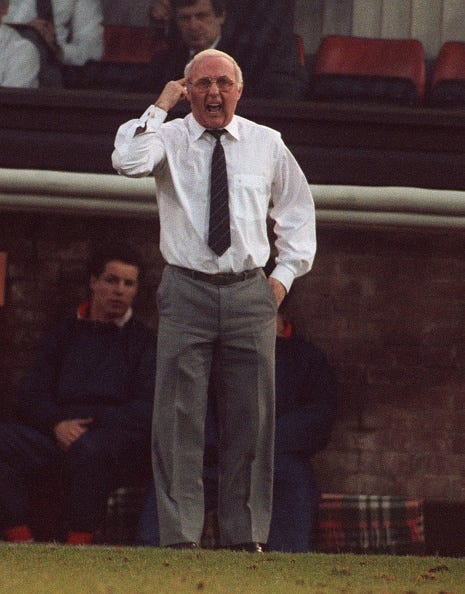
“Eeeastaay!” the second shout breaks off my chain of thought four steps into my climb, and I look up to see the chairman leaning over the bannister at the top of the stairs. He’s dressed in his usual attire: white shirt, navy and silver tie, grey dress trousers and loafers. Immaculate as always. Our eyes meet just as he finishes his second summons and he says, “Hurry up, I need to see you in my office for a minute.” Here we go. Just take it on the chin, Craig, I tell myself, you’ve heard the stories — bigger and better players than you have had the Wee Jim treatment and survived to tell the tale. In fact, you should be honoured.
“Come in. Hurry up, close the door behind you,” he says, as he walks about 15ft to his leather chair behind his large wooden desk in front of the window that overlooked the main entrance to the stadium. It wasn’t the first time I’d been in his office. If his door was open, and it often was — sometimes strategically now that I think about it, then the chairman would often shout you in when he’d notice you passing by. Sometimes it would be just to have a bit of banter, check how you were settling into your digs, but often there would be questions. Where you were staying; who you were sharing a room with; if you had a girlfriend; if you were working hard in training. All questions he already knew the answers to but he asked them in a way that you knew he knew, and he was making sure you knew he knew!
On other occasions, it was after a game in which you knew you’d played well and while there would be an acknowledgement of that, the main reason would be to remind you that you were still nowhere near the first team. He’d ask what you thought of players that played in your position, what they did well, and if you thought you could either play alongside them or eventually take their place. Did you have what it took to be a Dundee United player? Tough questions for a 17-year-old to answer, but I had a mantra of sorts that I recited to myself during each of those early forays into Jim McLean’s office.
It was something that the first-team goalkeeper, Ally Maxwell, had said to a group of us youth players during a lunch break not long after we had signed as apprentices. Maxy had just finished his fish and beans and was holding court with four or five of us. He was telling stories from his time at Rangers, imparting football wisdom and basically shooting the shit with kids who hang on every word a first-team player says, when the chairman burst out of his office to put his plate in the dishrack.
“Thank you, Maureen, that was lovely,” he said to the cook. Then Maxy shouted over: “Is that you chairman, are you not having seconds today?” There were a few nervous looks around our table. We were all wondering what Maxy was thinking. When the chairman’s about, surely you keep your head down. The whole point is not to attract his attention, isn’t it? “Aye well, you’d know Maxwell. How many cups of coffee and slices of toast have you had the’day?” the chairman shot back. “I’m just talking to these young pups, chairman, giving them some advice. Sydney said he saw you with a plate of biscuits earlier,” Maxy replied.
Cue more nervous looks and everyone turning to stare at Syd. “Is that right?” The chairman stopped and his eyes settled on Chris Devine, aka Syd, our youth team’s top goalscorer who was “blessed” not only with a surname that warranted the obvious nickname but also with a rear-end similar in scale to King Kenny’s. Syd laughed nervously and held up both hands. “You’d know eh, Syd?” the chairman chuckled. “By the size of your arse, you’ve been eating them as well!” and then he disappeared through the adjoining door between his office and the kitchen.
He’s only a man. He actually likes it when you have a laugh with him. Look him in the eye and talk to him, and he’ll respect you more for it
When the laughter died down, Syd slumped in his chair and turned to Maxy. “Cheers for that, you absolutely killed me there.” We were all thinking the same thing: you can’t be having banter with Jim McLean! Maxy’s reply was simple. “Why not?” he smiled. “He’s only a man. He actually likes it when you have a laugh with him. Look him in the eye and talk to him, and he’ll respect you more for it.” Those words didn’t only resonate with me then but I have utilised Maxy’s piece of advice on almost every occasion when I’ve had to converse with anyone in a position of status above my own: “He’s only a man.”
However, on this occasion, the chairman asked the one question I dreaded over them all: “How do you think you played last night?” Oh no. Where do I go here? Do I sit with the fence right up my backside and stammer, “Erm, I wasn’t great chairman… alright… I mean, I suppose I could’ve done better, but… alright.” That’s a cop out, the answer I think he wants to hear, especially if he’s of the same opinion about my performance as the manager. Even though Tommy isn’t my favourite person right at this moment, he’s shown he has belief in me to play in his first team and, of course, he has my total respect. If I say I thought I played well, am I undermining his opinion? This is a minefield… I take a deep breath. He’s only a man. Shit. Here I go, Maxy. “I thought I played well, chairman…” He cuts me off before I can embarrass myself with embellishing that comment. “So did I,” he says with a smile. “But you need to work on your body position when you receive the ball from one side and you want to switch it out quickly to the other.” What? Did he just agree with me there? And was that a smile? Before I can process his response any further, he’s on his feet rolling a Mitre out from under his desk. I remember stupidly focusing on the ball and thinking, “Does Jim McLean always keep a football under his desk?”
He’s standing with a tasselled loafer-shod foot on top of the ball, pointing to an imaginary player. “See when the right back has the ball and you start to angle off to receive, you already need to have a picture in your head about everything else on the opposite side of the pitch. At the moment, you’re sometimes getting the pass with your body too square on and it’s taking you three or more touches to get it out your feet to switch the play,” and he demonstrates the somewhat laboured technique that I’ve been utilising thus far. I was a wiry, tenacious player such that I didn’t mind contact. So when I received the ball under pressure, more often than not I could manipulate it and my opponent while maintaining possession and usually complete my intended pass, but admittedly somewhat less economically than it could’ve been done.
“If you have the picture in your head and time your movement, you can take the pass with your left foot, then you can switch the ball with your right in two touches, every time,” he says, beckoning me to the far wall, then passing me the ball as he tucked the bottom half of his tie into his shirt. He gets me to play it in to him to demonstrate what he was talking about. I didn’t pass the ball in hard enough on the first occasion. “PLAY IT IN TO ME WITH PACE!” he demands, and then after a couple of demos we swapped places.
I took in every detail of what he was saying and I remember thinking: Wow. Actual Jim McLean has just taken time out of his day to give me a personal coaching session. In his office. It was surreal. All of a sudden, he says, “You’ve got to keep working on that,” rolls the ball back under his desk and sits down. “I heard oor Tom gave you a hard time last night, is that right?” he asks with a knowing grin. I answer with a shrug of my shoulders. “Yeah, but it’s alright, I know I’m in and about the first team now, so I should be better.” “You can fucking handle that,” he says. “He wants you in that first team and he wants you to stay in it. You’re doing okay, keep working hard. And by the way, if Tom asks, don’t tell him you were in here.” “Eh… okay, thanks chairman.”
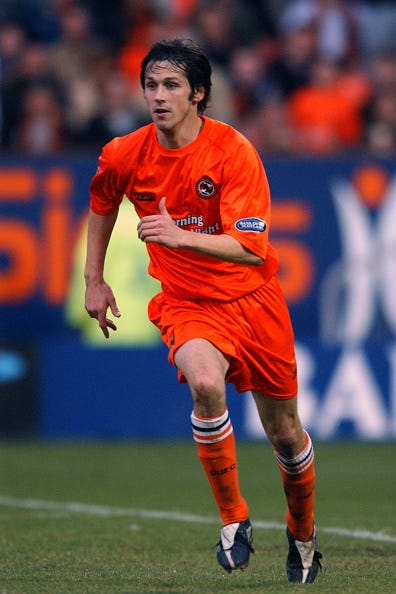
There were many more visits to Jim McLean’s office over the following five years of his tenure and I wasn’t the only young player who felt the butterflies every time I was summoned. We didn’t know it, because we didn’t discuss it at the time, but he was having these little pep talks with almost every one of us. Often there was the fear that the experience may not be one you were going to enjoy, however it invariably consisted of being given a combination of advice, coaching points, motivation or a kick up the arse, the latter two of those being very similar. There was always a bit of banter or a question that had you scrambling or laughing nervously. Something that would test you. However, myself and the other young players of the time almost always left his office feeling like he cared. Yes, whisper it, Jim McLean cared about us. But he didn’t want that to become common knowledge. He would give us praise, with the caveat: “Don’t let on to anyone I told you that, I’ve got a reputation to live up to.”
I’m not naive enough to misapprehend that the version of Jim McLean we experienced was a chairman who, while still intent on controlling the culture and impacting the future talent of the football club he built, was a few years removed from the tough, exacting, innovative manager who players equally feared and respected. And there were enough glimpses that added meat to the bones of the tales told by United legends at awards dinners to keep us all on edge. The way he would sit menacingly in the front row of his glass-fronted executive box, positioned directly behind the dugout, before blowing the door wide open like a tornado and rushing halfway down the outside steps to berate an official for a bad decision. Or when he hid behind a tree while “out for a walk” in Camperdown Park to catch Steven Fallon attempting to take a short-cut on the dreaded “Hamburger Hill” run through the forest.
Compared to Dave Bowman, Paul Hegarty, Gary Bollan, Richard Gough et al, myself and the players I came through the ranks with definitely experienced Wee Jim Lite. However, reading and listening to his former charges pay tribute to him, regardless of their position on whether they liked him or not, there is one constant. Every one of them credits him with having a desire to improve them. I was extremely privileged to be among that fortunate fold, and to have one of the greatest football minds of all time take an interest in me when I was attempting to make my mark.
I only realise now how much of a subconscious influence he was and writing this piece has helped me to recognise the way in which he’s shaped many of my personal and footballing values and standards. Ultimately, his legacy lives on not only with Dundee United Football Club, but in all those players who are now coaches and managers in their own right. Ally Maxwell’s piece of advice helped allay my fears and somewhat busted the myth surrounding the great man, which allowed me to form a relationship of sorts. He was only a man. But what a man.

Nutmeg Issue 41 is out now. Click on the cover image to buy or…