This article first appeared in Issue 1 of Nutmeg which was published in September 2016. To find out more about the print magazine and subscriptions, hit the button.👇
By Neil Forsyth
In the autumn of 2000 I was working for an advertising company off Tottenham Court Road. My job was to trawl through a labyrinthine suite of software and retrospectively confirm if clients’ adverts had been broadcast in the correct slots. I didn’t know how to work the software. My boss was called Brownie. He didn’t know how to work the software either.
The days ticked by. After unproductive mornings, Brownie and I would retire to the Fitzrovia pub in Goodge Street before a short, frantic stop at the all-you-can-eat Chinese buffet next door.
If you thought the mornings were unproductive, you should have seen the afternoons. Drowsy from lager and wontons, I spent them writing for football websites and diligently conducting business on behalf of the South London Tangerines, an ambitious Dundee United supporters’ club that I’d recently formed with other misplaced Dundonians. Sometimes, not often, I’d ask Brownie if we should perhaps ask for some assistance in working the software and he’d furrow his brow and say, “Tomorrow, Brucie.” He called me Brucie after the entertainer Bruce Forsyth.
It was on one of those empty afternoons that I set about tracking down the members of Dundee United’s 1982/83 Scottish Premier League-winning team. Most were still in the game and easy to find. Ralph Milne was harder. Eventually I found a community website for Nailsea, a small town outside Bristol. It stated that former footballer Ralph Milne ran a local pub called the Queen’s Head. The Queen’s Head’s telephone was answered by someone with a Dundee accent. I asked if it was him.
“Aye,” said Ralph.
In his autobiography What’s It All About Ralphie? (Black and White Publishing, 2009, co-written with Gary Robertson) Ralph relays this phone call and how “at first I thought it was a wind-up by someone on the capers.” But, he clarifies, it was “the start of a bond I’ve kept with the South London Tangerines.”
A few weeks after the call, a dozen of us visited Nailsea for the weekend. We rolled into Ralph’s pub and formed a half-circle of appreciation around him. It was a little awkward, as we talked of the train journey down and Broughty Ferry. And then someone said, “Here Ralph, tell us about the goal at Dens.”
And Ralph relaxed, smiled and briefly put down his pint.
Ralph Milne grew up in the Douglas council estate on Dundee’s eastern wing. A football prodigy, he’d already turned down Aston Villa when Tangerines manager Jim McLean sent word he’d be visiting the Milne household to sign the 14-year-old Ralph on schoolboy terms.
Ralph’s father hung up the phone, panicked and ran to the off-licence. When the abstemious McLean arrived it was to the sight of a kitchen table straining beneath a carry-out as varied as it was vast. When the bewildered McLean left with Ralph’s signature, the youngster asked his father, “Fuck me Dad, what was that all about with the drink?”
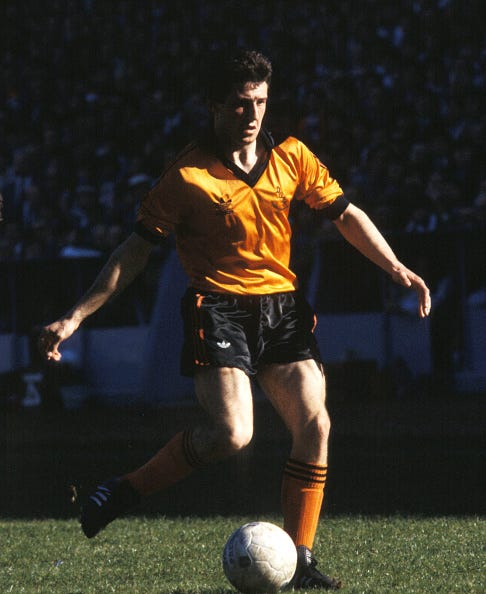
Ralph made his United debut aged 18 against Celtic, netted from 25 yards and was briefly the youngest-ever scorer in the Premier League. He was two-footed, rapid and instinctive. Playing wide or through the middle, hanging low over the ball, he was a searing attacking force in a team heavy with ability. This was the United of Hegarty, Narey, Malpas, Gough, Bannon, Sturrock et al, and Ralph comfortably held his own in the club’s most successful team.
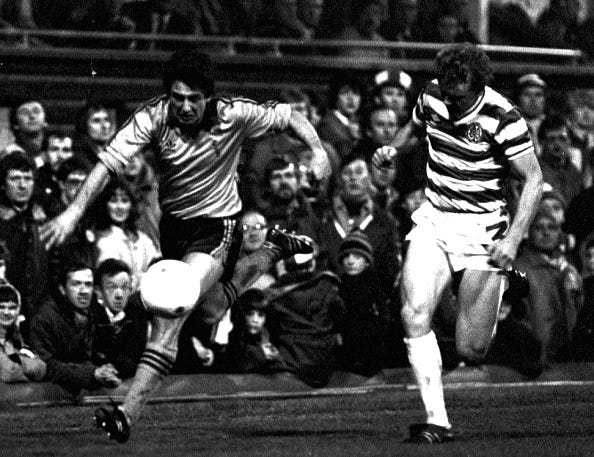
Under the borderline despotic leadership of McLean, United had won their first trophies, the Scottish League Cups of 1979 and 1980, and Ralph arrived in time for the most important one of all: the Scottish Premier League title of 1982-83 and the European years that followed.
Off the pitch, his relationship with McLean deteriorated into a blizzard of fines which at one point saw Ralph work labouring shifts to pay his mortgage. On it, he created an anthology of moments that United’s fans of that vintage still cling to.
There was the 4-0 European Cup victory over Standard Liege when Ralph scored two in what many believe was the best individual performance in the club’s history. There was a late volley at Parkhead which kept United in the 1982-83 title race, a goal against Morton when he beat four players from the halfway line and another against Rangers at Hampden when he outpaced their whole defence. In all, 179 games, 45 goals, including a club record 15 goals in Europe where Ralph thrived on being given more space to build up speed and dart late into the box.
For United, and for Ralph, those were the good times. And the goal at Dens was the best.
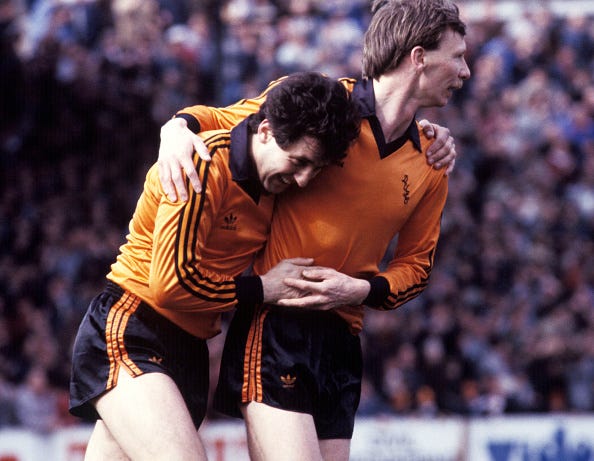
It came on the afternoon of the May 14, 1983. It was the final game of the season and a win for United would bring the club’s first (and, let’s face it, probably only) Premier League title. Standing in the Queen’s Head 17 years later, Ralph talked the rapt South London Tangerines through the goal. This was Ralph’s Everest, his My Way. I know the words because I’ve heard them so many times. Bit parts are played by Paul Sturrock (Luggy), Davie Dodds, Billy Kirkwood and the Radio Tay offices behind Dens.
“Two minutes before, Luggy had knocked it in the corner for me and I said, ‘Luggy, do you think I’ve got a fucking motorbike?’ So next time he hit my feet. I turned round and I had Doddsy on my left and Kirkwood on my right. Now, Doddsy’s left foot is for standing on and if I’d given it to Kirkwood he would have hit some poor c**t in Radio Tay. So I just hit it, and the rest is history.”
The next day, we battled through hangovers to play a team of former Bristol City players led by Ralph. He stood chatting to spectators on the touchline before the ball finally came too close to ignore. Ralph took a touch, swept it 50 yards to a teammate at the far post, then returned to his conversation. As far as I know, that was his last game.
We brought him to London for our end-of-season awards. He handed out the prizes and sang Suspicious Minds on the karaoke. The next morning he said he’d seen Jesus in the steamed mirror of his Travelodge while lying in the bath. I said Jesus was probably telling his friends that he’d seen Ralph Milne in the bath.
We went back to Nailsea and played a local side at Bristol City’s Ashton Gate before going on to a pub to celebrate Ralph’s 40th birthday. Brownie, who was a Charlton Athletic fanatic, came on that trip. He was keen to discuss Ralph’s short stay at the Addicks in the late 80s. Ralph told Brownie that it had been a nightmare. Brownie agreed, with a caveat. “To be fair Ralph, you didn’t look well.”
United sold Ralph to Charlton for £125,000 in January 1987, his battle of wills with McLean having been fought to an exhausting draw. The player who McLean had announced as “potentially the most exciting in Scotland” had ultimately defeated the manager’s varied attempts to have him accept his deadening discipline. In a last throw of the dice that gives an insight into his desperation, McLean charged a hypnotist with sorting out Ralph’s attitude, only for the session to be ruined by Ralph repeatedly dissolving into laughter due to the hypnotist’s resemblance to Worzel Gummidge.
As a result, Ralph had found himself slipping in and out United’s team. He was unfit and unfancied. He didn’t go to Rangers, who had chased him for years, or the big English clubs who had made intermittent enquiries, or Brian Clough’s Nottingham Forrest against whom Ralph had scored two goals in McLean’s testimonial. Instead he went to Charlton who were in the English First Division but cash-strapped, playing their home games at Crystal Palace’s Selhurst Park, and endangered by relegation.
Ralph arrived mentally drained. It didn’t help that United then drew Barcelona in the UEFA Cup and he was forced to watch their famous victories over the Spaniards in a London hotel room. And it didn’t help that, by his own admittance, his drinking was steadily escalating.
Ralph played for Charlton at Wembley in the final of the short-lived Simod Cup before his season ended prematurely with a shattered cheekbone. He flew back to Scotland, picked up his parents, and took them to America for a month. It was a bucket-list trip. His father was dying from terminal cancer.
The 1987-88 season started and Ralph was out of favour. In a particularly Ralph touch, he writes in his book of his mystification at the lack of game time, then talks at length of the “AK47 battery-operated water-pistol” he had taken to patrolling the training ground with and using at will against both players and club staff. Even when a coach, then manager Lennie Lawrence, then the club chairman demanded he refrain from the aquatic violence, Ralph indignantly refused, pointing out that “I bought it in America and it’s very precious to me.”
Escape came through a loan spell at Third Division Bristol City. Ralph scored a volley on his debut and it was the start of a resurrection. In his book, Ralph partly puts this down to the fact that while in Bristol he took to drinking in the afternoons rather than the evenings because — and he’s genuine in his warning — you can’t be a top-class athlete if you’re not getting enough sleep.
City’s manager Joe Jordan showed unflagging belief in Ralph, as the team vied for promotion and Ralph’s form returned to historical levels. He had been there less than a year, but news of his revival spread. Ralph spotted Aberdeen’s manager Alex Smith at a match and word reached him that the club were preparing a bid. With his son now living in Dundee with his ex-wife, Ralph would have welcomed the move and when Jordan called him into his office in November 1988 he believed it had arrived. Jordan said he’d accepted a bid. Ralph thanked him and said he was ready to go home.
Jordan said he wasn’t going home, then added, “You’ve got to call Fergie.”
In 2002 I left advertising for journalism and Ralph was the only contact I had. It won me my first commission. The magazine Four Four Two told me to take Ralph back to Old Trafford and see what happened. Ralph and I met at the train station and got a taxi to the stadium. He located his name on the museum’s wall of former players and pointed out his proximity to his friend Frank Kopel. In the lift a steward said, “You used to play here, didn’t you?” and Ralph said yes, he was Ralph Milne, and a silence descended.
In the dressing room, Ralph told a story about arriving on his first day and being given a peg between Paul McGrath and Norman Whiteside. “What fucking chance did I have?” he laughed. And then we went to the pub — an Irish bar in Deansgate where Milne, McGrath and Whiteside had once conspired to lose afternoons — and Ralph drank and told lots of stories.
I submitted the article and the editor sent back a raging missive. “This reads like the Morning Star obituary for the thwarted career of the Undersecretary of the Boilermakers’ Union” (you remember the bad ones). He wanted me to twist the knife. I wouldn’t, so he did, but Ralph never read it anyway. In hindsight, I’m not sure if he wanted to go back to Old Trafford at all.
At a League Manager’s Association dinner in the early Noughties, Alex Ferguson was asked who his worst ever buy was. “Ralph Milne,” he answered. “I only paid £170,000 but I still get condemned for it.” It was a clever answer, an easy laugh and with little judgement attached. The truth would have been more uncomfortable for Ferguson.
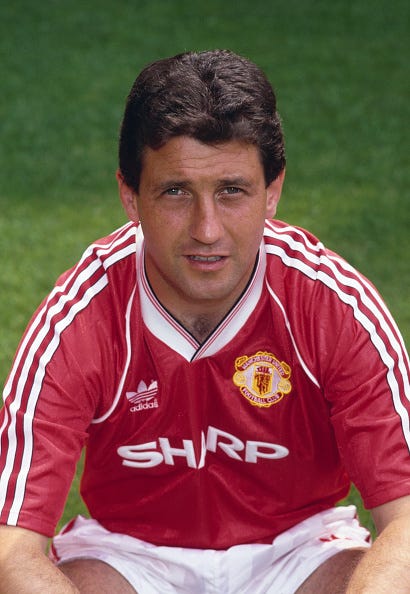
Ralph played 23 games for Manchester United, scored three goals, and indeed cost £170,000. There were many, many worse buys during Ferguson’s 27-year Old Trafford tenure. A brief selection: Bebe (£7million, seven games), Wilfried Zaha (£15m, four games), Massimo Taibi (£5.4m, four games), Zoran Tosic (£7million, four games), Dong Fangzhou (£3.5m, one game), Djemba-Djemba (£3.5m, 39 games, 10 cars, 30 bank accounts, one bankruptcy). But infamy sticks and Ralph became “Fergie’s worst signing”.
To be fair though, he wasn’t his best. In his book, Ralph’s account of his time at United is endearing. His surprise when Jordan told him about United’s bid never abated — he seems to have spent his two and a half years at Old Trafford in a state of shock. Later he would tell the Manchester Evening News that he would have signed for the club even if it meant “sweeping the terraces”. This self-deprecation shouldn’t have been warranted. Ferguson was right in judging that Ralph had the ability to be at Old Trafford, but Ralph’s mind was elsewhere.
He had joined a Manchester United that today feels archaic. Ford Escort club cars, the old Cliff training ground, no European football because of Heysel, and Ferguson under pressure from the fans as he tried to patch together a winning team.
Ralph was played out of position on the left after Ferguson told him his left foot was “better than Strachan’s”. He started well, scoring his first goal against former club Charlton, then another in a Boxing Day victory over Clough’s Nottingham Forrest (Ralph recalls ensuring he “didn’t over-do it with the drink” the day before). A week later, on New Year’s Day, Ralph played in a 3-1 win over Liverpool that bought Ferguson another few months. In the seven months that Ralph was at United that season, he played 22 games, scored three goals and Fergie thanked him for helping young left-back Lee Sharpe settle in behind him.
Another archaic aspect of United at that time was the industrial drinking culture. McGrath and Whiteside would both ultimately be sold because of their part in it, and club captain Bryan Robson was as keen an advocate as any. Inevitably, Ralph became willing collateral damage.
Amongst many other examples, his book details a hazy trip to the Cheltenham Festival with Robson and Steve Bruce, a pre-season tour of Japan where Ralph holed up in a karaoke bar with Mark Hughes and Neil Webb, and endless food-free “lunches” with McGrath and Whiteside. McGrath got the call from Ferguson to say he’d been sold while drunk with Ralph at Robson’s house.
The new season started and Ralph was shuffled out of the team, with Sharp pushed forward to left wing. Ferguson was in trouble. This was the era of the infamous “TA RA FERGIE” banner and the face-saving Mark Robbins goal against Nottingham Forrest. Ralph was injured for five months, had an unsuccessful loan spell at West Ham and was then bizarrely given a third year at United.
That season saw him barely make the reserve team, his life increasingly dictated by drinking and gambling. He left United in the summer of 1991. There can’t be many Manchester United players who leave the club and have their house repossessed a couple of months later.
His reputation in Britain somewhat tainted, Ralph played for Sing Tao in Hong Kong for a year, training at Happy Valley racecourse and drinking in a Scottish bar called Mad Dogs where he never had to pay. Just in case his lifestyle was threatened with improvement, Frank McAvennie rolled into town to play for a rival club and dutifully join Ralph in Mad Dogs.
In 1993, Ralph came back to Bristol where by now he had a second son. There was a brief, three-week spell in Northern Ireland at Derry City, which was largely spent in a bar with fleeting teammate Luther Blissett, and then it was done. Ralph was an ex-player at 32. And then his Dad died. Ralph was without both his “best pal” and his livelihood.
In 2005 Ralph moved back to Dundee, largely because of his mother’s failing health. I would see him whenever I was home, and my memories of the early part of that era are fond ones. For example, for the 25th anniversary of the Premier League win, Davie Dodds held a function in his Dundee pub and I found myself in a room full of heroes.
Ralph had returned to Dundee in a blaze of glory — settling into a flat, getting a job, becoming a celebrated fixture in Broughty Ferry’s pubs and making “wee cameos” in the bedrooms of starstruck Dundonian women. His company was as rewarding as ever.
There was his 50th birthday party in a packed Broughty Ferry hostelry where Ralph worked the room like Sinatra and Dave Narey stood silently in the corner like Clint Eastwood. There was a pre-season friendly for United against Newcastle where Ralph chose to stay in the social club and I picked him up afterwards.
There was his autobiography launch at the Waterstone’s in Commercial Street. I met Ralph beforehand in the Hansom Cab pub. He was with his childhood friend Andy McPhee, a loyal, kind man who played, often with great difficulty, a steadying role in Ralph’s life. Ralph signed my copy, “To Neil, who amazed me sometimes.”
When United played a pre-season friendly against Barcelona they held a Parade of Legends at half-time. No Legend enjoyed it more than Ralph. He strode majestically onto the pitch and soaked every second from the ovation. It was a last hurrah.
By now I had known Ralph for a decade. There had been a thread to our meetings, to my glimpses of his life, but I ignored it. It was easy to do so, until the Dundee Evening Telegraph quietly reported that Ralph was in Dundee’s Ninewells hospital. By the time I spoke to him he was discharged and defiant, summarising the medical advice as “Stick to beer.”
But things started to change and darken. There was talk of fallings out, mutterings of pub barrings, and (later dropped) assault charges. There was no job. Ralph had a combustible relationship with his new girlfriend which culminated in a brutal, drunken and frankly exploitative interview in a Scottish tabloid in which the couple were photographed looking sad in front of a table full of booze.
Meeting Ralph in this period was a different experience. A little sadder, and tinged with guilt. Every round bought came with a chaser, a lurking thought and an accusation to the self: You’re making this worse.
In 2013, Ralph was the subject of an episode of When the Floodlights Fade, a documentary series on former Manchester United players for the club’s TV channel. Ralph took the film crew to Douglas and talked with genuine warmth and a welcome pride of his time at Old Trafford. The programme ends with Ralph interviewed at Broughty Ferry harbour with his friend Andy.
Andy and Ralph talk vaguely about Ralph having recently been through hard times. “Things can only get better,” says Ralph, then adds, “D-Ream.” And then he thanks Andy for his friendship and says: “I’ve got no regrets, I’ve had a great life.” It’s an unsettling moment. He’s only 51.
In the summer of 2015, 15 years after I phoned the Queen’s Head pub in Nailsea, my mobile phone showed a missed call from Ralph. I live in the countryside and have to go outside to get a signal, so I walked my dog and called Ralph back. He was in ebullient mood. As I walked over fields, we talked about how long it had been. Ralph said it had been years. There was more to it than that, but it had and I felt guilty.
He was calling because he had a pension maturing later that year. “Big money,” he said. He and his girlfriend wanted to go to New York, where I had lived for a period, and he wanted hotel recommendations. He was funny and lucid. I told him how good it was to hear from him. He said he would visit me. A few weeks later, I received a text from Andy McPhee. It said: “He’s not hurting anymore.”
And that was it. Ralph was dead.
I tried to help him. Not nearly as much as others I’m sure, but I did try. Ralph was right that we hadn’t spoken for a couple of years but he didn’t know, or had more likely forgotten, that when he was hospitalised the first time myself and others put together an escape plan, to a specialist English clinic, that Ralph didn’t take. It was too late. Maybe from me it was too little. But addiction is a state of mind where friends look like enemies and help looks like a trap. It’s hard to know your role in the story. What’s clearer is that it’s just all so fucking sad.
Ralph told me a story once. Over a pre-match meal in the 1990s, his manager asked if he could do a job that day on the left of midfield. Ralph, who had presumed he wasn’t playing, gratefully agreed, but when he got to the dressing room the number 12 jersey hung waiting on his hook. “He must have smelt the drink off me,” Ralph flatly concluded. The manager was Sir Alex Ferguson, the club Manchester United.
He told these stories unprompted, offering them as trinkets to grateful and perhaps guilty pub audiences, myself included. But it’s not those stories he should be remembered for and it’s not those stories which caused a shrine to be built by strangers at Tannadice after his death. It wasn’t those stories that saw the stadium packed for the next home game for a sorrowful minute’s silence. And it wasn’t those stories that saw Ralph’s tearful old teammates come to the funeral without cars so they could give their friend the send-off they knew he’d have wanted.
The outpouring of appreciation for Ralph’s life was because of more wholesome treasures, and it is for them that he will rightfully be remembered. All those runs, all those goals, European nights under the lights. And, more than anything, Ralph will be remembered for the afternoon of May 14, 1983. You should look it up. It’s on YouTube, just search ‘Ralph Milne league winning’.
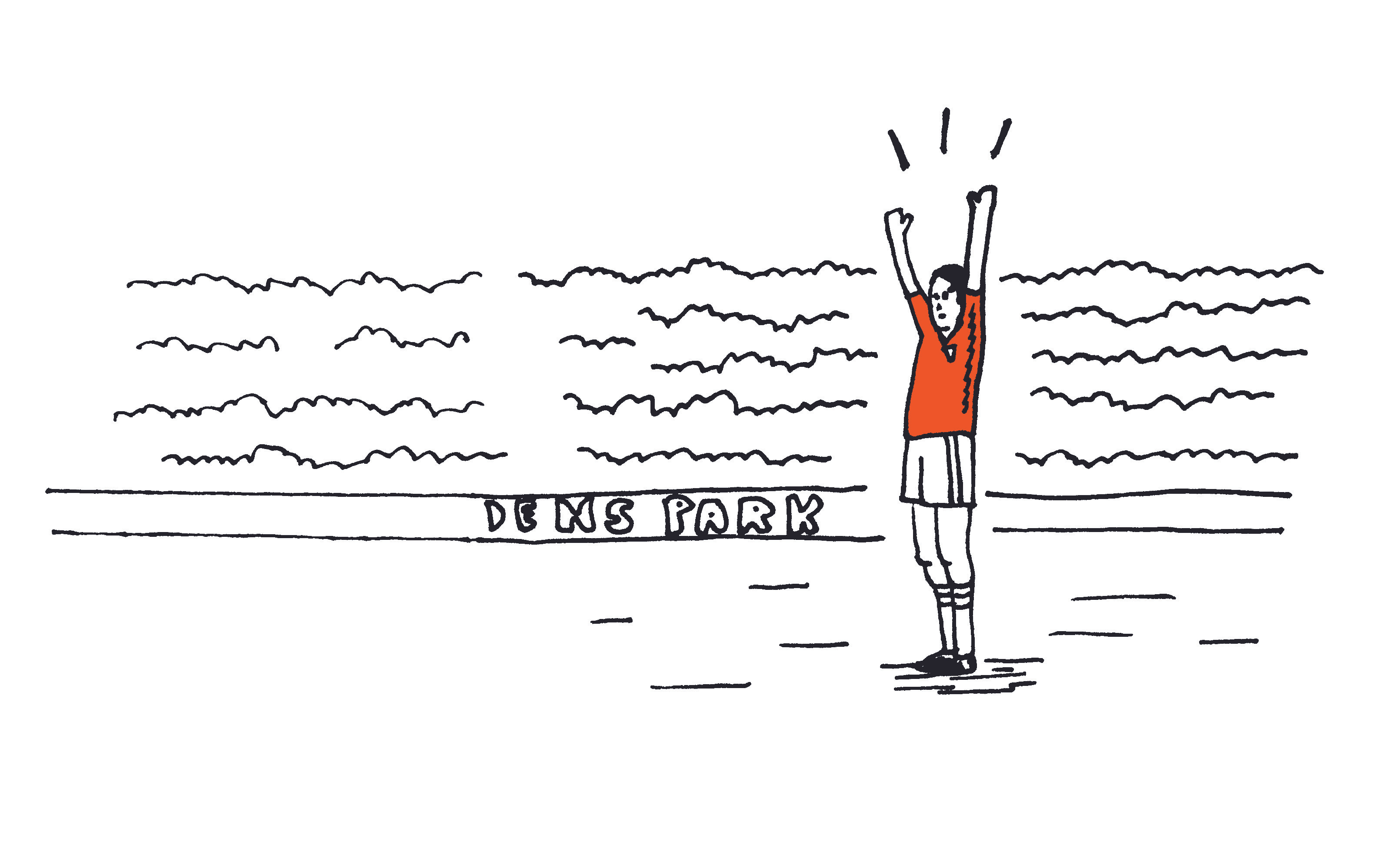
Narey plays the ball out of defence to Sturrock. He slides it on to Ralph, who barely looks at the ball as he glides across the rutted, end-of-season grass. He looks instead at the goal, and the positioning of Dundee’s goalie Colin Kelly. Thirty yards out, Ralph coils and flicks his left foot. The ball rises and rises as Kelly flaps hopelessly beneath it. Behind the goal, a penned mass of flesh and tangerine watch as, almost too late, the ball dips down into immortality and Jock Brown shouts “Absolutely unbelievable!”
As half of the ground erupts, Ralph lifts his arms, smiles and turns southwards. Then a thought flashes over his face and he turns to look at United’s fans in the main stand. He’s looking for a man who ran through the streets of the Douglas council estate to buy a carry-out because Jim McLean was on his way round. He’s looking for his Dad.