

By Stephen McGowan
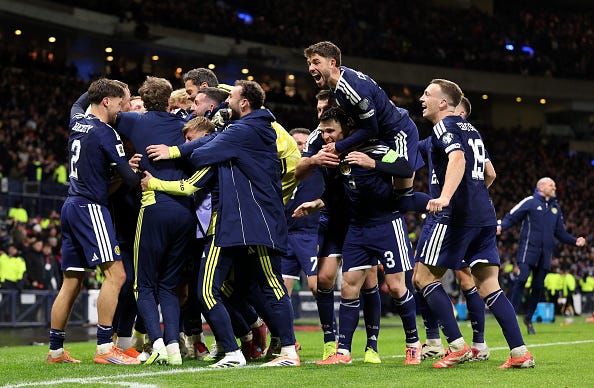
“Ultimately, life is about memories,” says Scottish FA president Mike Mulraney. “It’s about winding the clock back to the day you watched Kenny McLean score that goal against Denmark to take us to the World Cup.
“In ten years from now, maybe 15 or 20 or more, people will still remember that night when they came here to Hampden with their friends and their families in November.
“They won’t remember what they did the night before and they won’t remember the night after, but they will absolutely remember that night.”
In 2023, the UK Government staged a Westminster reception to mark the SFA’s 150th anniversary. When the speeches were done, the former chairman of Alloa was asked how he would like his time on Hampden’s sixth floor to be remembered in future and offered a one-word response. “Facilities.”
Pitching In was launched as an SFA campaign to raise £50million to invest in the game’s infrastructure by 2030. Thanks to Steve Clarke and his team reaching three of the last four major tournaments, the bar has now been raised to £100m.
Proceeds of the penalty shootout in Serbia in 2020 have been used to upgrade or replace changing rooms. Cash generated by qualification for Euro 2024 has been utilised to improve 3G pitches in areas of most need. Now the £9.5m coming from FIFA for reaching the World Cup finals can build new facilities for the Scotland internationals of the future.
Mulraney is hellbent on fixing the roof while the sun is shining because football’s natural cycle offers no guarantee of Scotland reaching World Cups in the future. Players like Andrew Robertson, Grant Hanley, Kenny McLean and John McGinn are aging and edging towards the end of their international careers.
A dearth of young Scots playing first-team football in the SPFL Premiership, meanwhile, hampers efforts by Clarke to bring through a new generation and, while improved facilities offer no guarantee of a quick solution, this much can be said with relative certainty. Without them, the task of improving the number of young Scottish footballers playing first-team football becomes impossible.
“We have made a difference by assisting 193 projects via the Pitching In initiative,” adds Mulraney. “And it’s growing.
“We are going to do more and we are going to do more and once we have done more, we will look at doing more again. It is never going to be enough because we need hundreds of millions.
“But we have already reached our Pitching In funding target of £50m by the end of 2030 and people told me that was impossible. At the SFA AGM I announced that, not only was that not impossible, but we have already blown through it in 2026 and the target has now been re-set to £100m.
“We want to see £100m invested into facilities across Scotland. New pitches, all-weather pitches, into changing rooms so that girls can feel safe.
“We have become the number-one sport in Scotland for women and girls for the first time ever this year. And we are going to build on that. And we can only build on it if we build places for them to play.”
The rest of this article is for paid subscribers only. Click here to support the best football writing in Scotland, plus you can order Nutmeg Magazine’s World Cup edition by clicking on the cover below.

The need for top-class facilities has not only been felt on home soil. Clarke and assistant Steven Naismith have made multiple trips to the United States to make sure that the World Cup base camps offer the players the best possible opportunity of making history by qualifying for the knock-out stages for the first time.
From the Florida Blue Training Centre in Fort Lauderdale to Charlotte FC’s 52,000-square-foot Atrium Health Performance Park, the governing body aim to give every player from Andrew Robertson and John McGinn to a seven-year-old in Kirkwall a chance to play the game within facilities bought and paid for by the World Cup dividend.
“We have left nothing to chance with the World Cup preparations,” says Mulraney, “but there is always something that catches you out.
“From testing the mattresses in the hotel rooms for the players to sleep on to figuring out what food we will take across for them to eat to how we are going to look after everyone going as best as we can. There are always limitations to what we can do as a national association, but we have tried to cover every base.
“That has put an enormous workload on the team upstairs. But we believe we have given it our best shot. There is nothing that we think we could have done that we did not have a real go at.”
The SFA is on the cusp of raking in over £9m to cover the World Cup overheads, but the Tartan Army must find their own way to pay for the eyewatering cost of a trip to America.
The morning after the 4-2 win over Denmark, supporters began plotting ways to make it to the United States, Canada or Mexico. Their enthusiasm waned slightly when they discovered the price of tickets, travel and accommodation.
Reports put the cost of the trip at an estimated £7500 per fan. While Providence, Rhode Island will witness the greatest influx of Scots on North American soil since the Darien Project, it’s difficult to predict precisely how many will journey over the Atlantic in the coming weeks.
“Our American friends have asked us how many will make the journey,” ponders Mulraney. “We can’t even make an estimate.
“We estimated that 50,000 might go to Germany and wondered if that might be ambitious. In the event, 200,000 went.
“So who knows? This is different because it’s a lot further away and one wonderful thing about it is that we will have fans who will already be in America or Canada. Maybe expat or second-generation Scots embedded in these nations who still feel in their heart and their soul that they are Scottish.
“They will be coming out and wishing us well, so for me I think it’s very difficult to put a figure on how many people might support Scotland in a World Cup in America.”
Even those unable to make the journey feel the anticipation building. Buy groceries at Marks and Spencer’s and they’ll thrust Scotland football stickers into your hand. Pub landlords are gearing up for late licensing hours to facilitate the 2am kick-off time for the opening game against Haiti and 11pm starts for the matches against Morocco and Brazil.
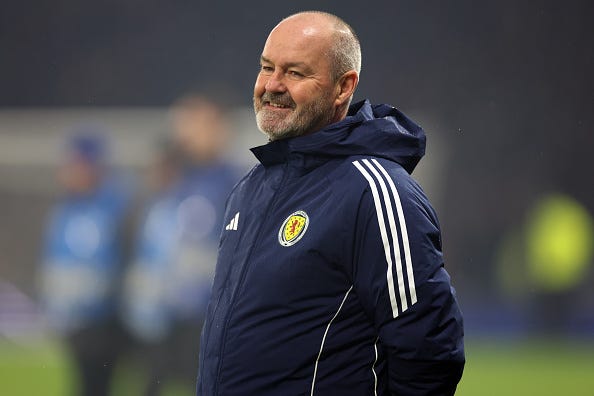
“It gives us a little bit of goodwill and critically it gives the nation a lift. I believe that everything becomes a lot harder when we don’t make it. It was the first thing I said to Stephen when we spoke about him becoming our manager.”
People are so used to hearing Clarke referred to as “Steve” that it takes a second to work out who Mulraney actually means when he speaks of “Stephen”.
“I said to Stephen, ‘Qualify for tournaments, that’s what I need you to do. I need you to qualify for tournaments.’
“The benefit of that to the Scottish Football Association and to every man, woman and child that pays attention to what’s happening, regardless of whether they come watch a game, watch it on telly or just read about it in the media, is self-evident. When Scotland qualify for tournaments, everybody feels a little bit better.”
How long the goodwill holds is contingent on results. People already speak of the first game against Haiti in terms of a cup final. Precedent shows that three points and a goal difference of minus one should be enough to secure a place in the last 32 as a best third-place finisher. Anything less than three points and the SFA’s ability to maximise and prolong the World Cup dividend will be tested to the full.
Every World Cup or Olympic Games leaves a legacy behind in terms of the memories it creates. The Barcelona Olympics transformed the city from an industrial, inward-facing municipality to a major international tourist attraction. London 2012 focused regeneration on projects like the stadium, which now houses West Ham United. While legacy is usually measured in terms of the impact an event has on host countries, Mulraney wants the upcoming World Cup to instigate positive spin-offs for Scottish football, while accepting that will only happen if the SFA maintain some forward momentum.
“I’ve been listening to people talking all my life about the legacies created by sporting events. Legacies are only legacies if you continue to ride the horse. If you understand that a snapshot in time only has value if you know how to use it to make an impact on a nation.
“So I think there will be a legacy as long as the SFA grasp the opportunity presented by this World Cup to keep driving forward.
“Ultimately, a legacy is about what you do next. Not what you did last.”