

By Stephen McGowan
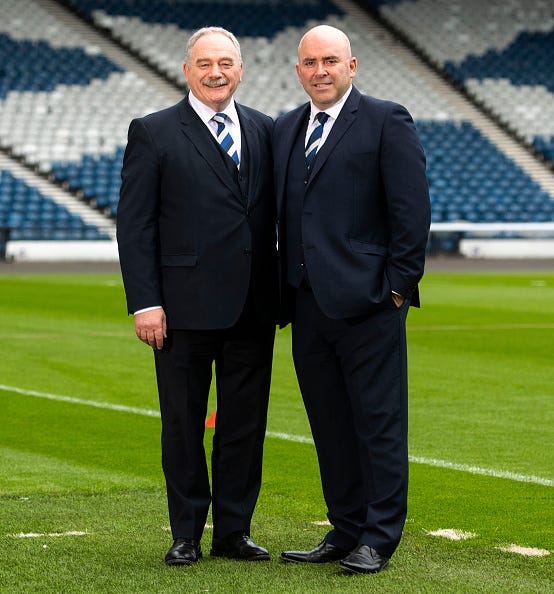
Mike Mulraney grew up in an era when world-class Scotland players made qualification for World Cup finals look easy. Seven years on Hampden’s sixth floor has schooled the current president of the SFA on just how difficult it can be.
“I still remember coming here when Kenny Dalglish scored against Spain,” he says, winding the clock back to November 1984 and the night when Scotland’s greatest player claimed the last of his 30 international goals in a World Cup qualifier.
Between 1974 and 1998 the national team qualified for six out of seven World Cups. When Dalglish thumped a thundering left-foot strike into the postage-stamp corner of the old wooden goalposts Mulraney was a teenager from Alloa, blithely making the same assumptions as everyone else.
“I thought that was what supporting Scotland would be like all the time,” he says with a shake of the head. “In time I learned that it was a little bit more challenging than that.”
A wealthy self-made man with extensive business interests, the former chairman of Alloa Athletic officially succeeded Rod Petrie as the 54th president of the SFA in the summer of 2023. Petrie’s long-standing health issues rendered Mulraney the de factor president long before that and, in 2019, he led the process which ended with the appointment of Steve Clarke.
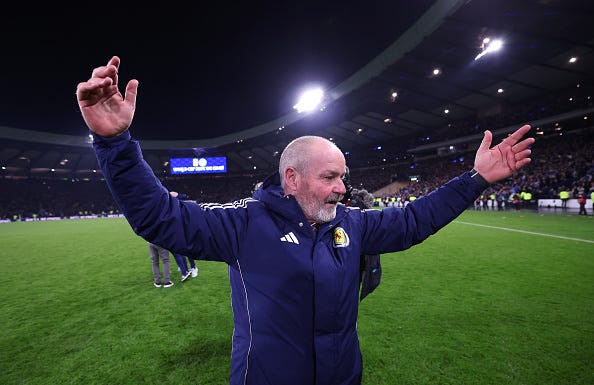
Clarke was handed the job of taking Scotland back to a major international tournament for the first time since since France 1998 and, in November 2020, he delivered on his remit. Leading Scotland to a Euro finals delayed by the impact of a worldwide pandemic, the timing could scarcely have been better. Facing a projected loss of £4.5million, the SFA had recently made 18 members of staff redundant. Their turnover had dropped to £27.7m — a 26.9% decrease on the 2019 figure.
“That was a challenging time,” admits Mulraney. “And it was a situation of its time as well.
“I certainly would never knock what previous presidents did or what their objectives might have been. But I made no bones about the fact that I was going to drive the economic model of the Scottish Football Association.
“We look at other sports around us and they are struggling a little bit. We determined that without funding nothing would work. So the whole team got on board, some new people came in and we have driven that model relentlessly.
“That has allowed other successes to come as well. We are very clear in our view that only by driving the financial model can we do all the other good things that need to happen to enhance the game. So the SFA is in a significantly different place.”
The importance of qualifying for major international tournaments can’t be overstated. Under Clarke, Scotland’s national team have now qualified for three of the last four major finals and, at the recent AGM, Mulraney announced a record turnover in excess of £80m. Trebling the turnover of six years ago, next year’s figure will be higher still once the proceeds of participation in the World Cup finals are factored in.
Payments for preparation support and group-stage participation mean the SFA will rake in around £9.3m from FIFA this summer. Chair of FIFA’s Finance Committee, Mulraney played an active role in the decision to increase prize money to nations by 15% at the recent annual congress in Vancouver, but takes the view that the payments matter less than the physical and mental benefits to the nation at large.
“We can put an enumerative value on reaching the World Cup and it’s not irrelevant,” he admits. “But it’s secondary to the real impact and the real impact is the emotional dividend and the dividend a successful qualification campaign brings us.”
Reports of an SFA windfall of £10m overlook the cost of going to a World Cup. While players earn no salary for playing for Scotland, the player bonus pool will gobble up a third of the cash. Another third will go towards travel and accommodation and the costs are substantial.
Premier League footballers expect Premier League standards. The pool of management, staff and players flew to Fort Lauderdale for a warm-weather training camp at the Florida Blue Training Centre. From there, they fly to New Jersey for a friendly game against Bolivia on Saturday. After that comes a settling-in period in Charlotte, North Carolina. The Queen City is equidistant between Boston and Miami, while the impressive Atrium Health Performance Park is home to Major League Soccer’s Charlotte FC and the Charlotte Academy. The 52,000-square-foot establishment houses approximately 200 employees and coaches, as well as players, and offers the best of facilities.
After that, the Scots fly to Foxborough to prepare for their opening game against Haiti, return to Charlotte for four days, fly back to Boston for the Morocco match, return to Charlotte then decamp to Miami to get ready for their final group game against Brazil. The nine flights already scheduled could increase in number if Scotland find a way through the group.
“Travel alone is massive,” says Mulraney. “I am glad for a number of reasons that we got the east coast. I’m glad from the point of view of travelling time for our fans, for us from a cost point of view.
“But even then, the basic fundamental costs of going to a World Cup are enormous. We have not been at one of these tournaments for a very long time. There is no one on the sixth floor of Hampden who has experienced a World Cup before.
“Going to Germany for the Euros was fantastic and the costs and the structures we had to put in place for that were significant. But this is a whole new learning curve. Not only are we having to learn about the totally different responsibilities and logistical challenges of a World Cup, we are also having to learn about the cost implications which are, quite frankly, formidable.”
The SFA find themselves in the strongest financial position in their history and the president is the first to acknowledge the interest that breeds. On top of a kit deal with Adidas, Barclays recently agreed to pay £2m a year for naming rights to Hampden and Scottish Cup sponsors Scottish Gas provide strong support at grassroots level. HALO are the association’s official technology partner, while Specsavers, JD Sports, Spar Scotland, M&S Food, Network Rail, Tennents and Matchworn Shirts are all keen to be part of the journey.
“Success brings success. We announced in 2024 that we had turned over £78m because of the Euros and at that time that was the highest turnover the Scottish FA had ever made by miles,” explains Mulraney.
“That was exceptional. Yet this year — without the benefit of an international competition — we beat that figure and made it to £80m. People thought that was impossible when we were turning over £27m four or five years ago. But that’s down to our national teams winning games. Our women’s team is doing well, but the particular revenue benefit comes from the men’s team reaching tournaments.
“That builds the whole model. People want to be associated with us because they believe we are successful. Not only on the pitch, but also off it where we are making a difference to people’s lives.
“We are making a difference through our after-school clubs; our sponsorship agreement with Scottish Gas means that 7000 kids are being fed during the school holidays. We have a relationship with Barclays as well and so many other commercial partners.
“These relationships run deep and they are making a difference to people’s lives.”
Like this high quality of writing? You’ll get much more of it in Nutmeg Magazine’s World Cup edition. Order your copy by clicking on the cover below.
