

This article was published in this month’s Nutmeg Magazine and is free for you to enjoy. However, most of our content is paid, such as monthly data breakdowns from Nick Harris, Adam Clery’s tactical analysis, Daniel Gray’s Slow Match Reports and Stephen McGowan’s investigations. Sign up for your Nutmeg Season Ticket to get 12 months full digital access PLUS a year’s subscription to the beautiful, 200-page print quarterly delivered straight to your door.
By Jonathan Northcroft
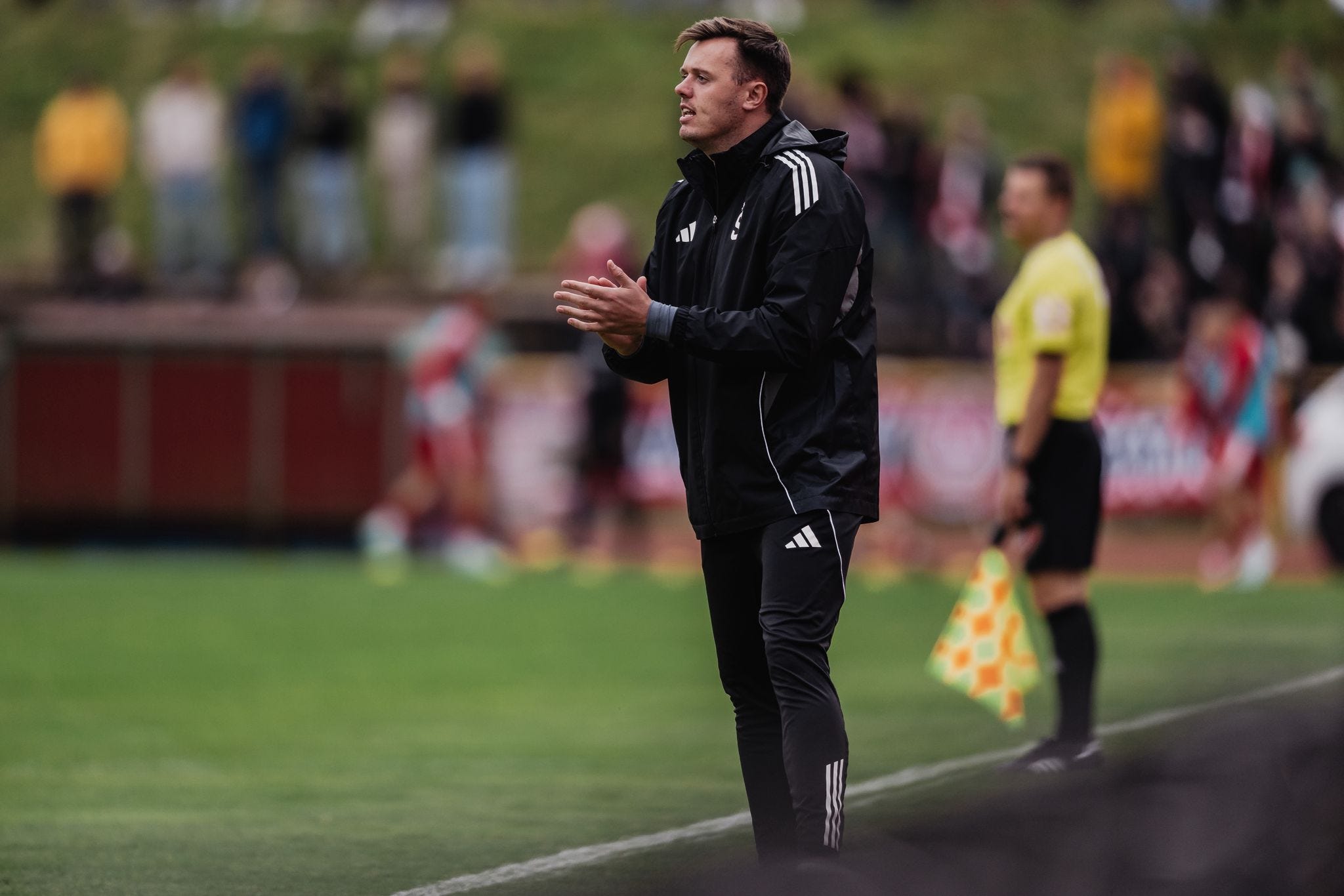
When we speak, he’s waiting in for an IKEA delivery. A sofa bed is arriving. In one sense, he’s just another young guy trying to furnish a new flat. But in another, Jack Wilson is very different. He’s a rising star in what is becoming an increasingly vital and high-profile role in football — and at 29 has already worked in the Premier League, international game and with superstars like Kevin De Bruyne. His apartment? It is in one of the world’s most gorgeous cities.
“Prague’s lovely,” Wilson says. “I moved out here in the summer when the weather was unbelievable but people say it’s beautiful even in the winter. Now it’s autumn, with leaves on the ground and dark afternoons, and the terrace in our flat looks out onto the city and you can see all the lights and the roofs. It’s really nice.”
Wilson is a long way from home village of St Monans in the East Neuk of Fife and tends to politely decline interviews. But for Nutmeg he agreed to unpack his journey, one that has taken him from training kids in Pittenweem to set-piece coach at Sparta Prague, via stop-offs like Manchester City, Brentford, the Northern Ireland national team — and Queen of the South.
Set-pieces have never seemed more important, so you are at the cutting edge in one of the biggest growth areas in the game. But how did you get here? Where did it start?
I played when I was younger, at a youth club in Pittenweem with my friends, but it was more just for socialising than anything. I knew I wasn’t amazing, I knew I wouldn’t play at a high level. I got to the age where I stopped because in the East Neuk football is not big in terms of grassroots clubs. It was more rugby so I played rugby and basketball in high school. But I still loved football and went to Dundee games with my dad, uncle and granddad — we were season-ticket holders. I was also going down to Liverpool matches with my dad and a supporters club from Ayr.
I was obsessed with the game really, got interested in coaching and went back to Pittenweem to coach the Under-15s on a Monday, Wednesday and Sunday. From there I got a paid coaching opportunity at AM Soccer up in Cupar.
Is that when you started thinking about a career in football?
Yeah, maybe it was in the later stages of high school. That time in your life when you need to decide what you want to do. I was looking at things like the football media — writing or working in radio — or the coaching side. At AM Soccer I coached the Under-11s and Under-14s and the seriousness and the level of coaching increased from Pittenweem — and you’re getting paid. So I went into the coaching side and have been in it since.
AM Soccer Club (a non-profit coaching programme) has some reputation, producing nearly 70 players for professional club academies since it started in 2006. And the founder was, of course, Austin MacPhee, Aston Villa’s set-piece coach. Did you know Austin before joining AM Soccer?
No, not at all. They had three full-time coaches: a director of coaching, a coach responsible for the teams and a coach responsible for the schools. Once every month or two we would do a CPD event with Austin and he would randomly pop up to your game on a Sunday morning at half nine when you’re not expecting him to watch, or he’d pop up at a training session and sometimes join in and help you.
The opportunity to work with Austin opened doors. For me, a big break was when he started working with Northern Ireland (as assistant coach to Michael O’Neill) and was looking for one or two of us to help him with analysis. From there, I started working part-time as an analyst with Queen of the South and then moved on to do it with Dundee United, then Hearts.
I was looking at the CV and thinking, when you’re an analyst for Queen of the South, what does that actually involve? It’s not full-time, is it?
No, it was 30 quid a week and I did it in my own time, but I really enjoyed it. I treated it — and the role with Dundee United — like my main job because I was so keen to get into analysis full-time. I was still coaching at AM Soccer and doing my university degree. On a Saturday morning I’d coach in Cupar until 12 o’clock then do something like drive all the way to Greenock to watch Morton against Livingston and create a report, then send it to all the coaches by Sunday night or Monday morning.
It was a really busy three years but I think it helped me understand how demanding football is. I probably learned a lot in a short space of time in comparison to other people. I knew the sacrifice I was making because I was making £200 a month from almost doing what I treated as a full-time job, but I enjoyed it.
What was your degree?
Sports Coaching and Development at Abertay University. I’d actually done two years at Elmwood College, getting an HNC and HND, which was good because it was in Cupar and I could do more coaching with AM Soccer. Then in my third year I went to Abertay for the honours part of the course. I put together a dissertation proposal on the impact of training analysis upon improving player development but then I got an offer to join Ian Cathro and Austin at Hearts and decided to go for it instead of doing my fourth year.
I enjoyed being in higher education though, because before me and my brother, nobody in our family had taken a degree. We have our own family business in the East Neuk and everyone has tended to go into it.
What’s the business?
G&J Wilson Fish Merchants in St Monans. It’s run by my mum and dad and has won national awards. It was voted best in Fife and Scotland in 2020.
I got the option to join my dad in the business or to go and get my degree and I chose my degree; but when I was younger, I’d get home from high school and be in the fish sheds, 4-8pm, cleaning trays or doing the orders for the fish vans with my dad. I enjoyed it but as I got older, I was, like, this isn’t for me. It wasn’t for my brother either so we kind of went in different directions.
At Hearts you were working with two very distinctive figures in Scottish coaching, in Ian and Austin. What did you learn from that environment?
They went in, I think, in December (of the 2016-17 season) and from around March I was involved on game days. I’d film a game, clip it, and give it to the coaches after — and then from the summer I went full-time. I had 10 days in hospital and missed the Scottish League Cup group campaign, except the last game — and the day after, Ian was sacked.
But it was great to be around two such modern coaches. I think at that time, in Scotland, it was difficult for fans to accept something so new but I love Scottish football and understand it. I understand fans, what they want, what style of play they like.
I haven’t spoken to Ian that much since then but he’s had an amazing career and I was grateful for the opportunity. I stayed another two seasons at Hearts after he left and learned and developed a lot.
Your next job was at Brentford, an absolute flagship club in terms of doing things differently, a great environment for coaches and football staff. How did that come about and what was that part of the journey like?
I left Hearts during Covid and moved home to Fife after three years in Edinburgh but I was still working with Northern Ireland as senior analyst and then a job came up at Brentford. I applied and from my experience of working with Austin and doing set-pieces with Hearts and Northern Ireland, I had quite good knowledge for the role — which was as set-piece analyst. I was offered the job on the Monday and drove to London on the Friday and that was me for an incredible two and a half seasons.
Thomas Frank was the manager and I worked closely with Bernardo Cueva, who was both the assistant manager and the set-piece coach. He’s now at Chelsea. It opened my eyes to the key details of set-pieces and was on a different level to what we’d done in Scotland because Brentford have a massive focus on set-plays. They see the importance of them and it helped me massively in terms of my role now, in understanding when you train set-pieces, how you train them, when to speak to the players. How you need to create a culture where the players understand how important they are — which I feel we’ve created really well so far at Sparta.
Actually, Brentford didn’t do too well with set-pieces in the Championship. We did really well defensively, conceding only five or six goals in 46 games, which was remarkable, but offensively we only scored about 13 or 14. We scored from maybe only one long throw. It’s because in the Championship every team had a long throw and could defend against it.
But as soon as we came into the Premier League, everyone was like, wow, Brentford are amazing at set-pieces. I don’t know if that was because no team in the Premier League had emphasised them like we did, or teams just didn’t know how to defend or adapt to what Brentford were doing.
But Brentford are probably not the pioneers — that would be Midtjylland and there are strong links between the clubs through (owner) Matthew Benham. The manager here at Sparta, Brian Priske, was previously manager at Midtjylland and did set-piece coaching in his first role with the club. So he understands how important they are.
As you say, Midtjylland and Brentford have led the way in set-pieces and produced some coaches who have become legendary names in the set-piece world…
Yeah, well the success Midtjylland had with set-pieces fed into Brentford who brought in Gianni Vio (a former banker from Venice dubbed ‘the father of set-piece coaching’) who went on to be Italy’s set-piece coach when they won Euro 2020. Then Brentford had Nico Jover (the guru behind Arsenal’s record breaking set-piece success), Andreas Georgson (now Tottenham set-piece coach) and Bernardo.
Austin was at Midtjylland and I moved on to Manchester City. The analyst who replaced me is now set-piece coach at New England Revolution. And of course, Keith Andrews (now Brentford manager) was doing set-pieces for them last year.
So what was the ethos? You say you learned a lot culturally at Brentford. How should a club approach things if they want to be powerhouses at set-pieces?
I think it is just making the players understand and recognise that games can be won or lost because of a set-piece. Of course, you want to win every game 3-0 playing amazing football but in reality, a lot of games in the Premier League, and other leagues, are so tight that they’re decided by a single goal — which could easily come from a corner, throw or free-kick. I read an article from Tony Pulis reflecting on how 10-15 years ago he was doing something that is now trending, yet back in the day he was called a dinosaur and people were negative. Set-pieces have always been a big part of football. Manchester United won the 1999 Champions League final by scoring from two corners in the last three minutes.
I think everyone needs to recognise the importance because if you narrow down the game, 33% is in possession, 33% is out of possession and 33% is set-pieces. Will they ever get to the level of (their importance in) NFL? Probably not. But how much you can use your strengths to exploit the weaknesses of the opposition (at a restart), and how much you can stop their strengths is crucial.
But are set-pieces now more important than ever? The game is becoming ever more athletic, intense and tactically drilled so it seems scoring in open play has never been harder.
Yeah, I think football is a lot harder now. The game has changed and will continue to change. It’s so complex. You can go into a match with a set-piece game plan, but you know the opposition are going to be looking at what you’re doing and have ways of defending against it. You might not be able to use that game plan after the first corner so you need to be on your toes and prepared to change straight away.
When I was at City and we came up against Austin at Villa, I didn’t know what to recommend because I know the guy really well. And I’d say, “If we do this, he’s going to do that. If we do that, he’s going to do this.” It becomes like a chess game, almost.
That’s interesting because set-pieces are seen as something mechanical but the way you’re talking makes me think set-piece coaches actually have to be creative and spontaneous.
Yes, I think it depends on what you do within a game and what the head coach wants. What players do you have?
Arsenal have Declan Rice, Buyako Saka and Gabriel Magalhaes. Two unbelievable takers and a monster in the box. They can go front post or back post, they’re that good. You might defend nine out of 10 corners against them amazingly well but they’ll score the tenth. Everyone will block and creates space for Gabriel to score, or he’ll make first contact and someone else will then score the second ball.
Then you look at Liverpool when Jurgen Klopp was manager. They had Trent Alexander-Arnold on the right, Andy Robertson on the left, and Virgil van Dijk in the box. And they went out-swing with their deliveries every time, they never went in-swing. It was always out-swing to Van Dijk, players blocked and Van Dijk would score. I think he averaged three first-contact goals a season, which is high.
So that is two clear strategies from head coach or set-piece coach. Arsenal change, Klopp’s Liverpool never did and both were successful. At a smaller team where you might not get a lot of set-pieces, maybe it works to be innovative. At Brentford if we were playing Man City away, we might need to do deep free-kicks to get into the attacking third and cause chaos, or use long throws because we wouldn’t get many corners. And it would mean we were slowing the game down — which a team who likes possession, like City, doesn’t want.
One example was when Brentford beat Man Utd 4-0 at home. For our third goal we had a free-kick, it came back out, we won another free-kick, then it went out for a corner and we scored the corner. There were three set-pieces in a row which added up to us scoring and it comes back to the culture and doing the game plan effectively. It might not be the first (set-piece) you score from, it might not be the second, it could be the third. You just need to keep believing and not get frustrated, stay disciplined. When I was with City we played Spurs away in the FA Cup. We did ten corners exactly the same and scored from the tenth.
In terms of what makes a good set-piece, I guess it’s pretty clear, isn’t it? It’s delivery and it’s first contact. Would that be about right?
Yeah, I think the most important thing is the delivery. You can think of any creative routine or standard routine you want, but if you don’t have a player to put the ball where you want, five times out of six, there’s no point doing it.
That brings us to free-kicks and ball striking generally. Which players do you admire, past and present?
Obviously, one from the past would be David Beckham, with his free-kicks and corners. But I was blessed to work with De Bruyne, with his incredible ability at dead balls.
Saka and Rice are unbelievable in terms of their technique, how consistent they are and I think it’s such a skill, maybe one that players still don’t appreciate enough. Because you’re helping the team to score goals and in an era where we really do judge players on stats, it gives you the opportunity to add five or six assists a season. That might allow you to push for a new contract or your club to ask for more money (when you’re transferred). But most of all you’re helping your club win games. I think, for a player, practicing set-pieces is such a small investment for what you can get out of it.
What was De Bruyne like to work with?
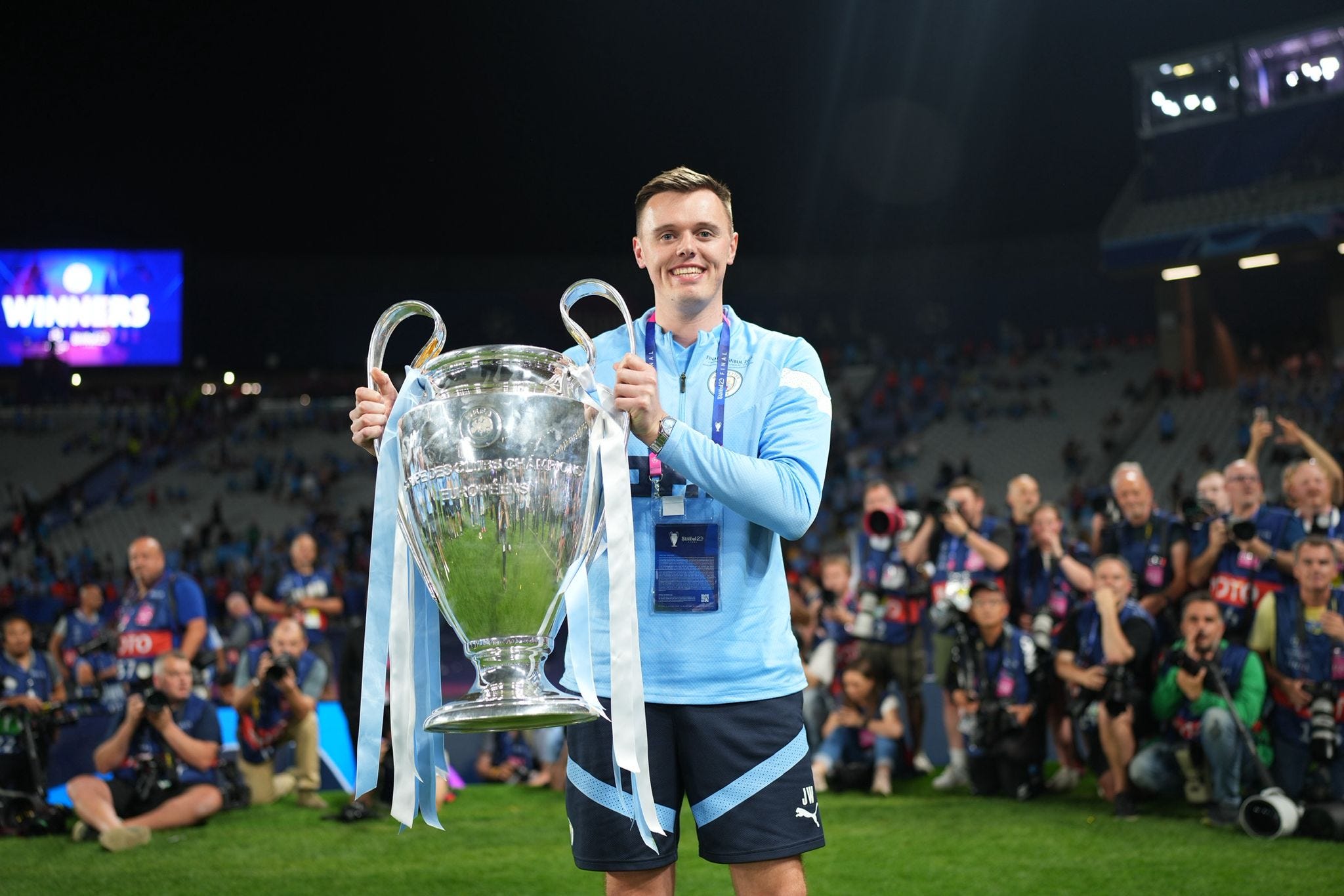
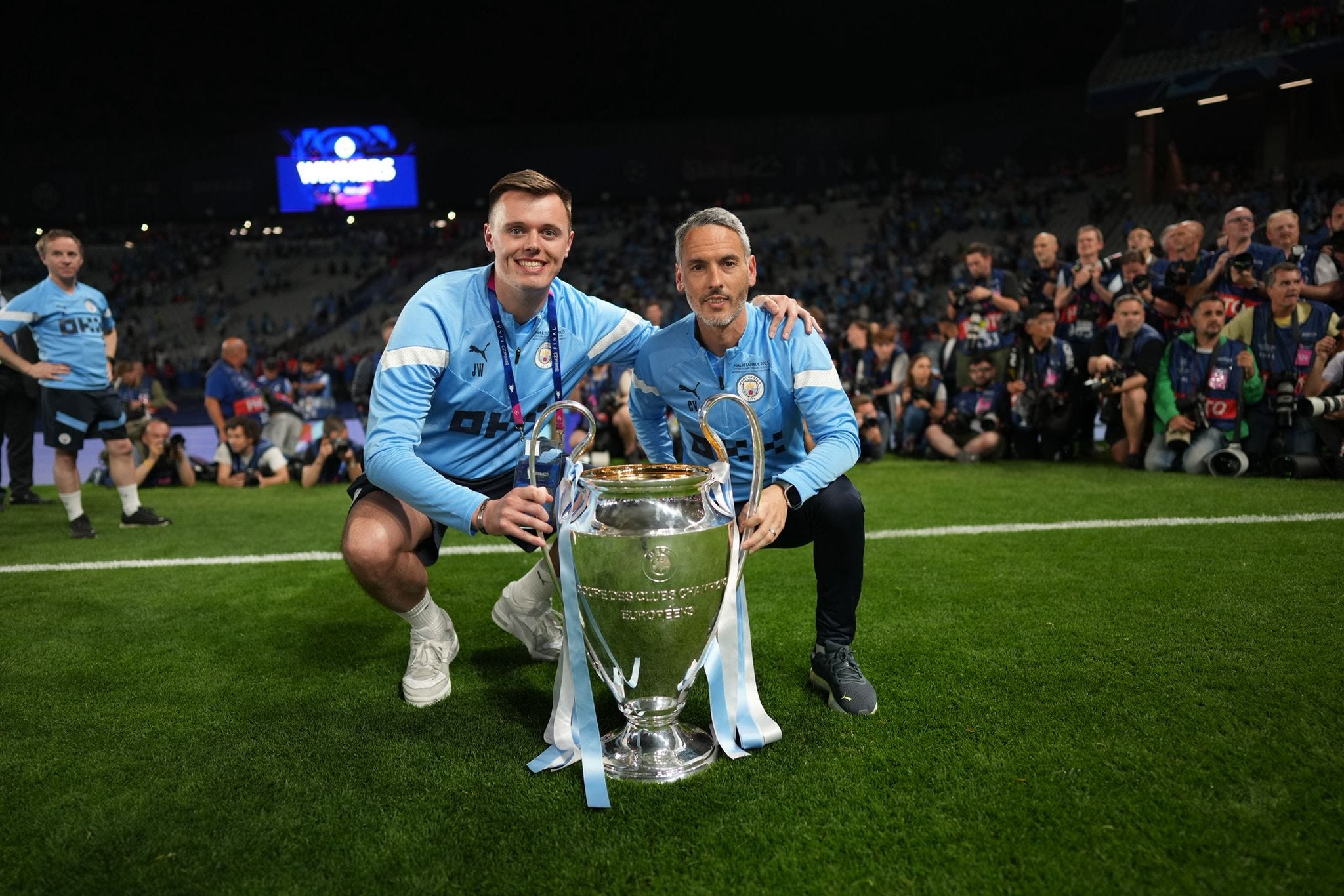
Really good. Extremely disciplined. Carlos Vicens was our set-piece coach and I was analyst. We worked together with Kevin a lot. His ability is incredible. You might remember the corner against Liverpool where John Stones scored at the near post — De Bruyne didn’t even train that. The day before, it was Julian Alvarez (on corners) but De Bruyne just had the ability to execute it, without practice. By the way, Alvarez produced a goal for Atletico Madrid with that same corner two weeks ago.
What about the great Scottish free-kick takers?
Well, the one every Scotland fan will remember is Leigh Griffiths against England, two free-kicks, one on either side. It was unbelievable. Unfortunately, we didn’t win the game. Griffiths scored a couple of free-kicks playing for Dundee as well. I’ll give you another great Dundee set-piece taker — Gary Harkins.
I like it. Niche. You could have said Gordon Strachan of course, who went on to take the best free-kick in the history of the game — v Bayern Munich, for Aberdeen… Your job now: as a young trailblazing Scottish coach, what’s the opportunity in terms of career development?
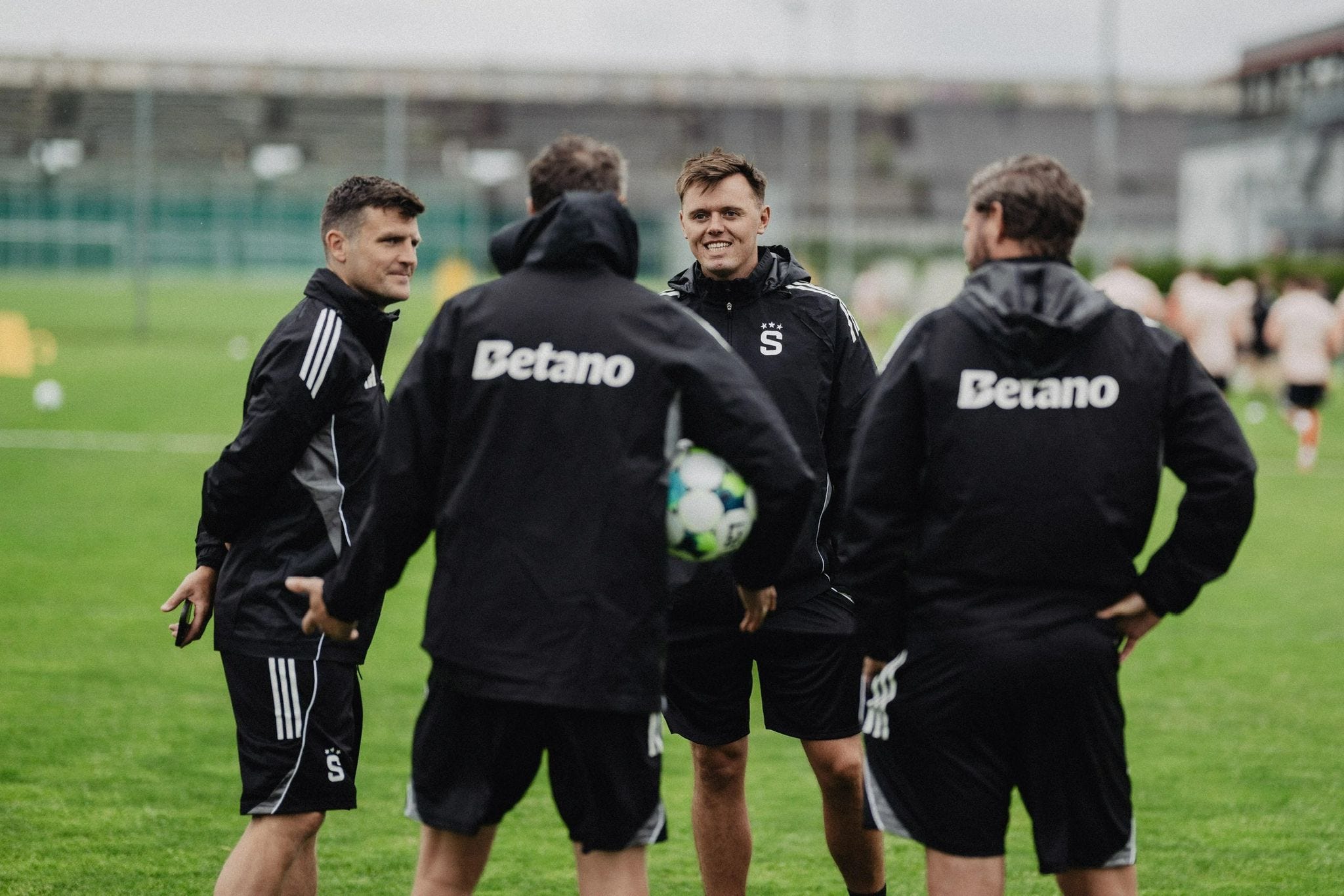
I’m enjoying Sparta immensely. I’ve only been here for a few months, but loved every minute. It’s important for set-piece coaches to be at a club for a period of time to implement your methodology and get to a certain level of consistency in what you do but so far, we’ve been really good in terms of attacking and defending set-pieces. We’ve scored the most in the league and conceded just once. That said, set-pieces are just one piece of the puzzle, and they have to be judged alongside our overall performances and where the club is at.
There’s great culture at the club where everyone understands the importance of set-pieces and what really helps is Brian’s experience with Midtjylland, and how he emphasises them. I want to create an impact at a club over the long term and my girlfriend is moving here in December, so I’m just really enjoying myself and looking forward to spending however long we are here for and just seeing what the future involves.
Thinking back to where it started for you, do you see it as a great stroke of luck you encountered Austin at such an early stage — who in Scottish terms has been a bit of a coaching pioneer?
Yes. Though I got to the Premier League before him… I always joke with him about that.
But yeah, he’s your role model, I would say he’s a mentor and not just to me but Ross (Grant) the set-piece coach at Hearts, who I worked with at AM Soccer. Also the set-piece coach now at Real Sociedad (Jose Rodriguez) who was his analyst at Villa.
I wouldn’t say there’s a community as such, but you always look out for set-pieces of clubs with set-piece coaches. You see what they’re doing, why they’re doing that. You’re always sharing ideas, communicating on WhatsApp or phone calls and I would definitely say Austin is someone who has been a great influence. If at any point in my career, I can assist and help people or inspire them, I would love that.
Did I think I’d be sitting here 10 years later (after AM Soccer)? Definitely not. Did I think I would achieve what I achieved at City or Brentford? No chance. I’ve been extremely lucky, but I worked extremely hard for it with Queen of South and Dundee United.
You always look up to different coaches and with Thomas, with Pep, Michael O’Neill, Ian Baraclough, Brian, I’ve worked with a lot of top coaches I take ideas and inspiration from.
Do you see yourself staying in set-piece coaching or evolving towards being a head coach at some point?
I have no idea. I’m not looking that far. Of course I have ambitions. Open-play coaching is where I started and if you’re a set-piece coach, you can’t just know set-pieces. You need to understand open play. You need to know your team’s style of play, profile of players, possession principles, training methodology.
If I was to go down that route eventually, I don’t think it’s something I would say no to. But at the moment, I’m focused on being the best I can be and helping Sparta be the best they can be.