

Leanne Ross has smashed records not just at Glasgow City, but across women’s football in Scotland, both on and off the pitch.
The 44-year-old captained City for seven years and scored 264 goals, making her the club’s (and the SWPL’s) highest-ever goalscorer. In the 2022/23 season, her debut year as head coach at Glasgow, she became the first female manager ever to win an SWPL title. She and her backroom team have built a formidable squad that is currently sitting third in the table.
Nutmeg caught up with Ross to talk about her career, her methods and what it takes to build the next generation of Glasgow City legends.
Tell me about your career up until you joined Glasgow City?
I probably never got involved in girls’ football until I was 16. I played for my local club, which at that point was Falkirk girls. Played one season there, quite successfully, scoring loads of goals. Then I got picked up by another local team, Stirling Albion, and that’s when I came into the senior women’s game, and I played there for about 10 years. It was Stirling Albion, Newburgh, Dundee — it was all the one club just changing their name. Then I got picked up at the national team. I must have been 24 or 25 at that point. I decided that if I wanted to retain my place within the national team, I had to play at a higher level.
Glasgow City had been trying to sign me for a few years. So, this is where I ended up. I played 14 years as a player here, before stepping into coaching.
How did you come to join City?
Peter Caulfield was the manager, and I’d get the phone call in the summer, “How about joining City?” And I’d try and avoid it. I felt at that time it was a huge commitment. But when the national team came along, I actually contacted Peter and he jumped at the chance to sign me, and the rest is history.
What was it about City that made you think you’d be a better player there?
They had good players. It was always tough playing against them. They started to challenge for trophies, so that’s where I wanted to be. I wanted to become better. There was no better place to be than somewhere where there were national team players playing, and I was going to have to fight for my place every week.
I just fell in love with the place and how competitive it was.
You were captain and now you’re manager. How did you transition?
Regardless of whether I was captain or not, I was always vocal in the pitch, always organising, and people were always telling me that I was destined to coach.
I was a student of the game. I would be analysing things as I was watching. I was always interested in the tactical side of the game. I was involved in coaching through my day job as well, albeit at a lower level, but it’s always something that I’ve done. The opportunity to stay here and be at a club that I loved and was really invested in was just a dream come true.


Do you miss anything about being a player?
Just not having the opportunity to be the one that goes and grabs the game by the scruff of the neck. It’s more my job now to motivate others to go and be that player that does that.
What’s the first thing that speaks to you about a player?
First and foremost, we ask — what types of players do we need? What type of football do we want to play? And try and match that up in a positional framework.
I’ve got then a team of people that are scouring the world for players that fit the profile. Once we find that shortlist, I start to look at those players, and we do a bit more investigating in terms of personality, what type of person they are, what they would bring to the team. We maybe find out that their personality doesn’t fit what we’re looking for. Our network of senior players, or previous players, comes into play as well. From there, we have that face-to-face discussion with the player as to what we look for and what we think they can bring to this environment. Obviously, we try and sell the club to them as well.
What type of personality are you looking for?
Somebody that needs to be a winner. They are all in for the team — it’s not about them as individuals. Also what they bring personality-wise to the team is important, because they spend a lot of time together off the pitch.
Do you ever look for specialists, or do you want people to be flexible in your team?
It’s always good to have somebody that’s an expert within their position, or they excel within the position, but we’ve had success with recruiting players that are flexible, that are able to play different positions, and that gives us a bit of flexibility tactically with changing personnel as well as within games.
Give some examples of City players who have developed significantly at the club.
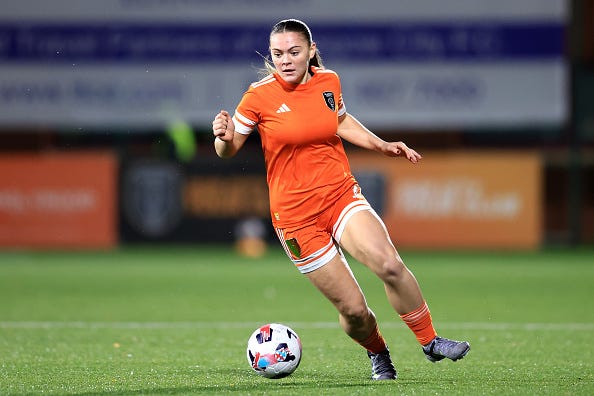
Lisa Evans came in really young with raw talent. She’ll talk about her first spell at the club in terms of how competitive it was here and how the senior players pushed her to be better. Also players like Erin Cuthbert — when you listen to her talking about her time here, it’s similar. We’ve played a part in their development. The best examples are probably the younger players that are coming through now, like Lisa Forrest. The progression that she’s made in the few seasons that she’s been a senior pro is great to see. The sky’s the limit, and I hope we can keep a hold of her for as long as possible.
Have you ever backed a player who the rest of the coaching staff didn’t rate?
The scouting team will look for players that have the attributes I like. The players they bring, I don’t always agree that they’ll fit in, or that they are the types of players we’re looking for, but I don’t necessarily think there’s ever been a time when somebody said somebody’s great, and I’ve thought that they’ve not been, or vice versa. There’s maybe been a slight difference in opinion, but I think we’re generally on the same page.
How do you help players develop their own unique identities on the pitch, while still meeting your high standards and your vision for the team?
We talk about our basic principles within every training session, in game plan meetings, and within game reviews. We always want to stick to our identity, our principles, but within that, the players need to bring their own individual qualities. We don’t want to be too prescriptive in terms of the way that we want to play. We want to give them the freedom to be creative, especially in the final third of the pitch.
How has being a former player influenced your managerial approach?
I like to think I can be in a player’s head in terms of what they’re thinking or feeling at certain times — I know where the pressure’s coming from. I can understand the decisions that they have to make in those moments on the pitch. As a player, I feel I always thought tactically anyway. I probably had the coaching hat on when I was playing, which helped the transition in that sense. I like to encourage the players to do the same. Just become students of the game, learn about different positions, different tactics, different formations, and I think the more you can add to your game through that type of education, the better the player you can be.
What behaviour do you expect from a player to be the best they can be?
Just everything that you’d expect of a professional athlete in terms of taking care of their lifestyle — making sure that they’re getting enough rest, the right nutrition, surrounding themselves with the right people and leading the right type of lifestyle. It’s making sure that when they come into the building they’re 100% ready to go for training.
Also, that they’re tuned into the analysis and buy into the other resources that we can provide, for example nutritional advice. We do a lot on the psychological support within the game as well. All the different aspects that are really important for the game, they’re all available here at the club in terms of the resources that we have. But once the player leaves the building, there is a huge expectation that that lifestyle and those types of habits carry on.
How do you balance celebrating wins with maintaining focus for the challenges ahead?
I won so much (as a player), but I probably never enjoyed it as much as I should have, probably not until the end of my career. So, the last time we won the league, a couple of seasons back, I made a point of ensuring that the players did celebrate it as much as they wanted to. It was a massive achievement, but it was done at the right time.
It’s really difficult in season when you win a big, important game, you kind of then go off celebrating and stay in that moment when you’ve got the next game to prepare for maybe two or three days down the line. We need to, very quickly, yes, celebrate the achievement and all that comes with that. But it’s on to the next one, because the next one’s the most important one.
If a Glasgow City player came along who was poised to break some of your records, how would you feel?
I would drop them — they’d never play again [laughter]. It’s about the team, but personal accolades are important as well. I think that you need to celebrate success of people, and you need to support them.
And listen, if somebody comes and takes my goalscoring record, then that’s good for me and my job right now.
How do you work with different personalities within the team?
We’ve got really quiet players, we’ve got players that are the centre of attention every day. They all come in here under the same guidance, the same rules and boundaries, and they all understand what those boundaries are and the expectations around them.
But the dressing room is a safe space. We don’t like to try and suppress anybody’s personality if they are loud. You sometimes need it in a dressing room to create that atmosphere and get the motivation going.
How do you keep that feelgood factor going if, for example, two players are competing for the same spot in the team?
It can happen. It’s a very competitive environment, and the players want to play, so they need to improve within games or training sessions to show that they deserve the jersey and to keep that jersey. So, training sessions become really competitive. There is always that challenge there to go and push that player and for you to take that jersey.
How do you feel about the team going forward for the rest of the season?
I’m pretty confident in terms of the squad that we have. We understood that it was going to become more challenging towards the end of the season in terms of the calibre of games that we have, and just the intensity of them and the frequency of them. We made a conscious effort to improve the depth in the squad, bring in some quality players as well that can come in and challenge for places.
I think that can only be good for us, because that competition then drives everybody on.
Like this high quality of writing? You’ll get much more of it in the latest Nutmeg Magazine — our World Cup edition. Order your copy by clicking on the cover below.
