

It is a decade since issue one of Nutmeg dropped from letterboxes across the land. When we launched, we had no idea how long the magazine would last. Print, went the consensus, was yesterday’s news.
Over 1,500 articles and hundreds of photographs and illustrations later, we’re still here. To celebrate, over the coming weeks we’ll be publishing some of our favourite pieces for your delight.
And if you’ve not sampled Nutmeg in print yet, please do give us a try — there’s nothing quite like the escape that pages can bring.
This article first appeared in Issue 6 which was published in December 2017. To find out more about the print magazine and subscriptions, hit the button.👇
By Alan Pattullo
Every so often, around twice a decade or so, I find myself plucking Fever Pitch from the shelf, normally finishing Nick Hornby’s fan’s memoir in a single sitting. A most recent re-reading, unintentionally timed to coincide with the 25th anniversary of its 1992 publication, reminded me of the author’s cruelty towards Ian Ure. And I say reminded because I recall being perplexed, as well as slightly miffed, at this treatment when first devouring the book a quarter of a century ago.
Statuesque, flaxen-haired and a regular attendee at club functions, Ure is someone I happily associate with Dundee’s glory years. He would automatically be named were a greatest-ever Dens Park side to be selected. Indeed, he already has been. When Jim Hendry wrote Dundee Greats, published in 1991, Ure was one of ten players included. The chapter detailing Ure’s achievements makes clear what an impact he had at Dundee. He was a bouncy haired Colossus in the heart of the defence as the Dens Park side won the Scottish title in 1961-62 and then reached the semi-final of the European Cup the following season, going down 5-2 on aggregate to eventual champions AC Milan.
Since it was the first readily available book I knew of about the club, I raced through Hendry’s tome (Ure’s own memoir, Ure’s Truly, was, even then, long out of print). When Dundee Greats came out, Dundee were playing the likes of Montrose and Stirling Albion in Scottish football’s second tier. So it’s hardly surprising I was agog at such tales as Ure helping resist surge after surge of Cologne attacks in a European Cup preliminary-round tie in Germany. Dundee, with goalkeeper Bert Slater deployed out on the wing after suffering concussion, were fighting to defend an 8-1 first-leg lead against the German champions and tournament favourites, and defend it they did, losing 4-0 in trying circumstances, before going on to beat Sporting Lisbon and Anderlecht.
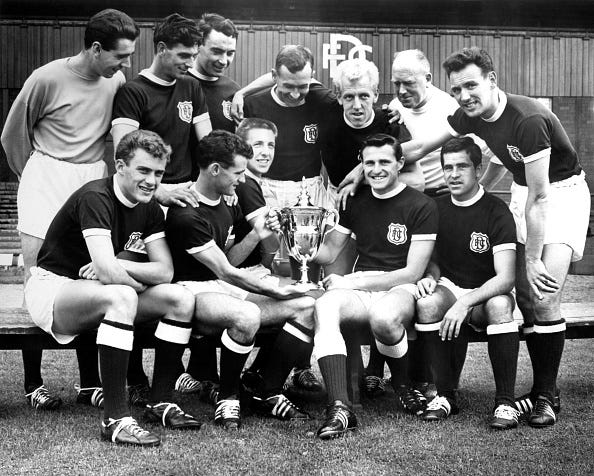
Ure’s legendary status was only enhanced in my mind when I learned where he had gone after Dundee: to Arsenal and then Manchester United. Not only this, but when he left Dundee for Highbury it was for a world-record transfer fee for a centre-half. Then, when the time came to head to Old Trafford, this too broke the world-record fee at the time for a centre-half.
So you can imagine my confusion when, only a few months after being properly introduced to Ure through Hendry’s book, I read Fever Pitch, succinctly summed up by Irish writer Roddy Doyle in a review as “funny, wise and true”. If it was so true, if it was so wise, then how was I supposed to deal with the conflicting portrayal of Ure as a hapless scuffer, one who, Hornby seems to suggest, was indirectly responsible for the author’s stint in therapy when he was in his thirties.
It’s not even as if Hornby makes mere passing, critical mention of the defender. He’s there in the first section, as the author reminisces about his formative days following Arsenal, and he’s there, unbelievably, in the very last sentence as Hornby signs off what is an otherwise enjoyable and deservedly acclaimed memoir with another kick in the goolies for Ure. Describing Arsenal returning to their old, inept ways the season after winning the league title in the final seconds against Liverpool at Anfield in 1989, Hornby muses that all that was missing was “Ian Ure falling over his feet and my dad grumbling away in the seat next to me.”
It’s a surprise to imagine Hornby at such a crucial, exhilarating moment as composing the last line of a work that would go on to win the inaugural William Hill sports book award being compelled to have another go at Ure. It’s not as if he hadn’t already administered something of a kicking. In the edition I have to hand now, purchased in the three years since Hornby’s work was upgraded to a Penguin Modern Classic, Ure’s first mention comes on page 14, when it is stated as if a matter of record that he was “famous only for being hilariously useless”. Ain’t so at Dens Park, Nick.
Hornby does concede that Ure, who was brighter than your average footballer, shone when appearing on Quiz Ball, a television panel show where players from clubs such as Arsenal were pitched against those from other teams. But then a few paragraphs further down comes another punch in the stomach. Making brief mention of the playground phenomenon of Soccer Star stickers, Hornby remembers swapping Ure for Geoff Hurst, scorer of a hat-trick when England won the World Cup. “Extraordinarily,” he writes, “the stickers were of equal value.”
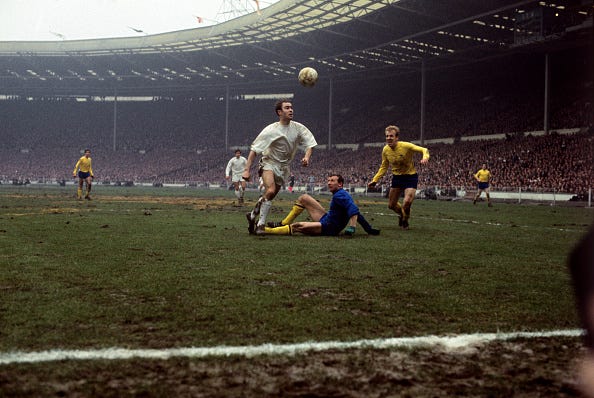
Four pages later, Ure’s part in Third Division Swindon’s opener in their famous 1969 League Cup final victory over Arsenal at Wembley is discussed. Writes Hornby: “The goal was one of the most calamitously stupid ever given away by a team of professionals; an inept back-pass (by Ian Ure, naturally), followed by a missed tackle, followed by a goalkeeper (Bob Wilson) slipping over in the mud and allowing the ball to trickle over the line just inside the right-hand post.”
Ure then appears to slip Hornby’s mind for a dozen or so pages before, in a passage explaining how television coverage of the 1970 World Cup suddenly opened people’s eyes to Pele’s quality, the author sneeringly notes that “people of my age and a good few years older knew more about Ian Ure than they did about the greatest player in the world”.
Okay, so four or five derogatory mentions in a book that is more than 200 pages long does not constitute a witch-hunt. Nor can it detract from a seminal work that has sold well over a million copies, been deemed a modern classic and also made into a film.
But that’s cold comfort for Ure, who once calculated that, in his entire 16 years as a professional footballer, he earned what John Terry did between Monday and Wednesday in any given week towards the end at Chelsea — around £60,000. It’s also cold comfort for Ure’s two daughters, who, it transpires, leapt to protect their father’s reputation a few years ago in that very modern way — by leaving comments online, at the end of an article on the Arsenal Collective, a fans’ website. The author of the piece in question — entitled In Defence of Ian Ure, published in November 2011 — was not a remorseful Hornby, plagued by decades’ worth of guilt. He, instead, has gone on to greater things.
Rather, it was another Arsenal supporter, Dave Warriston, who penned this latest piece. His intentions appear laudable: he genuinely seems to want to rescue Ure’s reputation in the eyes of Arsenal fans. But if this constitutes a defence then I’d hate to be the subject of one of his hatchet jobs. He accepts the critical acclaim Ure accrued in Scotland with Dundee but claims the defender lacked footballing nous, something Jack Charlton, one of his centre-half peers, “had in spades”.
Ure, Warriston adds, was found wanting against quicker, more skilful English strikers. He also questions whether Ure, who attended the rugby-playing Ayr Academy, was ever truly part of the dressing room culture of the day — a ridiculous suggestion, since Ure, in the view of those I’ve spoken to who played with him, was the epitome of a clubbable teammate, and was invariably first at the bar after games.
Warriston argues that Ure might have been better served staying in Scotland and joining Rangers. This is not an opinion entirely without foundation. Even Alan Gilzean, who followed Ure down the road from Dens Park to London, has proposed this, once offering to me the view that Ure would have become a legend at Rangers, whose play hinged on strong, commanding centre-halves, their first task being simply to clear their lines.
But it’s still another wounding read, including a reference to what Warriston considered Ure’s “finest hour” at Arsenal — a 7-3 win over Dunfermline in the Quiz Ball final of 1967. He wraps up his article by drawing a comparison between Ure and agricultural heavyweight boxer Jack Bodell since they “always seemed one moment from disaster”. No wonder both Ure’s daughters, already stung by the barbs contained in Fever Pitch, were roused to action.
With admirable restraint, “M Ure” delivers an elegant rebuke to Warriston in the comments section, following another post, from a Dundee fan, who complains the piece has shattered his memories of Ure — “to me he will always be a great player for Dundee and Scotland”.
But it’s the contribution from someone so close to Ure that really stops you in your tracks. It reads like a prayer in places. “Ian Ure is my dad,” she writes. “He doesn’t speak up on behalf of himself but does for others, so his history and long tales will often be written by others. I, and many of those he played with, have and will testify to different versions of the above.
“While it really doesn’t matter (it’s a game) it is sad that Nick Hornby, in particular, disregards the facts of one or two specific occurrences that others, actually there on the pitch, would disabuse them of. There are many other inaccuracies above, but it only matters to me. I’m glad to say that it doesn’t matter to my dad, since he knows what he does.”
This heartbreakingly poignant reply was posted in February 2013. Twenty months later, in October 2014, a “V Ure” weighs in. “Ian Ure is also my dad. Would like to second M’s comments and congratulate her on being polite. A couple of points… Ian being a ‘grammar school boy from a rugby playing school who was presumably never quite part of the dressing room culture’…. you know this how, Dave? And your assumption that he might have had a ‘more enjoyable career if a less lucrative one’ (playing for Rangers and then Ayr United) had me pissing my pants laughing on so many levels.”


All the above is why I’m in Glasgow, with a folder full of loose-leaf printouts of Warriston’s article, a dog-eared copy of Fever Pitch, and the hope that Ure, who recently turned 78, won’t be offended by my wish to talk, not about Dundee and European Cup runs, as usually happens when we meet, but about Arsenal, and misdirected back-passes in the mud at Wembley.
If you knew Ure as a player, you’d still instantly recognise him now, all of 50 years on. He’s a head taller than most people in the city centre pub where we arrange a lunchtime rendezvous, but not as tall as the shelves of whisky bottles lining the wall behind the bar. After a bowl of soup, a toastie and a couple of pints, we’ll later sample what’s in a tiny percentage of those hundreds of bottles.
After some preamble, we get to the matter at hand. Ure was working as a social worker at Barlinnie, the maximum-security prison in Glasgow’s east end, when Fever Pitch was published.
He had finally hung up his boots in 1974 after an unrewarding stint — both parties would agree — at St Mirren, where Ure played just a handful of games. He then succeeded Alex Ferguson as manager at East Stirlingshire but left within a year, following a bust-up with the board about player bonuses for a cup clash at Berwick Rangers.
It wasn’t the first time Ure spoke up for others, nor was it the last. “The directors expected wonders after Alex Ferguson left but without paying anything — he had got them to sixth in the Second Division and that was great respectability,” recalls Ure. “They wanted to win the league. It was farcical.”
An enjoyable stint in Iceland, as manager at FH Hafnarfjaroar, followed. Ure helped lay the first grass pitch on the island while there, literally sowing the seeds, perhaps, of Iceland’s current success. However, he did not go back for a planned second year following a chance meeting in Ayrshire with an old friend, who suggested Ure should consider social work as a career.
Ure was in his mid-thirties. Even though he’d played for Arsenal and Manchester United, at the highest level, he needed to continue earning. He had already taken a temporary job during the Iceland off-season, working at a child assessment centre in Darvel. One of his tasks was taking children to the children’s panel in Ayr. It was on one of these trips that he met his pal, who explained there was a shortage of older, more experienced social workers, and Ure fitted the bill. “I needed to work, I needed money,” Ure says. In the end he was a social worker for far longer than he was a footballer. “I was getting kind of desperate in the mid 1970s; what was I going to do with the rest of my life?”
So Ure, whose two Highers were not enough to get into university 20 years earlier, was sponsored to go to Glasgow’s Jordanhill College, emerging with a degree in social work. He started work at Barlinnie in the early 1980s. Some responsibilities, such as compiling social inquiry reports, were not to his liking. Ure hated having to judge others. Mostly he was sticking up for the disenfranchised and dispossessed. “You would interview prisoners who had gripes,” he explains. “You listened to what they had to say and took their complaints to the governor.”
It might be why one of his daughters, in her comment below Warriston’s article, mentions Ure speaking up on behalf of others more often than he ever did for himself. He clearly had more pressing concerns than what an Oxbridge graduate had written about him in a book that was blamed for contributing to the gentrification of football. Suddenly, it seemed, the middle-classes were attracted to the game, interest already piqued by the 1990 World Cup.
While the book took hold, selling huge numbers, it didn’t impact on Ure’s life in the west of Scotland, where he was simply trying to earn a living and look after his family. “I have not read it,” he says. “Nick Hornby, is that his name? Would you believe they wanted me to go on some television programme with him? I got a call years after I finished playing, it must have been shortly after the book came out, wanting me to go on with him. I told them to shove it up their arse.”
It’s easy to see why the producer of an edgy Channel 4 late-night discussion show from the time might have had the idea to pitch Hornby against Ure, ply them both with alcohol and watch the sparks fly.


Ure wonders what age Hornby was at the time of the Swindon game that so traumatised him, questioning the veracity of someone so young at the time. “He must have been about ten or something,” he says. The author was 11 at the time of the final, which was his first trip to Wembley. “I don’t know why he criticised me there,” continues Ure. “The park was unplayable. It was a bog.” YouTube footage of the game supports this claim.
“Did he criticise me for that game? I must read the bloody book. We should have won that game 10-1. We murdered them, pounded them. We only scored with three minutes or something to go. We had been one down. We got the equaliser and I thought: ‘That’s it. We will get them in extra time.’ That guy Downsborough, the keeper, I have never seen a display like that in my life. He’d dive to his right and the ball would hit his heel, it was incredible. I will never forget his name — Downsborough. We could not get the ball by him.”
As for Swindon’s first goal ten minutes before half-time, the one described by Hornby as among the most calamitous ever conceded by a team of professional footballers, Ure is honest enough to admit culpability. “We had a mix-up,” he says. “Bob Wilson and I ballsed it up. I gave him a dodgy pass-back. I should have either kicked it out of play or else played it outside his right-hand post.”
Ure also lost possession high up the pitch en route to Swindon’s third in extra-time as Arsenal threw caution to the wind in an attempt to get back into the game. But Ure didn’t deserve to be persecuted for one poor performance on a day when others, too, fell short. It wasn’t representative of his Arsenal career. Nor are Hornby’s words, which pack an extra charge because of their eloquence, necessarily the feelings of all those who stood on the North Bank. “I don’t remember the guys on the terracing thinking that way about me,” ponders Ure. “I thought I was one of the stalwarts.”
He was one of the stalwarts. Now a member of the Arsenal 100 club, a band of brothers who have made 100 or more appearances for the club, he can watch games at the Emirates whenever he wishes. Ure, who lives in Kilmarnock, goes down when he can and reports warmth from fans.
Which is as it should be. Because Ure, who played 168 times over six seasons for Arsenal, put his health on the line for the club. A career-threatening knee cartilage injury sustained early in his second season left him, he estimates, just 75 per cent — at best — the player he was at Dundee. It’s a main factor in why he became a figure of fun in a Penguin Modern Classic.
“Not bad for a lad from Ayr, eh?” he says, with a smile. It certainly wasn’t. For Ure to end up playing professional football at all was something of a miracle, never mind winning 12 Scottish caps and playing for two of the biggest clubs in the land. Dundee aren’t one of those. But they were the best footballing side Ure reckons he played for.
He ended up at Dens through fate as much as anything. “I had no remote contemplation of ever making a living being a footballer,” he says. “Seriously, I never gave it a moment’s thought. I was at Ayr Academy wondering what to do with the rest of my life.”
He’d been happy growing up in Ayrshire, playing cricket and rugby as extensively as he did football. The invite to a trial at Dundee was a surprise. Ure describes himself as a makeweight — the club’s eyes were really on Alan Goldie, who was the star of Ayrshire boys’ club football. They both made their way to Dens. After one week’s training, Ure was asked back. He agreed because it meant another fiver in his pocket. But still he entertained no real hopes of being considered good enough. After this second week manager Willie Thornton was for letting Ure return to Ayr. But trainer Sammy Keane, whose instinct was renowned, was adamant: sign him, he told Thornton.
“It just shows how things happen, I could have drifted into the ether,” says Ure. Four years later he was a league champion, five years later he was playing in a European Cup semi-final and then, after six, he signed for Arsenal, the club he followed as a boy. But then the luck, if that’s what it was, ran out.
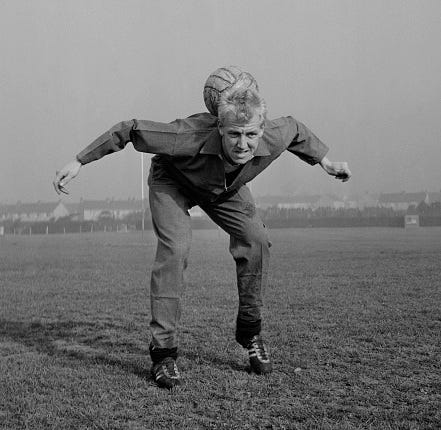
Three league games into the 1964-5 season, Arsenal were hosting Aston Villa. “It was a tackle,” recalls Ure. “It was innocent. I still remember it. It was the big guy, Tony Hateley, who was playing for Aston Villa at the time. I can still see it. As I tackled him there was a sudden impact and I thought: ‘Oh, that feels different.’
“I’d never had one like that before. My knee never felt like that. In those days, instead of taking you off, which I wish they had, they came and gave it a spray with some deadener, the ‘magic spray’.
“That was the beginning of a four, five-year cycle,” says Ure. He is referring to the post-and-pre-game routine that involved a mix of powerful medication, aspirations (injections drawing fluid from the knee cap) and pressure bandages. All his trousers had splits up the seam to accommodate rolls of dressing.
A young Nick Hornby, looking on from the stand, would have had no inkling of the discomfort Ure was enduring, of course, and neither would most other Arsenal fans. They certainly did not know about the painkillers being pumped into his body. Ure later discovered that it was medication more often used on racehorses. If you look up Butazolidin you’ll discover it’s long been banned for human use in the United States and the United Kingdom and has been linked with bone marrow loss. Ure has already overcome one battle with cancer.
So there’s some necessary background when Hornby writes, as he does several times, of Ure’s supposed incompetence as a footballer. The target for such mockery is forgiving. Ure even displays some empathy and confesses to haranguing players on the terraces at Somerset Park as a boy. “That was just his impression,” says Ure of Hornby. “I used to have hates against players I watched for Ayr United. You get these things in your mind and it’s hard to shake.”
Of course he accepts he had poor games, like any other footballer does. But the perception of him as slow and accident-prone hinges on an injury that left him operating at little more than half his capabilities and finally forced a knee replacement operation in 2008. He was playing under a handicap for almost his entire career in England.
He remembers hearing about the Arsenal club doctor, Alan Bass, who was also an eminent Harley Street consultant, showing Ure’s X-rays to groups of students. “He used to point out my right knee’s X-rays and ask students: ‘How old do you think is the man whose knee this is?’” says Ure. “Most of them said about 70.” He was in fact in his late twenties.
So the fact that Ure played on at Arsenal until 1969 is something of a miracle. However, not as much of one as being declared fit enough to sign for Manchester United. The Old Trafford club had won the European Cup just over a year earlier but the shoddy nature of Ure’s medical was indicative of a club in rapid decline. There was not even a doctor present, only Jackie Crompton, the trainer. Ure was told to hop on a bed and bend each knee to 90 degrees, which he could because of the anti-inflammatory pills he was popping like sweets each day. “Arsenal must have thought Christmas had come early getting £88,000 for a cripple,” he says.
Ure made 47 league appearances in two seasons at Old Trafford, before falling out with compatriot Matt Busby, who had returned as manager, and joined St Mirren, his arthritic knee again passing undetected. “You did not advertise your state of health,” he says. “If you did, that was you.”
Ure tells it as it is. We settle for a couple of drams before we leave. “With a dob of ice!” he requests. Someone at the bar wonders whether that really is Ian Ure. It is, I say proudly. But my pride can’t match that of Ure’s two daughters, Mandy and Vikki, whose stout support of their father helps melt away all other criticisms in his eyes. Mandy is an associate professor of fine art at Kingston University, while Vikki is a chef in a hotel on the Crinan Canal.
“His history and long tales will often be written by others,” wrote Mandy, in that well-pitched, devastatingly effective website reply to Ure’s critics. She’s right, of course. This is just another of those long tales. It’s written with an intention to help restore a balance tipped so firmly against her father by a book. Ian Ure spoke up for prisoners, and others, on enough occasions. He should know there are those who speak up for him.