

With Glaswegian Robbie Ure making his multi-million Euro transfer to Sevilla, we reissue an article from Nutmeg Issue 35 about Rangers cult hero Ted McMinn’s trailblazing but doomed switch to the same club in 1987.
The latest edition of Nutmeg Magazine has just been sent to the printers. To subscribe, choose ‘Annual’ below — and it will be dropping through your letterbox in early September.
By Stephen Walsh
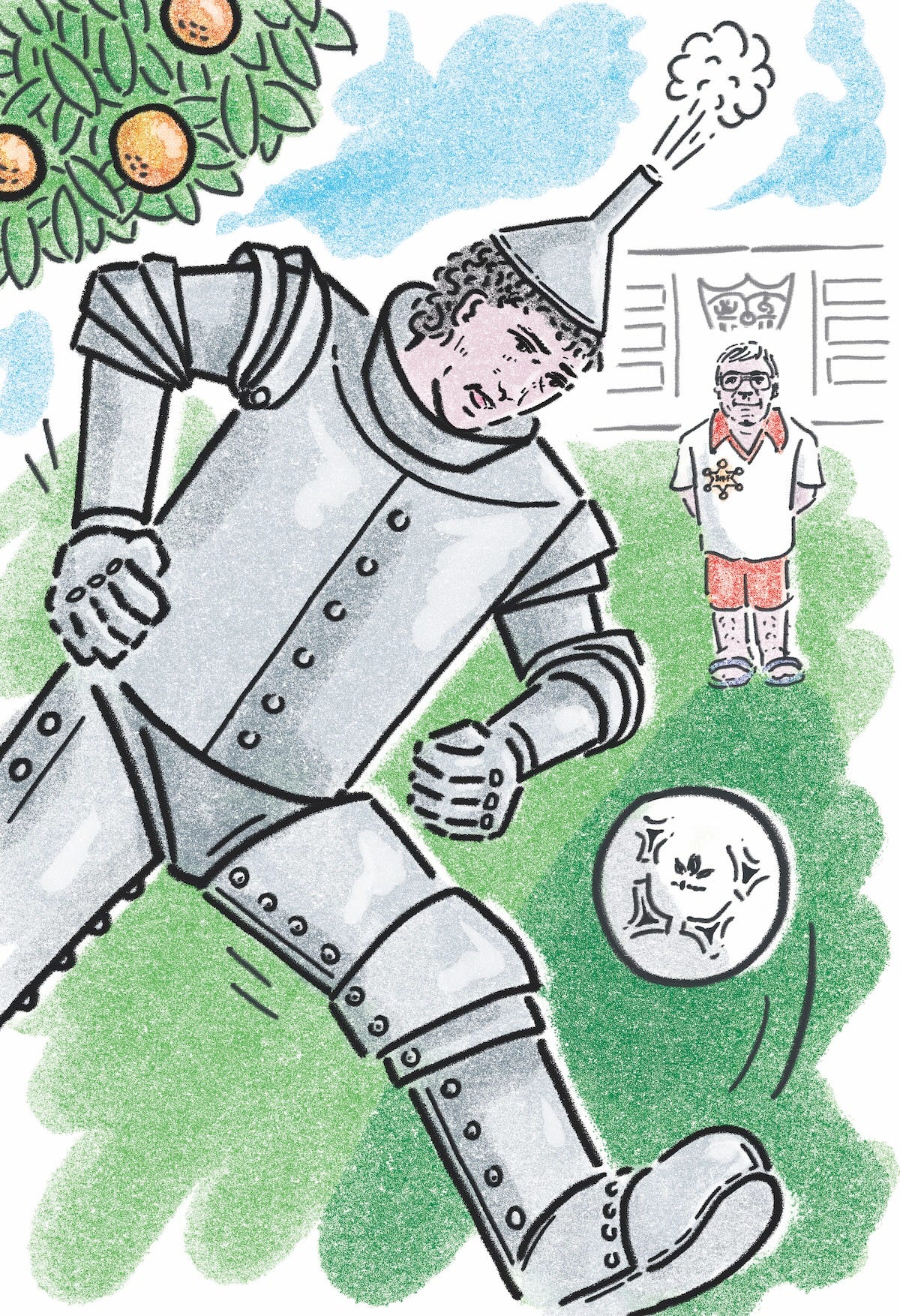
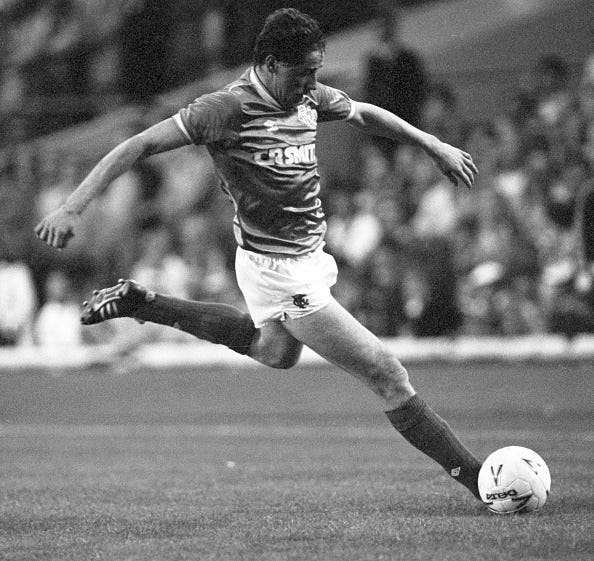
The publishers of Ted McMinn’s autobiography came up with a wizard marketing wheeze — a reversible cover that allows it to be displayed from either side. Pick up the book — titled The Tin Man — in Argyle Street Waterstones and Ted will be on the front in the CR Smith Rangers shirt. In WH Smith in Derby, however, the other side will be on display. The Tin Man has turned Tin Ram, and is in Autowindscreens white.
It does mean that shorter stop-offs in McMinn’s journeyman career are not referenced. Not his beginnings at his near-enough hometown club, Queen of the South. Not Burnley (where, from my uncle’s seat in the Bob Lord Stand, I once saw him score when visiting my East Lancs cousins). And certainly not his exotic stay with the rojiblancos of Sevilla, where for a season and a half in the 1980s he was a pioneering Scottish football export.
McMinn went to Sevilla primarily because his former manager Jock Wallace did. By then, Wallace had had his two spells as Rangers manager — the successful 1970s version, when he dragged Rangers out of the nine-in-a-row shadow of the Lisbon Lions, and the 1980s edition, when he managed McMinn. That second coming turned out to be the archetypal never-go-back scenario. He dragged them back into the shadow, this time of Aberdeen, and got the sack.
Booted out of his spiritual home, this Scottish manager of a dinosaur school hardly known for its cosmopolitan tendencies somehow landed the managerial gig at the Ramón Sánchez Pizjuán. When McMinn was unceremoniously booted out of Ibrox a few months later, Wallace signed him for the peseta equivalent of £200,000. And so begins the story of a season or two in the sun for two of the unlikeliest tourists ever to put their footballing handbags in the middle of the dance-floor and give it the full Y Viva España.
*
Wallace died in 1996, aged just 60, and one suspects he might have struggled with the arm-around-the shoulder requirements of modern football management. Ally McCoist calls him “the hardest man I ever met” (Wallace once decked him with a right hook during a pre-season training camp in Switzerland). Gary Lineker “encountered” him at Leicester City. At half-time in a reserve match, Wallace made a beeline for the rookie striker, raising him up the dressing-room wall by the throat and calling him “a lazy wee English c**t”. Leicester were two up, by the way, and Lineker had scored both goals.
Wallace kept goal for the Wee Rangers when they beat the Big Ones at Shielfield in the 1967 Scottish Cup, but his coaching aura originated not in his playing career but in his military service in what the papers invariably called “the jungles of Malaya”. His trademark training sessions were endless shuttle-runs on Murder Hill, the sand-dunes at Gullane. These were famously punishing, with the salt-smell of the sea slowly supplanted by the saltier whiff of young men’s vomit. “I’ve got the battle fever on,” was his favourite slogan, and the military metaphors played well with the Ibrox faithful.
So did the results, which were spectacular. Having coached the Willie Waddell team that won the Cup Winners’ Cup, he took over as manager in his own right. He won the Cup in Rangers’ centenary season, the League (their first flag for 11 years) in ’74/75, and the treble twice. He then suddenly resigned, refusing until he died to divulge why. His reasons remain an enduring 1970s sporting mystery, up there with what happened to Shergar and the true identity of the masked wrestler Kendo Nagasaki.
After Leicester, and a short period at Fir Park, Wallace was lured back to Ibrox in 1983. He was not the first choice. In time-honoured Old Firm fashion, Rangers had tried to sign the opposition’s best talent, but neither Alex Ferguson nor Jim McLean was willing to play ball with a club still loaded with debt from the post-Disaster stadium remodel. In desperation they turned to Wallace, hoping to wind the clock back. Performances in Wallace’s second term proved feeble.
On the odd occasion when things were going right, such as the 1984 League Cup final, Wallace carried himself as if they weren’t. That day he harassed the on-field reporter, making the hapless shortie-raincoat boy chase him across Hampden in search of the post-match platitudes. Every time the boy caught up with him, Wallace bawled him out on live TV. “COME ON!” As the boy waited for a signal, Wallace harumphed. “HURRY UP, MAN!” “Were you confident when it went to extra-time?” “I WIZ CONFIDENT BEFORE IT STARTED, SON,” Wallace says, and strides off.
Only 40,000-odd turned up for that final (an Old Firm clash which Rangers won 3-2) and that was widely regarded as a better-than-expected turnout. The next season there was further dwindling. Between October and April Rangers won only a handful of times. They finished fourth in the purgatorial ten-team league that was the first iteration of the SPL, and Wallace was sacked in April 1986.
*
McMinn was one of the headline acquisitions of Wallace’s second stay. Not a marquee signing, perhaps, but at least a family-sized tent. Rangers got him from Queen of the South, who had nabbed him from the junior side Glenafton for £325 and 1,000 half-time lottery tickets for the next match at Palmerston. The Queens board had dispensed with the manager and the chairman was picking the team; not surprisingly, McMinn’s transfer to Rangers was presented to him rather than discussed with him.
As a part-time sawmill worker on £20 a week, McMinn had turned down various other clubs to stay near home and to combine work and football. But Rangers’ offer was good (the tyrannical chairman got £100,000 for his new stand, and McMinn got £250 a week) for a player who had not convinced everyone of his genius. When he announced he’d signed for Rangers at the sawmill, the foreman asked him what the f*** he’d want to go to Berwick for.
McMinn tin-manned his way around Ibrox reasonably successfully for 18 months or so until his mentor Wallace was replaced by Graeme Souness in the summer of 1986. His stiff-legged running became a metaphor for the dead wood Souness was trying to clear out. “How can I tell Ted McMinn what to do when he doesn’t know what he’s going to do himself?” was his exasperated cry. Rangers won the league in 1986/87, but McMinn didn’t play enough games to qualify for a medal.
McMinn helpfully directed himself towards the revolving door with a series of “incidents”. A fight in a nightclub in East Kilbride was followed by a ruckus in Shawlands, shoulder to shoulder with McCoist and Ian Durrant. Durrant’s role was unspecified, but McCoist showed what he’d learned from Wallace by knocking a dentist’s front teeth out, while McMinn chased the victim down the road and up the stairs into a police station.
It was not his finest moment, as he says himself in the Rangers half of his choose-your-own-adventure autobiography. Pished, they hadn’t noticed that the dentist’s teeth were false and that McCoist’s punch was not the slam-dunk he had imagined. The rope McMinn had given Souness to string him up with was real enough, however, and, after one last curfew-break, his days at Ibrox came to an end in a foul-mouthed showdown with the manager.
*
Bring on Spaniards by the score... So went a chunk of a popular song we would all sing at Hampden in the 1970s and 1980s. It never occurred to us for a moment that the Spaniards might want to bring on even one Jock Wallace.
Wallace, after all, was almost in the Jim McLean class in terms of inexpressive dourness, while Sevilla was a glamour destination of sorts. A World Cup venue in 1982 (and the city where David Narey toe-poked Jimmy Hill into a different Tartan Army song), it was host city for the 1986 Steaua-Barcelona European Cup final, when the Romanian goalie’s performance in the penalty shootout hastened the fall of Communism.
Add to that the strangeness of someone so rooted in the Rangers “tradition” going overseas, especially to Catholic Spain. Wallace’s mantra (“It’s never been sectarian as far as I’m concerned”) was typical of the time, and covered a multitude of signing policies. Wallace was blue to the tip of his nose, and the joke that did the rounds was that Sevilla was the one place in the world where he would find more Orangemen than on the Copland Road.
Spanish football in the era of President Felipe González was an odd beast too. According to Antonio González, in the late 1980s it was 80 per cent politics and 20 per cent sport. The Franco era’s deep oppositions and regional imbalances were not so long dead, and the Galactico era at Real (which in González’s view reversed those percentages) was not yet a twinkle in Florentino Pèrez’s eye.
And compared with the declining tedium of the Scottish club set-up in the 1980s, the Spanish liga was sometimes properly loca. La Liga was the league in which Johan Neeskens was sold by Barcelona because he didn’t pass the toilet paper to the club president; where Real’s Santillana, named after a seaside resort, was kicked around the Bernabéu so hard his doctors thought he had lost a kidney; and where El Carnicero, the Butcher of Bilbao, broke Maradona’s leg with a single kick of which Tam Forsyth would have been proud.
Sevilla were regarded as southern softies compared with such Basque hard cases. Founded by two Scots “after the consumption of some small beer” on Burns Night 1905, the club has a Scottish connection, but the impetus for the appointment originated further south. Terry ‘El Tel’ Venables had just tickled the sleeping giant Barcelona awake, while John Toshack had dressed up the Cinderellas of Sociedad. Doing things the British way was in vogue down La Liga way.
The Sevilla fans had no idea who ‘Jock’ was, however. Its popularity as a character name in B Westerns meant that ‘Jock’ was perceived as cowboy rather than Scottish, so Wallace’s first nickname was El Sheriff de Sevilla, come to clean up a team that had been flatlining for several years. The fans’ lack of knowledge was echoed by Wallace’s own ignorance of his squad. At his first training session he “robustly” chastised one of the squad for a lack of effort, only to be told that the player in question was actually the club masseur.
He started poorly. He lost his first derby to Betis, lost a lifetime’s worth of tactics notebooks in a theft from his car, and lost some of the fans for his perceived neglect of their rising stars. His board was encouraging him to “Buy British”, as if it was a Mini Metro he was shopping for. He wanted Robert Fleck and ended up making an offer for Ted McMinn. McMinn was not sure, but Chick Young made up his mind by buying him a ticket to Andalucia in exchange for an exclusive.
Wallace clearly wasn’t that sure either. When he met McMinn at the airport he shoved him into the back of his Opel and told him to put a blanket over his head. The Sevilla chairman thought £200,000 was a lot of money to spend on someone the Spanish media were calling a thug, but Wallace defended his player. “He’s an honest lad. He’s told me he’d no involvement with the boy losing his teeth and I’m happy with that.”
*
Ted McMinn was not a name you’d have particularly associated with an international outlook either. In his era, most Scots’ experience of Spain was two weeks on the lash in Benidorm and flying back into Abbotsinch with a sombrero on and a stuffed donkey under an arm. Discounting John Fox Watson’s one game at the Bernabeu in the 1940s, Steve Archibald, a very much more complex kettle of fish, was the only Scot who’d made a living from football in Spain.
McMinn’s move seemed almost impossibly exotic. Or possibly just impossible. In his first match, against Cádiz, he remembers being penalised every time he touched the ball. That was just the start. The day after it, he broke his foot playing squash with his interpreter. Plastered up, and feeling a fool, he decided not to lie low, went to an away match with Atletico on a supporters’ bus and was persuaded to join the commentary team. He had no knowledge of his own team, let alone the opposition, and didn’t possess a word of workable Spanish.
Exclusively Spanish apart from McMinn and a couple of Uruguyans, the Sevilla side should have been doing better than it was. It featured Francisco López Alforo, on a ten-year contract after appearing for Spain at the 1982 World Cup; the current national coach Luis de la Fuente; and the future manager Manolo Jiménez, with whom McMinn bonded over their upbringing on the wrong side of the tracks to the extent that the squad nicknamed him ‘Manolin’, or Little Manolo.
Wallace, already under pressure, had a vested interest in McMinn’s recovery, and so took him to his holiday flat in Torremolinos. He had watched a documentary about Ginger McCain healing the Grand National winner Red Rum by getting him to trot in the sea off Southport, so got McMinn to do the same thing in the wintry Mediterranean. Whether it shortened his rehab is not clear; he was out for eight weeks.
When he got fit Wallace made a tactical error that affected both of them — he gave Alforo’s No.6 shirt to McMinn, apparently on the basis that the Spaniard didn’t track back enough. The Sevilla Ultras, the Biriris, were unhappy, and cushions were thrown. No one came to wave Manolin off when he had to fly home to face the legal music for Denturegate. The verdict was “Not Proven”, but his association with the general class of los hooliganos británicos was established.
All might have been forgiven with a derby win against the verde blanco caca of Betis (how at home both Wallace and McMinn must have felt to be facing up to “green and white sh*te” again) but training for the match was fiasco-ridden. At the camp, on the Mediterranean coast, the players went out to eat. In an attempt to integrate, McMinn took on the challenge of a Full Spanish, a giant seafood paella. An hour later, like a first-time tourist, he was throwing it all up at the water’s edge. He played next day while still debilitated and was booed off.
*
Meanwhile it was clear that Wallace was not bringing about the renaissance Sevilla’s board had demanded. Two wins from their last three games would have seen them into the European places, but they ended up ninth, just three points clear of relegation. El Sheriff had acquired a new fan nickname based on the local phonetic pronunciation of Wallace — they called him Señor Vayasé. ‘Señor Go Away’, in other words or, more idiomatically — ‘Mr GTF’.
In response Wallace tried to impose a Gullane regime, complete with beach runs and dietary restrictions, ahead of 87/88. McMinn might have been able to let Wallace know of the rumblings in the camp and rumours of revolt, but he couldn’t understand what the players were saying. When the axe fell, the Sevilla board ducked Wallace’s poor stats, holding the official line that they sacked him because he had reneged on an agreement to learn Spanish.
McMinn stayed until the following February. He reckons he played about 25 games in all, but the new manager, from Valladolid, repeatedly named him as a sub and he was often unused. Finally, with his team 5-0 down at half-time against Real Zaragoza, McMinn refused to get up from the bench. He was back in England and playing at the Baseball Ground by the time the Hillsborough season was underway.
Though not without a little swansong. “We beat Betis in their stadium in my last game,” said McMinn. “Everybody knew I was leaving, and I got presented with a lovely plaque. It was strange. I never thought the players liked me much. I couldn’t speak their language so I couldn’t really communicate. Turns out they did. But because I didn’t learn the language, I was just looking at four walls every night. The days were getting longer. I was lonely. And I missed the big man.”
*
Two poor travellers clinging together for warmth. It doesn’t say much for the Scots of that era. To this day it is only Archibald, of the handful of Scottish players who have played in the top league in Spain, who has made it to two seasons or more. It’s hard to imagine him doing what McMinn and Wallace did — living in each other’s pockets, sharing lunch, dinner, pints and hours of chat. “It wasn’t really a manager-player thing,” said Ted. “It was a father-son thing.”
When Wallace was sacked, McMinn met him for a beer in the bar beneath his flat. With Wallace off the scene, he could see no future at Sevilla. Wallace told him to stay, that he had to keep going, that if he walked away he’d be seen as a failure. They had a few beers and Wallace sent McMinn upstairs to get an early night to be ready for the next day’s training. He himself stayed in the bar for a few more.
McMinn went to bed and dozed. A couple of hours later, through the windows of his apartment, he could hear Wallace’s distinctive footsteps echoing down the street and off into the night. Wallace was whistling. McMinn tried to make out the tune. Was it Una Paloma Blanca? La Bamba? Despacito? Or even La Macarena? Of course not. It was Follow, Follow. McMinn lay in the dark listening to what sounded like the Lone Piper. Or perhaps a Pied Piper, whose flute-tune was calling him home again.
Brilliant, had me laughing out loud in places