


Welcome to the first in our series of collaborations with the brilliant Scotland's Coefficient. Please check out his Substack for in-depth analysis of Scottish football.
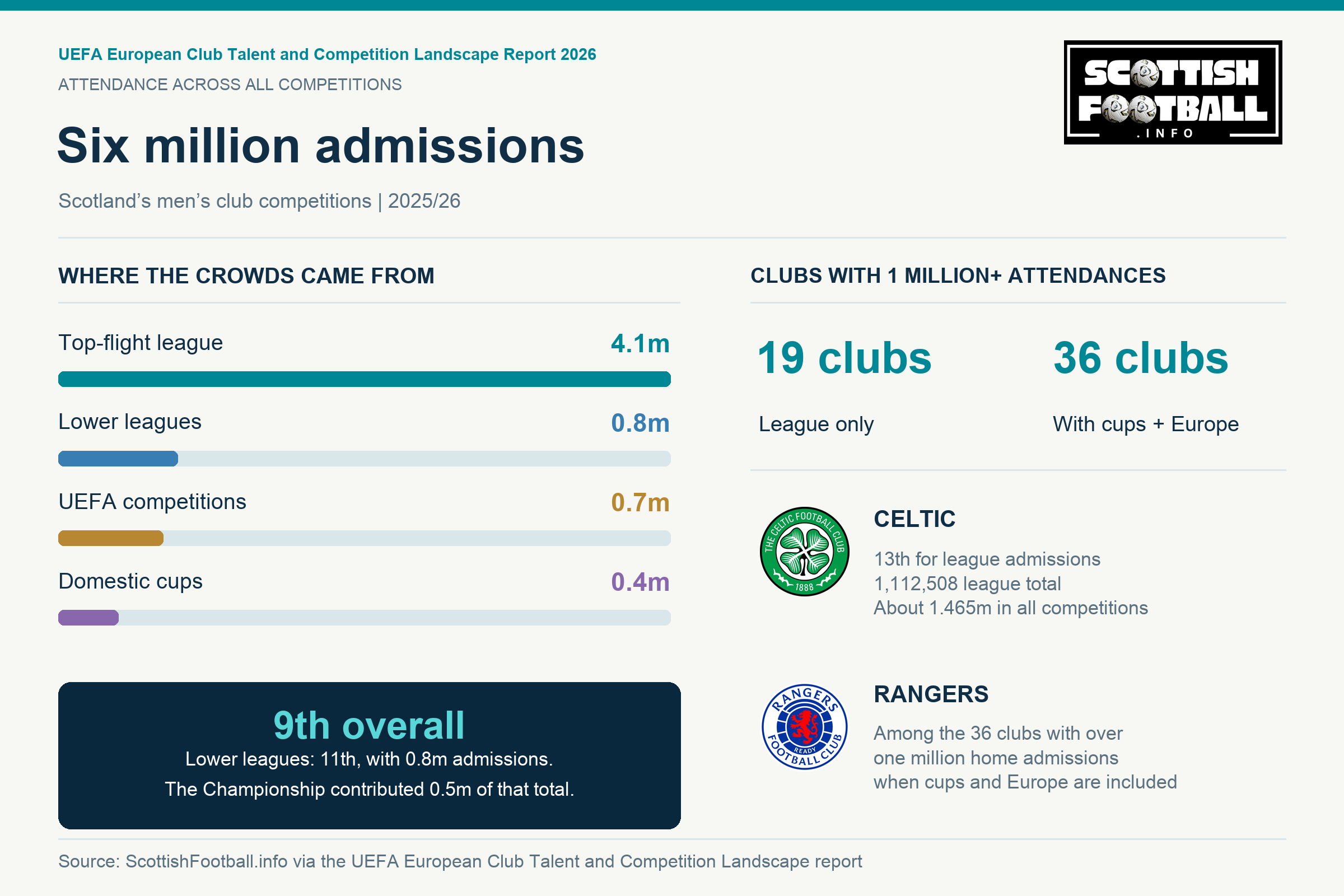
Scotland’s total attendance across men’s club football in 2025/26 was six million, once again putting it top of the UEFA charts for attendance relative to population.
The European Club Talent and Competition Landscape report, released last night, also shows record Scottish transfer spending this summer, extensive use of loan players and comparatively limited playing time for teenagers.
Looking at the top flight only, crowds totalled 4.1 million, which is an all-time record - as anticipated by the SPFL in may. Scotland ranked seventh for total top-flight attendance, behind only England, Germany, Spain, Italy, France and the Netherlands, with an average crowd of 17,903.
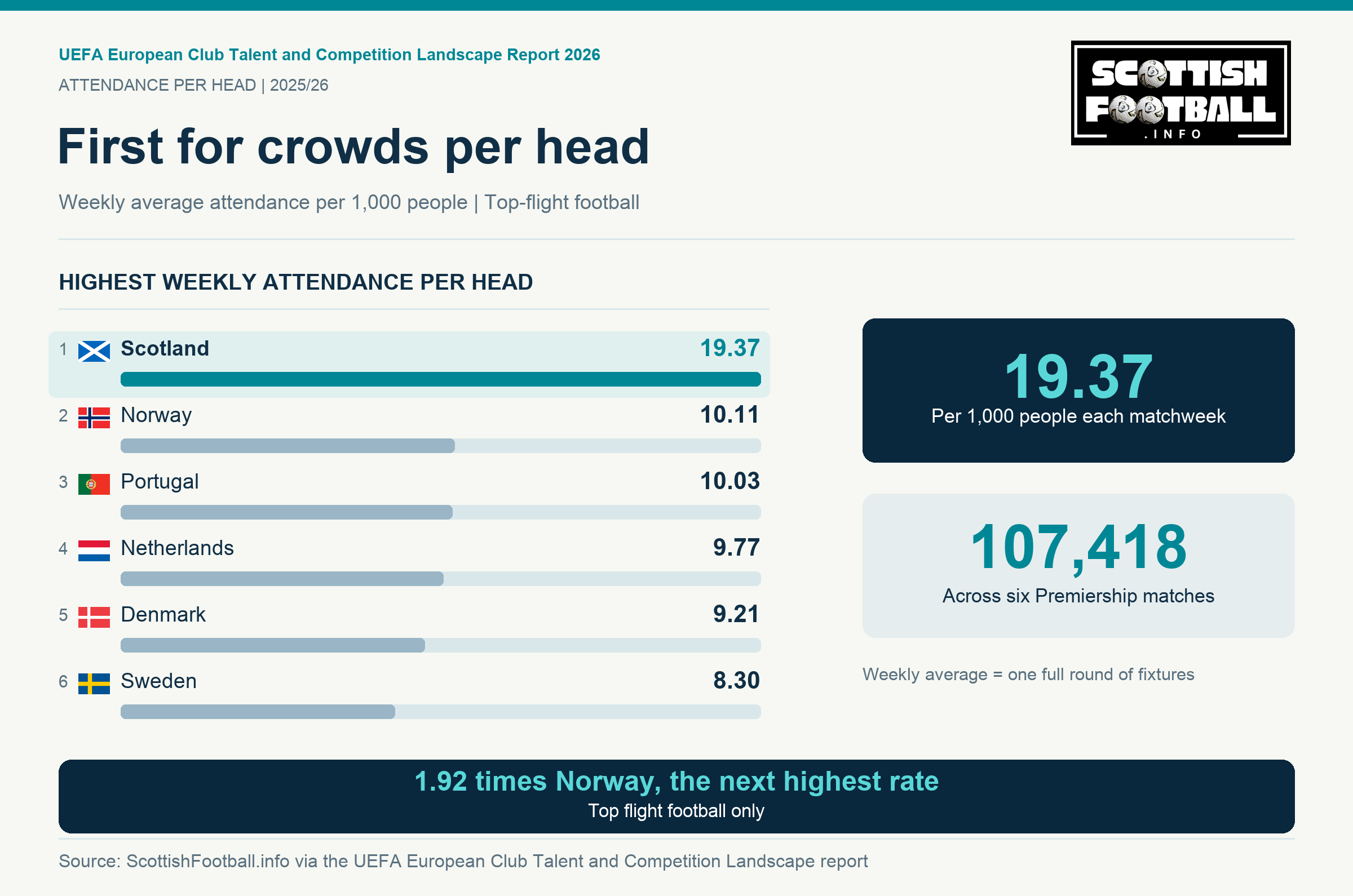
Adjusting average weekly crowds for population puts Scotland first, with about 19.37 top-flight attendees per 1,000 residents. Scotland’s weekly per capita figure is around 1.92 times the next best nation, Norway, who were at 10.11 per 1,000, followed by Portugal on 10.03 and the Netherlands on 9.77.
A per-capita figure of 19.37 compares with the 18.36 reported by the SPFL in a collaboration with myself just two years, an increase of around 4.7%.
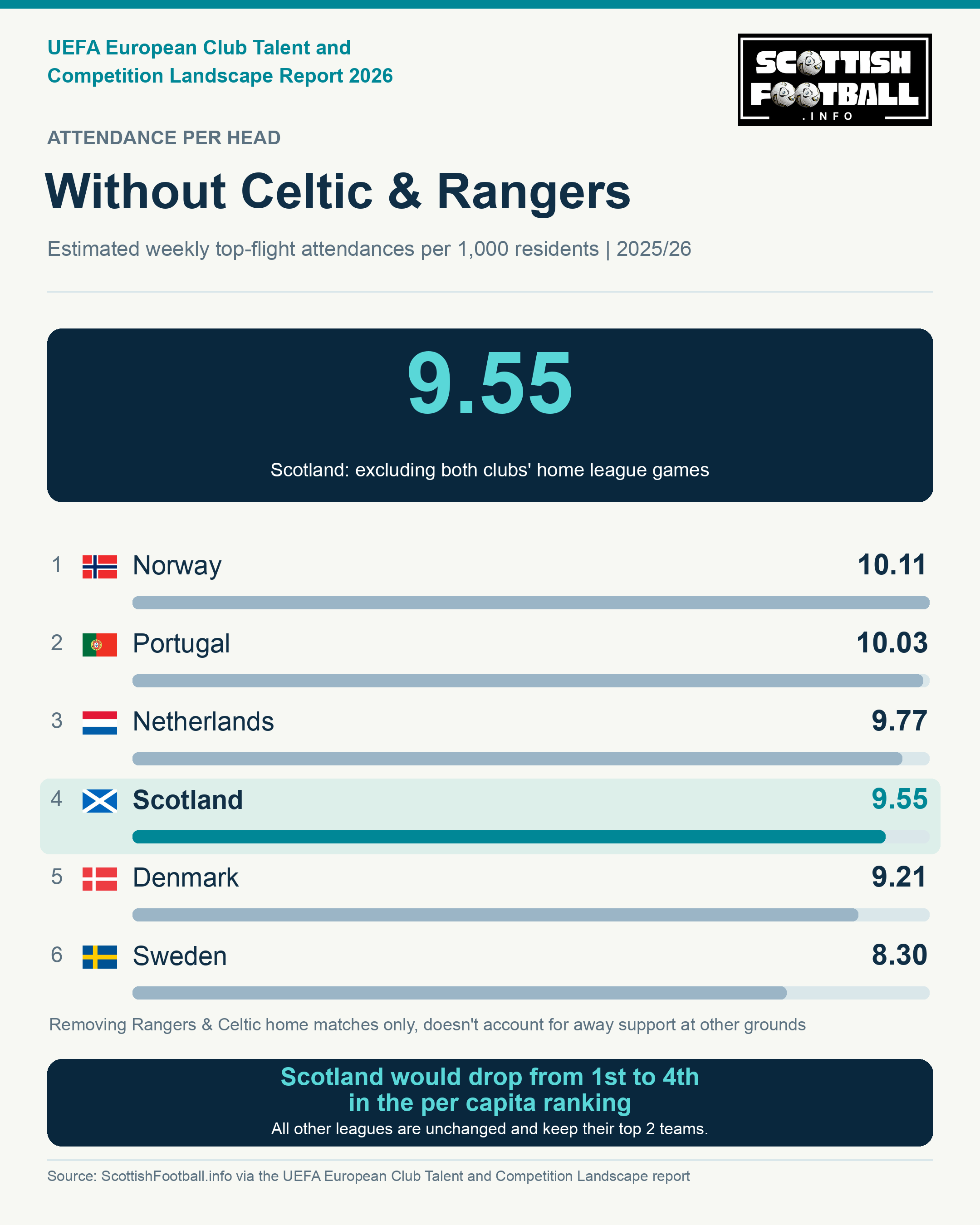
It is often assumed that Scotland’s high per-capita ranking is solely driven by the crowds at Ibrox and Celtic Park. But actually, when completely removing Celtic and Rangers home attendances - while allowing all other nations to keep their top two teams - the Scottish top-flight would still rank 4th in Europe for attendance per head.
Across all men’s competitions, Scotland’s total attendance was about 6 million, which is an incredible 1,082 admissions per 1,000 residents over the full season! This is approximately 32% higher than England’s 823 per 1,000. These figures obviously count repeat visitors throughout the season, so it isn’t six million different people - but it’s still hugely impressive for a country of 5.5 million.
Scotland ranked ninth in Europe for total attendance across all competitions, and the six-million figure breaks down into:
4.1 million in the top flight
800,000 in lower leagues,
700,000 in UEFA competitions.
400,000 at domestic cup matches
Outside the Premiership, the lower-league total ranked 11th in UEFA’s report, with the Scottish Championship alone contributing about 500,000.
Looking at individual clubs now, and Celtic were one of only 19 European clubs to exceed one million home league admissions, ranking 13th with 1,112,508 and averaging 58,553! They were the only club outside the top five leagues to record 1m+ home league attendances, as this graphic shows:
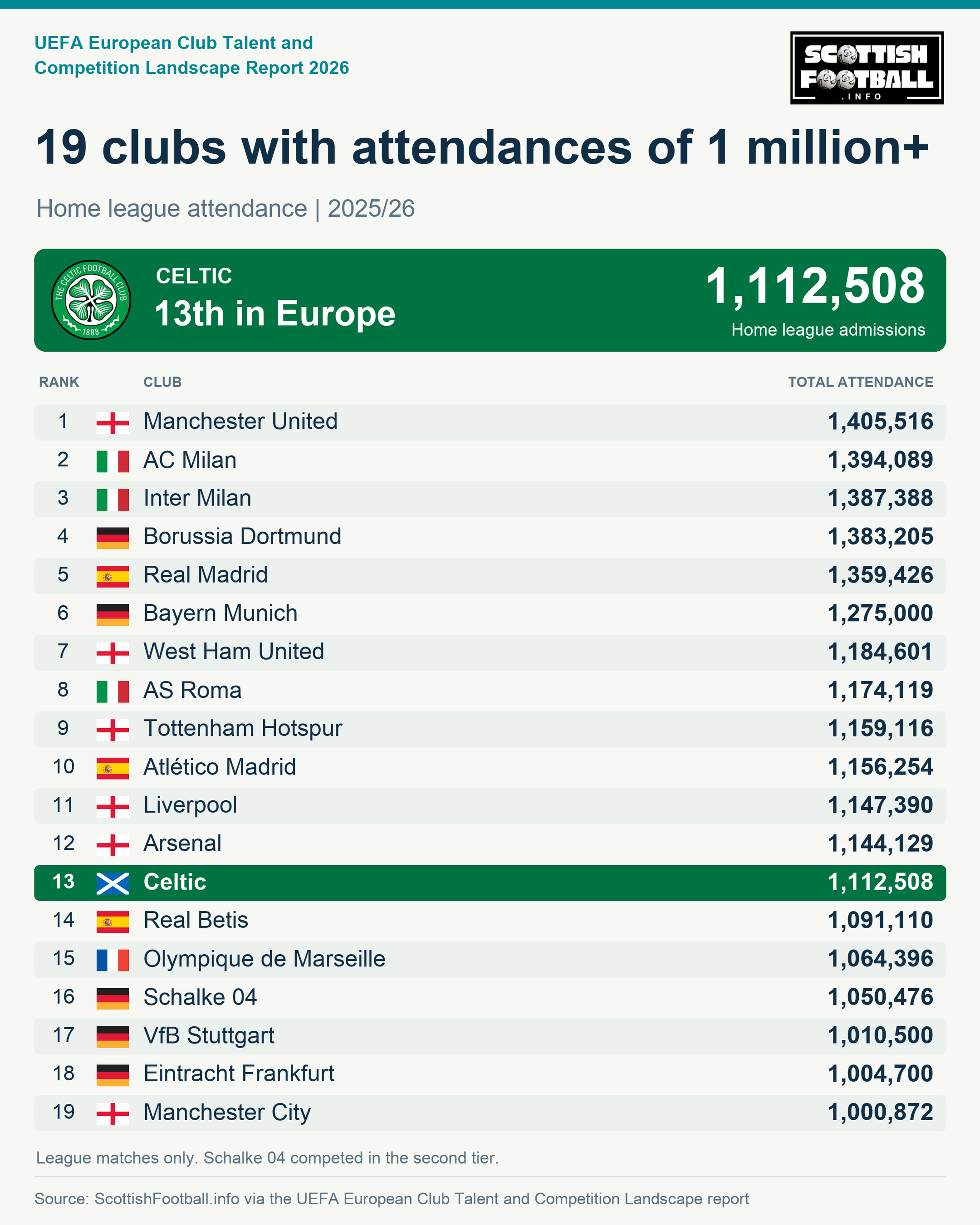
Adding domestic cups and European matches increased Celtic’s total to about 1.465 million. When adding all competitions for all clubs across Europe, and the ‘one million club’ jumps from 19 to 36 clubs - including Rangers.
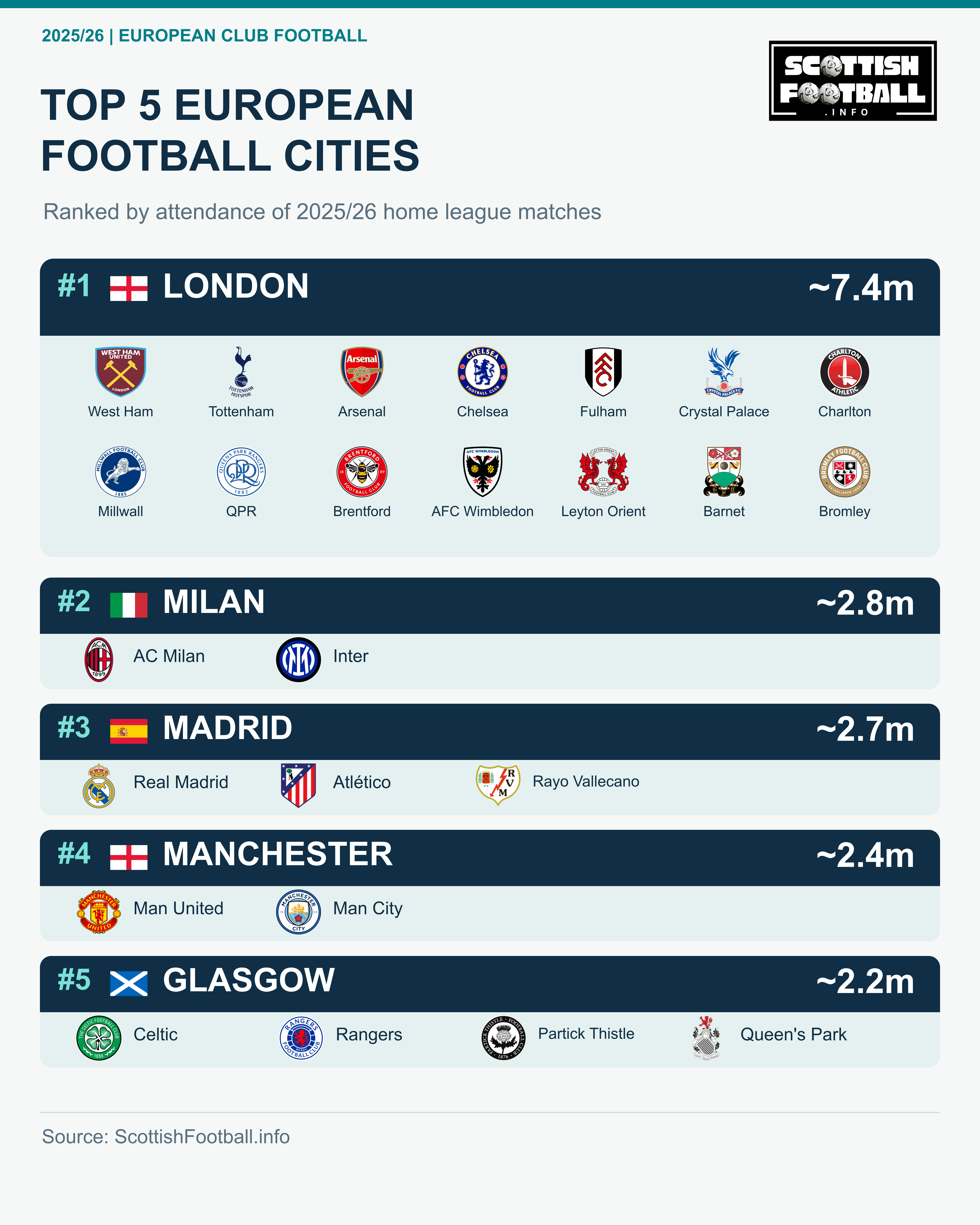
Glasgow is a top five European football city in terms of attendance at league games last season.
Transfer Spend & Premiums Paid
UEFA’s reports states Scottish clubs spent a record €82m (£70m) during summer 2026 and received €87m (£75m) from sales, according to UEFA’s provisional transfer figures. As per their annual report, we know that Celtic spent £31.6m this summer, with media reports estimating they received around £50m in sales, with Rangers receiving an estimated £12m, and Motherwell a reported £8m.
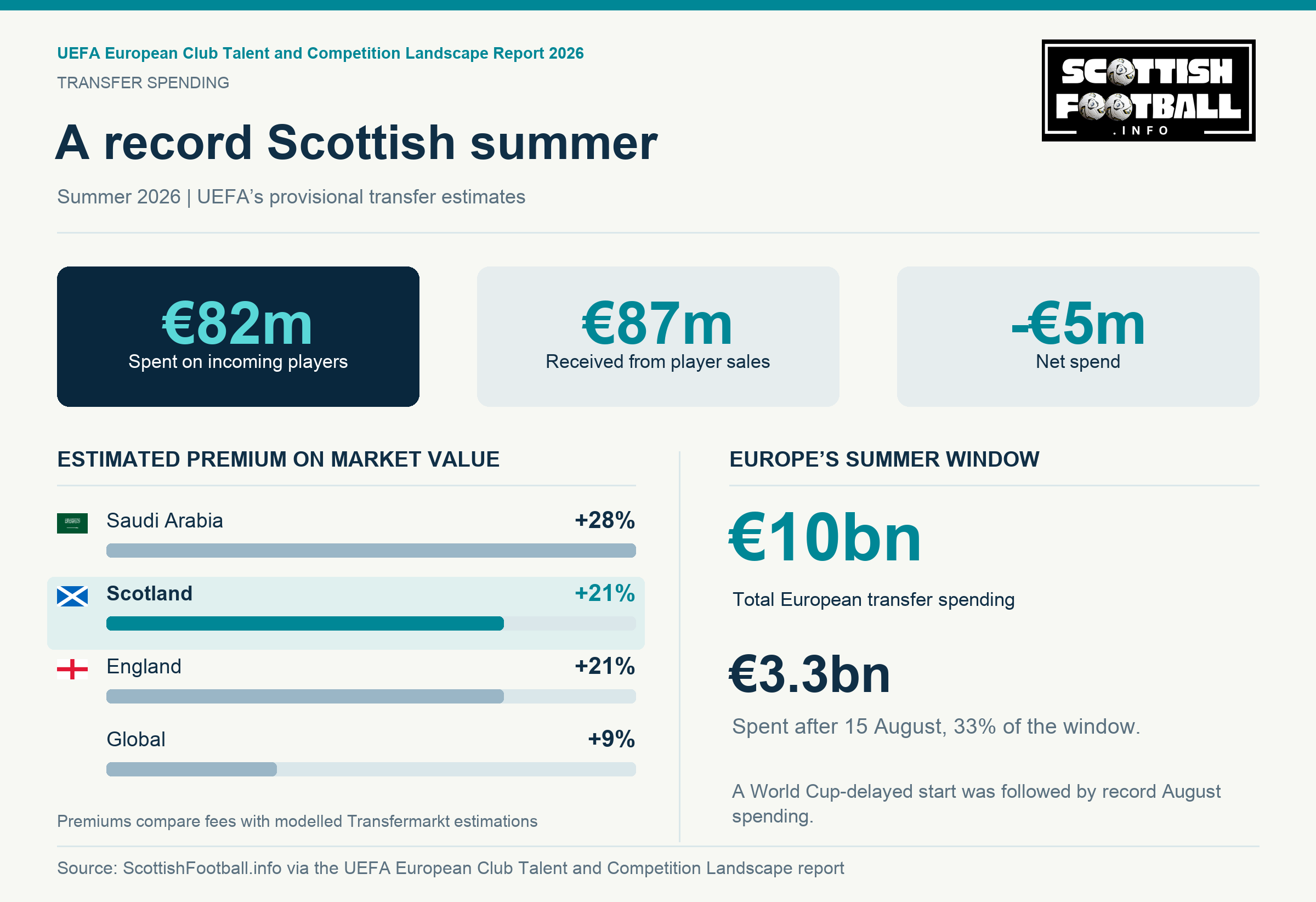
On a Europe-wide scale, spending reached a frankly ridiculous €10bn, despite a World Cup-delayed start to any spending. Europe had a record August with more than €3.3bn, a third of the summer total, spent in the last two weeks of the window! The €10bn summer total is up 8% from the previous year and when including January, the 2026 calendar-year figure reaches €11.7bn across all divisions.
English clubs committed €4.6bn during the summer, more than the next eight European markets combined. Deals involving at least one English club accounted for 52% of worldwide transfer value. The boom is largely due to continual inflation of football transfer fees, as the actual number of transfers across the leading 20 leagues increased by only 0.3%.
Those transfer fees measure clubs’ transfer commitments, rather than the cash changing hands between clubs. The way so many clubs are spending incomprehensible fees, paid in installments, means that the transfer market is becoming a paper transfer of money, to be paid in future. UEFA warns that growing reliance on player sale profits, deferred payments and financing against future transfer receipts leaves clubs exposed if prices or market liquidity weaken.
UEFA’s comparison of transfer fees with modelled Transfermarkt valuations estimated Scottish and English buyers paid a 21% premium, compared with 9% globally. Saudi clubs had the largest premium, at 28%.
Those valuations are estimates, and Transfermarkt can be off with how it values players, but it shows that the Scottish clubs, mainly Celtic and Rangers, do tend to overpay for the players they bring in. English clubs sold their players at an estimated 7% premium over transfermarkt valuations, with the BBC finding earlier this month that Premier League clubs paid around £20m more on average for players bought from other Premier League clubs than for those bought from abroad.
Number of Signings & Manager Changes
Scottish clubs fielded an average of 32.4 players, 7% more than ten years ago, which ranked 17th across UEFA’s associations. Motherwell used Scotland’s fewest players and Aberdeen the most.
Average time already spent at a Scottish club before the season was only 1.2 years. Dundee United had the shortest average tenure and Celtic the longest. That limited continuity helps explain the recurring task of building a functioning team from substantial annual recruitment.
Scottish clubs averaged 12.6 senior arrivals during the summer, an increase of over 4%, with the 12.6 number broken down into 4.8 transfers involving fees, 4.4 free transfers and 3.3 loans. Only Italy’s first and second divisions averaged more incoming summer loans among the 20 leagues compared.
Across the full season, Scotland had the highest average number of inbound loans in Europe at 5.7 per club. Loanees played 15% of league minutes, against an average of 9%, only Türkiye’s top tier played more loanees, with 16% of league minutes going to loan players.
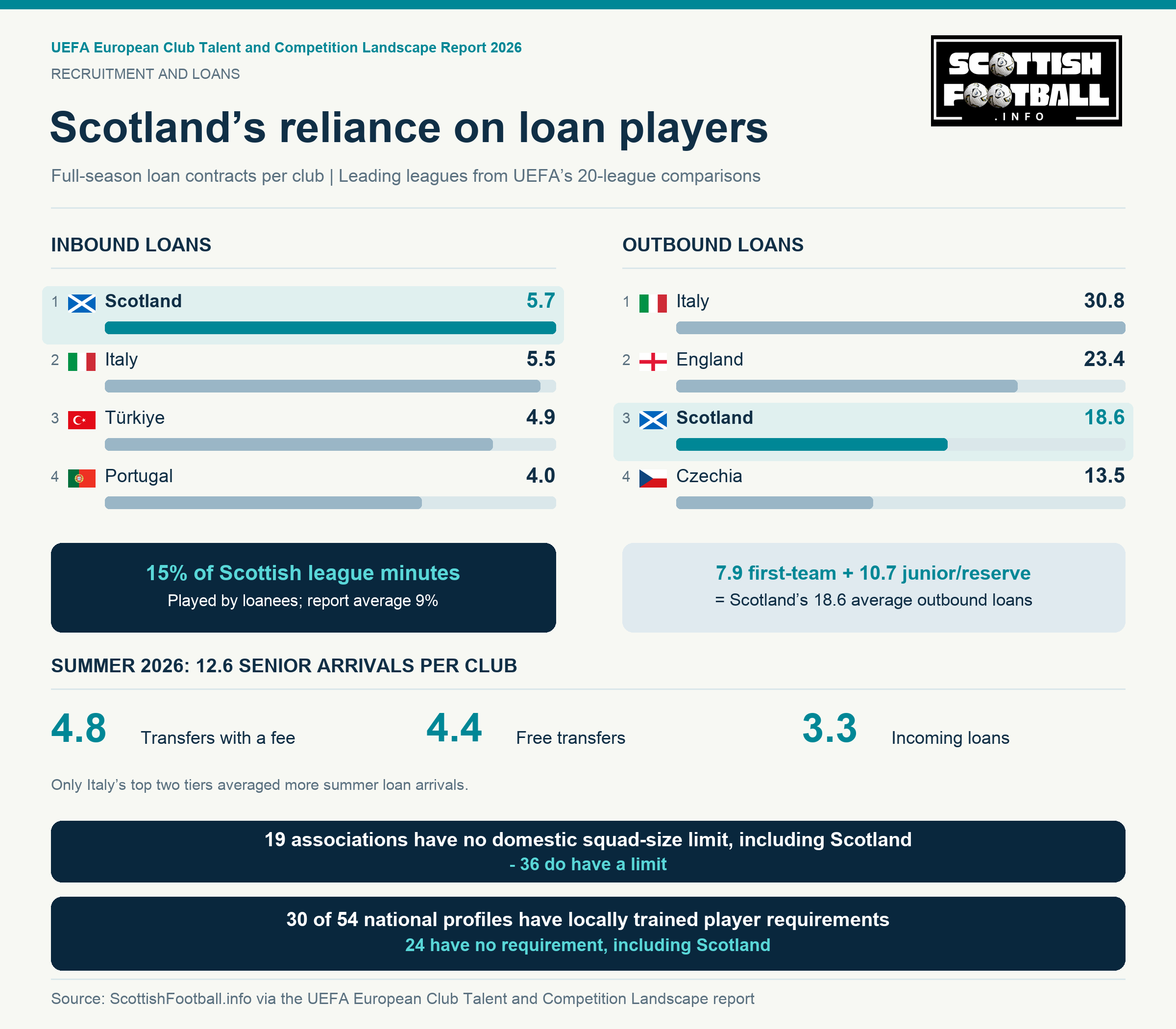
Scottish clubs also ranked third for outbound loans, behind only Italy and England, averaging 18.6. That number includes 7.9 first-team players and 10.7 involving academy players, with the number inflated by any player that went out on more than one loan spell in the season.
UEFA records 738 coaching changes across Europe, with a whopping 63% of clubs changing coach last season. In Scotland there were 14 managerial changes, up from nine, averaging 1.2 per club. Two-thirds of clubs in the division changed coach, which seems a huge number - but Scotland’s average ranked only 17th in Europe
Youth Minutes & Squad Rules
Craig Mulholland, the SFA’s new chief football officer, has a nervy few months ahead as he waits to see if the clubs will vote through his proposals to increase minutes given to Scottish youngsters.

The UEFA report backs up his argument, as it showed that Scotland spends a smaller share on youngsters and gives them a smaller share of minutes than the European average.
Under-20s (of all nationalities) accounted for just 4% of Scottish transfer spending, while half of the money went on players aged 24-28, and 44% spent on those aged 20-23. Only 2% of transfer spending went on players aged 29 or older, and it was notable that in Rangers’ recent victory at Celtic Park, 27-year old James Penrice was their oldest player in the starting XI. By contrast, Celtic had six players older than Penrice from their eleven starters.
Across Europe, players aged 23 or younger accounted for 56% of spending, showing that for Scottish clubs to maximise their trading models, they have to buy even younger before selling at peak market ages of 22 or 23.
U20s of all nationalities received 4% of league minutes in Scotland, which was below the report’s 6% average. Only six of the 20 leagues featured had lower shares than Scotland’s 4%; England, Spain, Italy and Poland on 3%, with Greece and Türkiye on 2%.
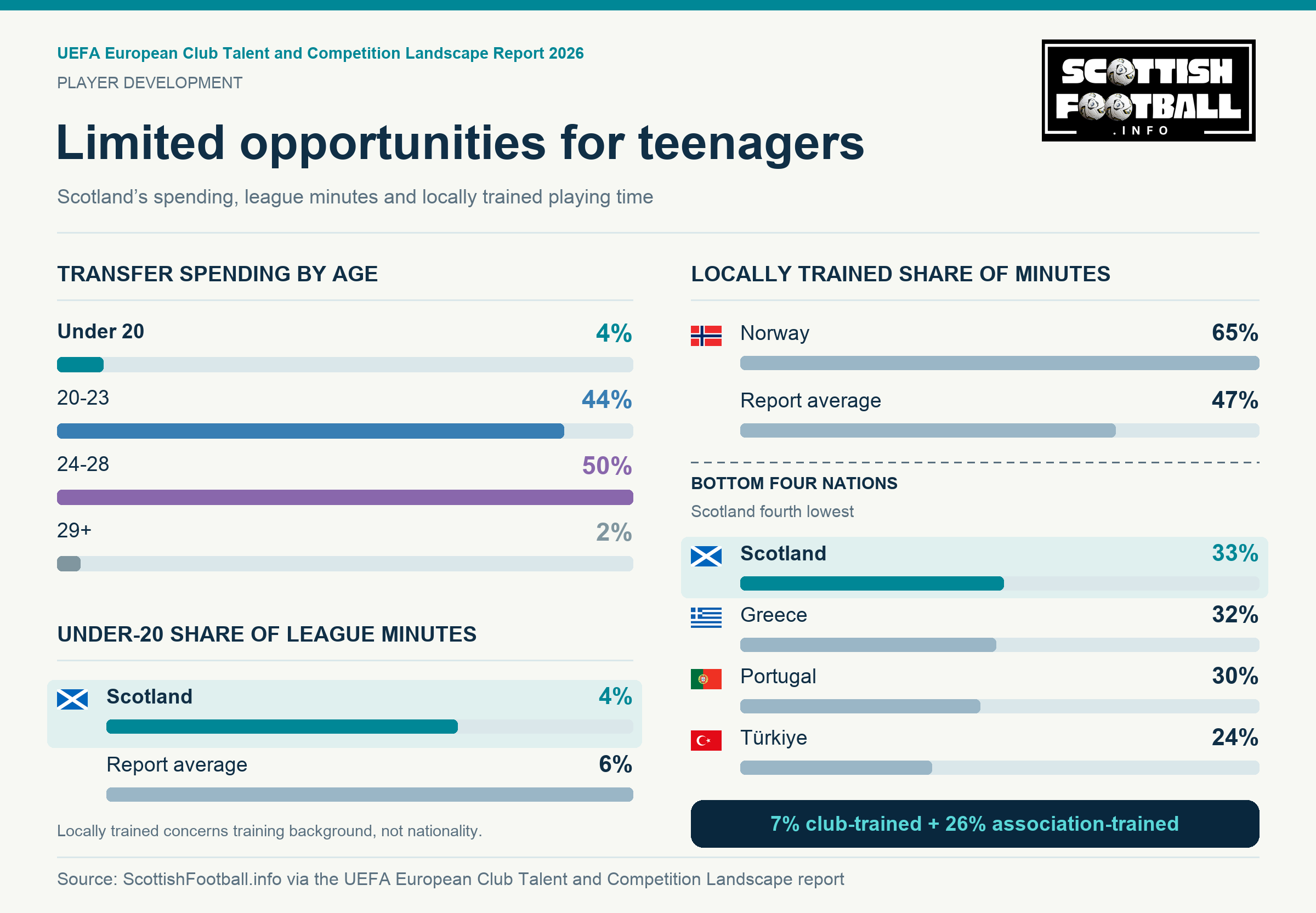
Locally trained players of all ages accounted for 33% of Scottish league minutes. This is one of the lowest figures in Europe, with only Greece, Portugal and Türkiye giving a smaller share of minutes to players produced in their own country.
Scotland’s figure comprised 7% for club-trained players and 26% for players trained elsewhere within the association. For this measure, players can be of any nationality, so as an example Paul Nsio, currently on loan at St. Mirren, would count as association trained - despite not being eligible for Scotland.
Scotland was also one of 19 associations without a specific domestic squad-size limit and one of 24 associations that have no home-grown rules at all (30 leagues have one). Mulholland will hope to see a footnote in next year’s report stating that Scotland will be implementing new youth-playing-time rules from 2027/28. Unfortunately, I don’t think this will be the case as I don’t think our clubs will vote it through.

Massive interest by supporters. Terrible results on the pitch by the teams across the board. And it's getting worse.