


Euan Marshall is a Scotsman who has spent 15 years following South American football from Barranquilla to Buenos Aires, working as a journalist in São Paulo, Brazil. He is a commentator for the Copa Libertadores and Copa Sudamericana. He also works as an expert for football travel company Aficionados.
There is no shortage of links between Scotland and the foundation, organisation and popularisation of football in South America. Take Charles Miller, the São Paulo-born son of a railway engineer from North Ayrshire, who is often dubbed the ‘father of Brazilian football’. After returning from boarding school in Southampton in 1894, he set about creating Brazil’s first-ever football teams and competitions.
Just months before him came Thomas Donohue, a football-mad textile worker from Busby who moved to the outskirts of Rio de Janeiro in 1894, where he put together regular kickabouts with his workmates at the Bangu textile factory. There’s still a statue of him in front of where the factory once stood.
Over in Argentina, there was the Glasgow-born Alexander Watson Hutton, who in 1893 established what is now the Argentine Football Association. Three Scots founded the Chilean FA, and others played important roles setting up the game in Uruguay.
When I moved to São Paulo as a 19-year-old university dropout back in 2011, I knew only a tiny part of these stories, along with little more than a handful of words in Portuguese (and even fewer in Spanish).
Chief among my motives for emigrating was a long-standing curiosity about what is now my adopted home. I am from what I suspect might be the last generation of Scots to be mesmerised and fascinated by Brazil and its football. I was told tales of 1982, of 1970, of Pelé, of Zico, of Jairzinho and of Falcão.
At the opening game of France ’98, I hid behind the couch whenever the unstoppable Ronaldo bore down on our defence. I was in primary six when Brazil won the 2002 World Cup, and in second year when Nike launched its Joga Bonito adverts.
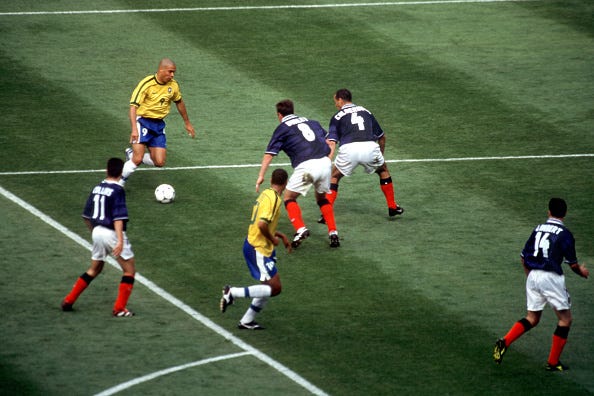
Throughout my childhood, everyone playing football down the park wanted to be Ronaldo or Ronaldinho — or, if free-kicks were to be taken, Roberto Carlos.
I remember an Irn-Bru advert from the 2000s that proposed a tongue-in-cheek plan for Scotland to win the 2034 World Cup, by “inviting Brazilians over to have kids with us”, creating dual nationals with names like Crawford Baptista, Aberdinho and Mackaká, set to bring us footballing glory. Over years, this all built up an exaggerated perception in me that Brazil was everything Scotland was not: colourful, sunny, sexy, thrilling, dangerous and good at football.
Much of that turned out to be true, at least to some extent. My first Brazilian five-a-side experience comes to mind, where I was amazed to find out that the other team’s rotund striker could turn on a five pence piece and finish like Romário. I quickly fell in love with the country, the continent and its football.
When Nutmeg FC asked me to preview this Saturday’s final of the Copa Libertadores — South America’s Champions League equivalent — for a Scottish football audience, I spent a few days staring at a blank sheet of paper, hoping my notes and article outline would magically appear.
Convincing any European crowd to take note of football in another continent is hard going, and the game in South America has few obvious links or selling points to attract viewers from further afield.
For Scottish football fans, some may be interested to know that Alfredo Morelos now plays in green and white, banging in the goals at high-flying Colombian side Atlético Nacional, who are competing for this year’s domestic title against clubs like América de Cali, managed by one-time Aberdeen reserve goalkeeper David González. Tenuous, I know. Direct links rarely go much further.
And kick-off times do not tend to be friendly for anyone trying to watch from Scotland. The earliest weekend fixtures in Brazil and Argentina tend to start at around 7pm GMT, scuppering many a Saturday night social engagement. Meanwhile, staying up for a midweek Libertadores group stage match in Peru requires real dedication, typically kicking off at 3am. (Granted, Saturday’s final will be kinder, starting at 8pm in the UK — hopefully with live BBC iPlayer coverage.)
But where South American football excels above all others is in its storytelling. All over the continent, narratives of revenge, retribution, supremacy and betrayal are being woven on an almost daily basis, often with strong links to local footballing history and tradition.
Take this weekend’s Libertadores final between Argentine side Estudiantes de la Plata and Brazil’s Palmeiras, for instance. The only time Estudiantes and Palmeiras have faced each other in their history was at the same stage of the same tournament in 1968. Finals back then were two-legged affairs: Estudiantes won in Argentina, Palmeiras won in Brazil, setting up a neutral decider in the Estadio Centenario in Montevideo, Uruguay — which, as fate would have it, will also be the stage for Saturday’s final.
Estudiantes won that match 2-0, with the crucial second goal being scored by Juan Román Verón — the late father of former Manchester United midfielder Juan Sebastián Verón, now Estudiantes club president.
Despite being almost 60 years later, the weight of the 1968 final will no doubt be felt on the shoulders of the Palmeiras and Estudiantes players this Saturday, not least because the Centenário stadium hasn’t exactly changed much since that historic match.
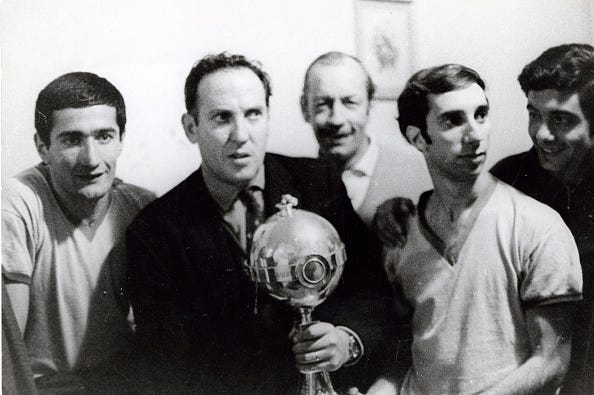
South American football also provides the thrill of having a deep lore, including the colourful nicknames and running jokes that fuel fan rivalries and identities. Where else, for example, would you find a continental final between the Pigs and the Rat-Stabbers?
Palmeiras’s swinelike sobriquet dates back to the 1980s, when the São Paulo giants faced a long drought of silverware. Since then, rivals disparagingly referred to Palmeiras as porco (Pigs), until the club’s fans decided to claim the nickname for themselves, eventually adopting a giant pig as their mascot.
For Estudiantes, the Pincharrata (Rat-Stabbers) moniker dates back to the club’s early years, at the start of the 20th century. The simpler (yet no less delightful) version of the story relates to the team’s origins as a university club, made up largely of medical students who, on occasion, practiced their surgical techniques on small rodents.
The nickname’s more colourful explanation relates to Felipe Montedónica, an early Estudiantes fanatic, who worked at the fruit and veg stalls at La Plata’s municipal market. To protect his merchandise, Felipe would keep a large garden fork on hand at all times, ready to spike any pesky rodents on the market floor. As the story goes, he and his club then proudly became known as the Rat-Stabbers.
These are just a few examples of the colourful threads of narrative that I love knitting together over on my Substack, CLOSED FOR THE FOOTBALL, where I write about the past, present and future of the South American game, often all at once.
Next week, I’ll be unpacking Saturday’s final, and there are plenty more exciting tales lined up for between now and the end of the year.
Argentina and Brazil have long been at the heart of the Copa Libertadores. Now you can experience the footballing passion of these two great nations first-hand with Aficionados. Discover legendary clubs, historic stadiums and unforgettable matchday atmospheres by signing up to their football experiences in Argentina and Brazil, including The Samba Football Experience, which Euan Marshall will be joining.
Find out more at www.aficionadosft.com.
