

Nutmeg Magazine contributor Andrew Downie was born in Edinburgh. He moved to Brazil in 1999 and spent 20 years there. He translated the biography of Garrincha from Portuguese, then wrote ‘Doctor Socrates: Footballer, Philosopher, Legend’ and then ‘The Greatest Show on Earth: The Inside Story of the Legendary 1970 World Cup’. ‘Epic,’ his biography of Pelé, has already been hailed as the most complete work on the greatest footballer of all time. This extract exposes the rift that grew between Pelé and his one-time protégé, Diego Maradona.
By Andrew Downie
Pelé and Diego Maradona first met in April 1979, not long after the Argentine led his country’s under-20 side to the finals of the World Youth Cup. Maradona told an Argentine journalist friend that his dream was to meet the Brazilian, and after a few weeks of aborted attempts to bring them together — mostly because Diego did not want to travel on a Monday, the one day he had free for his girlfriend Claudia — the meeting finally took place in Rio. Reporter Guillermo Blanco, who was writing about the meeting for Argentine sports magazine El Gráfico, got the OK from Pelé’s people and was so intent on making it happen that he checked Maradona onto a flight one Sunday night without telling him. He collared the young man after Argentine Juniors played Huracán and then raced to the airport and put him on a plane with his father, his agent and a photographer.
The next day, the small group of Argentines went to Alfredo Saad’s apartment in Copacabana, where Maradona and Pelé sat for an hour discussing football and life. ‘It was all great, they chatted, Pelé got out his guitar, he sang some songs, it was really nice,’ Blanco recalled. ‘Then there was a moment when it got a bit deep when Pelé started to give Diego some advice. He took Diego’s hand and he started giving him counsel. “Look after your body. Remember to always train. There’s a lot of responsibility on your shoulders.” It was like a premonition. Everything that would happen to Diego, Pelé, with all his experience, was telling him would happen.’
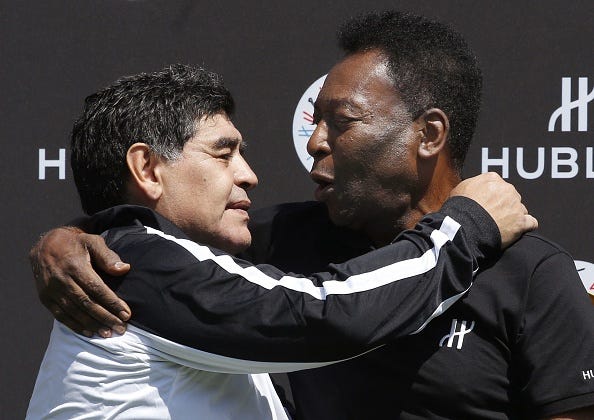
Before they left, Pelé hugged Maradona’s father and gave his son a signed ball, a Brazil shirt and a Pelé watch. The friendship between the players appeared to be sealed. ‘I knew Pelé was a god as a player,’ Maradona said. ‘Now that I’ve met him, I know he is as a person, too.’
Those present that sunny afternoon in Rio could never have imagined how the paths of the two men would diverge, overlap and collide, like wingers and full-backs determined to get the better of each other. Their mutual admiration survived for a few more years but when it soured, it soured royally and the fallout made headlines around the world. They were often described as rivals but what they really had was a love-hate relationship fuelled by South American nationalism and grandiose egos. Adding even more spice were the moralistic subtexts of good vs evil, the establishment vs the people, and the conformist vs the rebel. They were two completely different people and everyone took a side. Maradona summed it up perfectly: ‘We’re oil and water.’
The first cracks in their friendship appeared three years after their Rio meeting, when Pelé criticized Maradona’s performance at the 1982 World Cup. The Brazilian agreed to write a syndicated column during the tournament, and before it even kicked off, he predicted that Zico would make more of an impact than Maradona. In a sentence that would drive the first wedge between them, he questioned not just Maradona’s ability but his character. ‘My biggest doubt,’ Pelé wrote, ‘lies in knowing if Diego has sufficient greatness in his person to justify the honours that the world audience pays him.’
Pelé’s scepticism turned out to be entirely justified. Maradona lost the plot in Argentina’s second-round match against Brazil and was sent off after stamping on João Batista in the dying minutes of their 3-1 loss. The defeat meant the champions were out and Maradona, as Pelé predicted, had failed to live up to the hype. In his column the next day, Pelé piled on the misery, calling Maradona ‘an immature young man, who almost hasn’t had the time to transform himself into the great player that many people blindly state that he is’. To Maradona, the words were a betrayal. He had considered Pelé a friend and an ally, and he never forgot how the Brazilian became one of the first major figures to cast aspersions on his talent and character. Maradona was hardly a paragon of loyalty — he fought with just about everyone who ever loved him — but he demanded fealty from everyone else and Pelé’s slight wounded him deeply.

Tomorrow, we’ve got five copies of Epic to give away. Stay Tuned.