

It is a decade since issue one of Nutmeg dropped from letterboxes across the land. When we launched, we had no idea how long the magazine would last. Print, went the consensus, was yesterday’s news.
Over 1,500 articles and hundreds of photographs and illustrations later, we’re still here. To celebrate, over the coming weeks we’ll be publishing some of our favourite pieces for your delight.
And if you’ve not sampled Nutmeg in print yet, please do give us a try — there’s nothing quite like the escape that pages can bring.
This article first appeared in Issue 27 which was published in March 2023. To find out more about the print magazine and subscriptions, hit the button.👇
By Sam Phipps
October 14, 1936. The Pathé announcer does his usual plummy, jaunty thing: “In Glasgow, the Germans show 60,000 Scotsmen how it’s done… how they (the Germans) will stand up to one of our best international elevens is the question that adds the mustard sauce to a tasty dish of football.”
The venue is Ibrox and the “it” is the Nazi salute. Scotland, as hosts, are under no pressure to follow suit and decline to do so, though “loud applause” is reported among the crowd for the German gesture.
Only a few minutes’ footage is available on YouTube but it is still startling to see the swastika flag over the stadium, and the big crowd, albeit below capacity. In fact, around 44,000 attended that day, including 500 Germans who had arranged a cruise ship to take them on to Dublin for a match against the Irish Free State a few days later.
A question adding a bit more mustard sauce might be: why was Scotland playing this friendly, almost four years into Adolf Hitler’s regime, with conscription and rearmament well underway and persecution of Jews and other minorities even more vicious under the recently passed Nuremberg Laws?
The simple answer is because the SFA invited them. England had hosted Germany at White Hart Lane the previous December, despite protests from Jewish people, trade unions and anti-fascist groups, and within a fortnight the Scottish association extended their own invitation.
By the time of the Glasgow match, the Berlin Olympics had also taken place, again in the face of widespread opposition around the world, ultimately handing Hitler a major propaganda coup.
By the mid-1930s few people were unaware of the nature of Nazi Germany. Those who advocated that sporting contact be maintained, or even stepped up, ranged from the sympathetic to the optimistic or wilfully ignorant.
Somewhere on this spectrum were the likes of Anthony Eden, foreign secretary from 1935 to 1938, who argued that an international football match was a good way to show “we are not the effete and degenerate people we are misrepresented as being by our totalitarian rivals”.
Everything that applied to England’s game against Germany in 1935 — a football association intent on “keeping politics out of sport”, a largely compliant mainstream press and an active though ultimately unsuccessful protest movement — would hold true for the Scotland game.
The only real difference is that the Third Reich had been going almost a year longer by the time the German party touched down at Renfrew Aerodrome on October 11, complete with a red swastika on their plane’s tail.
On April 22, 1936 Hitler congratulated the British ambassador to Berlin and his wife — in a typed and signed letter — on the birth of their son the day before. That baby was my father.
One family story has my grandmother throwing a bunch of flowers, also from the Führer, from her bed in the maternity room to the street below, although this is disputed.
Beyond doubt is that my grandfather was an early and astute observer of Hitler’s character, militarisation and consolidation of power. After their first meeting — he had arrived in the German capital in October 1933 — Sir Eric Phipps wrote: “It was disquieting to feel such power in the hands of so unbalanced a being.”
In a dispatch to London in January 1934, he noted: “Nor do I see anything to show that Hitler will fall in the near future... he will in all probability continue the rearmament of Germany until his security is such that he can afford to display openly what now he still condescends to conceal.”
A year later he wrote: “Let us hope that our pacifists at home may at length realise the rapidly growing monster of German militarism will not be placated by mere cooings.”
The most entertaining — as well as sinister and prescient — of his reports describes a visit to Hermann Göring’s vast estate outside Berlin.
“Our host as usual was late, but eventually arrived in a fast racing car driven by himself. He was clad in aviator’s garments of India rubber with top boots and a large hunting knife stuck in his belt.”
Göring proceeded to lecture the assembled diplomats and politicians on the joys of the primeval German forest. Then a group of cow bison were driven towards a large box containing a bull. Cinematographers and photographers were on hand to capture a glorious mating but “the bison emerged from his box with the utmost reluctance, and, after eyeing the cows somewhat sadly, tried to return to it.
“The chief impression was that of the most pathetic naivety of General Göring, who showed us his toys like a big, fat, spoilt child: his primeval woods, his bison and birds, his shooting-box and lake and bathing beach, his blond ‘private secretary’, his wife’s mausoleum and swans… all, or so nearly all… Germanic.
“And then I remembered there were other toys, less innocent though winged, and these might someday be launched on their murderous mission in the same childlike spirit and with the same childlike glee.”
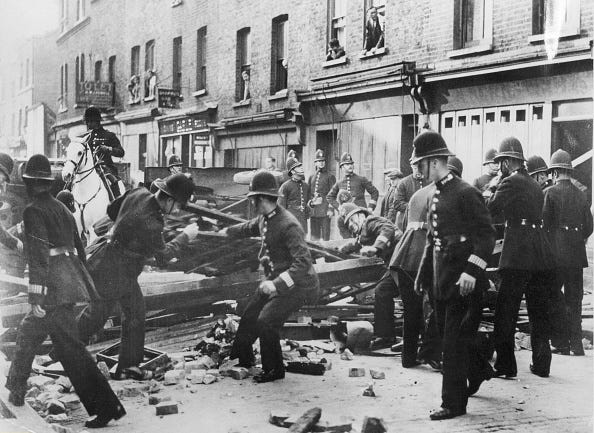
Barnett Janner, the Liberal MP for Whitechapel — the predominantly Jewish area of east London that would see off Oswald Moseley’s Blackshirts in the Battle of Cable Street only ten days before the Ibrox game — had told one newspaper: “The great mass of English football followers regard the Nazi persecution of Roman Catholics, church people, and Jews as a violation of the rules of sportsmanship.”
And Walter Citrine, TUC general secretary, had appealed to the government: “That team that will come over here to play is as directly representative of the Nazi government as the Ambassador in London here.”
He decried the disbandment of non-Nazi sports organisations and the way police and taxes would be used to protect a “gang of organised bullies” at the risk of “decent British… Trade Unionists getting battered by our police”. He was referring to the 10,000 German fans who came to London as part of the state-orchestrated trip.
A week after the England game, my grandfather wrote how the Nazis were “slowly but surely tightening their hold on German sport”. He continued: “It is one of the more important objectives of Nazi policy to develop the health and strength of the nation, and sport is also valued for the unifying influence which it exercises on Germans of different classes and from different states.”
He cited a notorious handbook by Bruno Malitz that extolled the benefits of “gymnasts and sportsmen fighting against Jewry” and the pride that stemmed “in being allowed to fight under the swastika”.
“Sport must be recaptured… and used as a weapon for the genuine building of a nation…. We Nazis want to educate the people through sport,” Malitz wrote. He also claimed 3.3 billion enemy soldiers had faced Germany in the First World War.
My grandfather noted that if the trade union leaders had been in possession of the book “they would have had a stronger case” in stopping the England game.
As it was, they faced a backlash from politicians and much of the press. The Daily Mail referred to the TUC’s “clumsy efforts” to “stop all but Marxists playing on British grounds”. The Conservative minister Lord Mount Temple, at the first Anglo-German Fellowship dinner, which was held after the game and attended by several MPs, denounced the TUC for its “stupid” attempt to sow discord.
The home secretary was too lenient on protestors, he said. “I would have told them to mind their own damned business... The Germans have always been our good friends. They always fought fair in the war, and I hope we did the same. If another war comes... well, I must not say what I was going to say. I hope the partners will be changed.”
Daniel Gray’s Homage to Caledonia cites a letter by William MacDonald to the Daily Worker. It typifies sentiment in some quarters in the run-up to Scotland’s game.
“The Nazis… have the insolence to send a team of propagandists on to Glasgow, a socialist city noted for its love of freedom and democracy… in the interests of peace and safety the magistrates of Glasgow should urge an entire veto of the match… Our slogan and that of the trade unions should be: ‘No truck with the Nazi murderers’. If an impudent attempt is made to proceed with the match, I can visualise in Glasgow the mightiest protest demonstration of our time.”
But on the day there was little if any disorder, partly because of a big police presence, as in London.
The German party landed three days before the match, staying at the Central Hotel and attending a show at the Pavilion. The next morning, they trained at Ibrox, where the Rangers and Scotland goalkeeper Jerry Dawson poked fun at the visitors by painting a small black moustache on his upper lip and pulling his hair over his right eyebrow.
It was widely suspected that the German ‘amateurs’ were being paid after their humiliating loss to Norway at the Berlin Olympics, according to the sport historian Andy Mitchell.
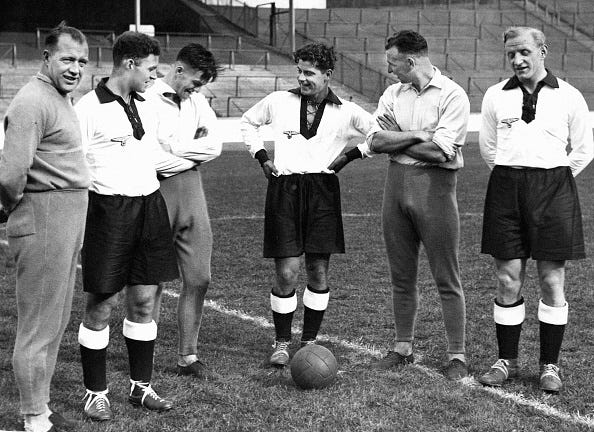
The start was delayed for 18 minutes after the Germans were held up in traffic. The team came out in the Nazi colours of white shirts with red collars and cuffs, and black shorts, with a Nazi eagle badge. They then lined up and gave the straight-armed salute to the stand before turning and saluting the opposite side, and saluted again for each national anthem.
Their salutes were mirrored by the 500 or so German fans, which is said to have bemused the Scottish reporters. The team had also brought two large Nazi flags, which flew over the stand with one Union Flag.
Scotland were expected to win easily but all the flair belonged to Germany, the hosts scraping a 2-0 win with a second-half brace by Celtic’s Jimmy Delaney.
The next day’s Scotsman praised Germany’s “swift, accurate passing movements… of real beauty to the football connoisseur”. The visitors only faded in the closing stages when, “playing to the British code of conduct”, they tired after what it called “many severe joustings”.
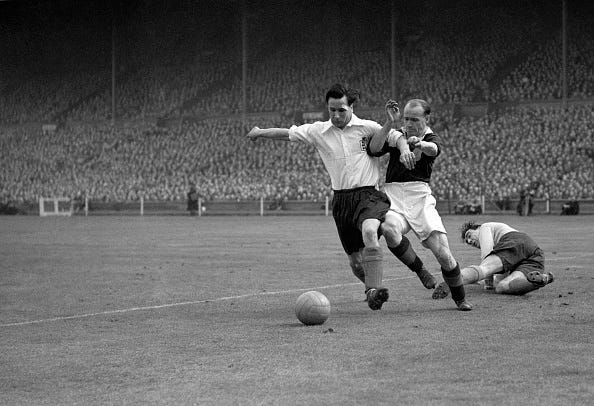
The Times agreed: “The quality of the Germans’ play surprised everyone. Not only were the visitors as good as the Scots at keeping the ball on the ground, but in the first half they were actually superior.”
Match reports also remarked on the impeccable courtesy and fair play of the visitors. But it is the Scotsman’s comments about the context of the game and the arrest of two protestors that jar most today.
“The German Chancellor and his Propaganda Minister have accomplished few things to more purpose in their efforts to foster friendship between their people and those of this country than by their assent to the football match between... Scotland and Germany yesterday,” it stated.
As for the two men, they were detained in Govan police station on breach of the peace charges after holding up a large red banner in the crowd at half-time.
“The inscription referred to the Jews and Hitler. Police officers immediately made their way to the spot, but before they reached the men the banner had disappeared from sight. The police, however, were able to effect the arrest of the men. The banner was taken possession of,” the report assures readers.
Meanwhile, in what looks like another propaganda coup, the following day’s Scotsman gave a roundup of German press reaction to the game. This was suspiciously gushing in its praise of Scotland’s players, so unlike the verdict of British newspapers.
“The Scots played wonderfully,” the Berliner Tageblatt reported, while Deutsche Allgemaine Zeitung said: “Every Scotsman proved himself to be an artist at the game.”
Three days later, Germany were trounced 5-2 in Dublin, failing to reproduce the “scientific football” that had been on display in Glasgow, according to the Times.
It was not the last of Germany’s matches against British or Irish teams. In May 1938, a few months after the Austrian Anschluss, England beat them 6-3 in Berlin. The visitors, Stanley Matthews and all, gave the Nazi salute on that occasion, reportedly under duress from the British ambassador. He had given the instruction in the dressing room before kick-off, to avoid offending the hosts. It wasn’t my grandfather though — he had been moved on to Paris the previous year.
The question of sporting boycotts has always been fraught. Few nations, certainly not the UK, have an immaculate record when it comes to military aggression or human rights. But it is still hard to believe Russia was allowed to host the 2018 World Cup four years after annexing Crimea. Some friendlies make even less sense. These Germany games are among the starkest examples — another is Scotland’s 1977 visit to Santiago, where they played Chile in the Estadio Nacional, which had been used for the detention, torture and murder of General Pinochet’s opponents a few years before.
As Brian Glanville has written: “International sport is no pacifier of nations, and the specious efforts of certain governments to use it for propaganda have made it still more of a divider.”
I never knew my grandad. He was 60 when my father, the youngest of six children, was born, and he died weeks before the end of the war he had seen coming, and in which another son was killed. My grandmother outlived him by more than 40 years but never spoke about those times.
The few photographs I have seen show a formality of dress straight out of the Victorian and Edwardian eras; he often wore a monocle. In these images he is usually in work mode but is known to have remained dapper at all times.
On the cover of his diary, Our Man in Berlin, published in 2008, he stands dressed in full regalia, brocade and all. Opposite him, angled slightly away, is Hitler, arms crossed, head bowed, in tails and white tie. Chilling, to say the least.
In contrast my dad William, a silversmith, shunned formality — and in some ways authority. One T-shirt he wore not long before he died featured the Banksy image of a chimpanzee with the slogan: “Laugh now, but one day we’ll be in charge”.
I am grateful to Andy Mitchell of Scottish Sport History and Richard McBrearty at the Scottish Football Museum for their help with this article.