

By Stephen McGowan
Relegation from the SPFL Premiership forced St Johnstone’s American owner Adam Webb to take stock and assess.
Simo Valakari had been manager for seven months, taking charge of 35 games. The Finn had expressed the hope that, together, he and the club could do something special.
When the Perth side finished bottom of last season’s top flight, five points adrift of 11th place Ross County, special wasn’t the word which came to mind. Under Valakari, Saints had won 11 games and drawn four in all competitions, a win rate of 31.4%. Losing 20 of their 35 fixtures, they had conceded 55 goals and scored 36.
Despite results, Webb had forged a relationship with his manager off the pitch. So much so that, come the end of the season, the Atlanta-based attorney flew his manager out to the United States to plot the path ahead. After three days — and one or two 3am finishes — they agreed to regroup and go again in the Scottish Championship. Saints currently sit in top spot, relishing their televised face-off with second-placed Partick Thistle at McDiarmid Park tomorrow night.
“I do believe — and I think everyone senses — that we have a problem,” says Webb. “There is too much of a readiness to fire the current coach and to think it will solve everything when the truth is that it rarely does.
“I think people should consider all these factors, including cost, disruption and the question of loyalty to the people you appointed. What does it say about your organisation if you are throwing people in and out so readily?”
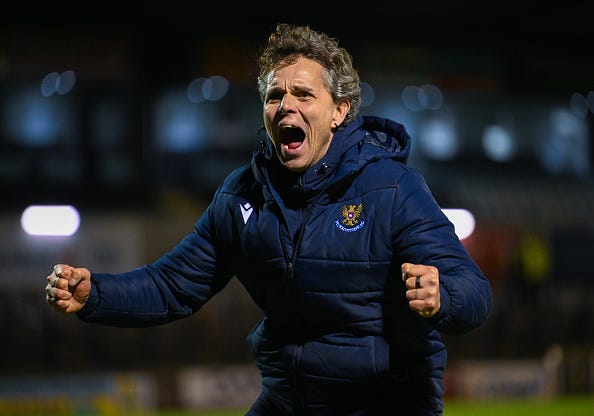
One of Scotland’s wealthiest men, Roy McGregor adopts a different approach to managerial relations at Ross County.
The Highlanders have made 12 managerial appointments since 2010. While Don Cowie survived relegation after a play-off defeat to Livingston, the reprieve was short. He was replaced by Tony Docherty in August.
Docherty had previously lost his job at Dundee despite keeping the Dark Blues in the Premiership at the expense of County and St Johnstone. He lasted four months in Dingwall before a 6-0 defeat to Raith Rovers prompted his removal and the installation of Stuart Kettlewell, a coach fired by Kilmarnock after six months, 21 days and 23 games in charge.
Trigger-happy football clubs are not unique to Scotland. In April 2025, a CIES Football Observatory report analysed 65 leagues and found that, on average, 65.6% of coaches had been in their roles for less than a year.
Ranked 49th on the list of volatile footballing environments, the SPFL Premiership paled in comparison with Costa Rica’s Primera Division and Liga MX in Mexico — where 100% of the coaches lasted less than a year. Half of the managers in the top tier of the SPFL suffered the same fate while a quarter lasted one to two years. A mere 16.7% had been in post for three years or more, the average tenure of a coach in the Premiership working out at 487 days.
While the return of Livingston’s David Martindale and Falkirk’s John McGlynn raised the average slightly, the line dipped when the nation’s top clubs began throwing P45s around faster than Nottingham Forest owner Evangelos Marinakis.
Russell Martin lasted 123 days at Rangers after a calamitous reign. Celtic watched events unfold across the city but failed to heed the warnings and stood by Wilfried Nancy for 33 days. Hired as part of a three-year project, Aberdeen’s first Scottish Cup in 35 years failed to prevent Jimmy Thelin’s dismissal in half that timeframe. Factor in Kettlewell’s departure from Kilmarnock and a third of the teams in Scotland’s top division have already changed their manager this season.
While results offer the most common explanation for managerial sackings, results considered satisfactory in an 18-team league might be hazardous in a 12-team competition like Scotland. Fortunes, like perceptions, can change quickly.
Valakari had been manager of St Johnstone for less than three months when Dundee made the 22-mile journey to Perth last January and won 3-1. Defeat made it two points from eight games for a Saints team which had failed to win a game since November. After the final whistle, 30 members of the club’s ultras group gathered outside the main door of McDiarmid Park to register their protest. Undergoing treatment for head and neck cancer at the time, Webb was unmoved.
Get 12 months of access to every post on Nutmeg FC PLUS a year’s subscription to the beautiful, 200-page print quarterly — delivered straight to your door.
Monthly digital-only subscription also available
“Our biggest priority is pleasing our supporters and keeping them on board,” he tells Nutmeg FC. “But you just have to know that short-term thinking is not good for our club.
“You can’t blow with the wind. We have to spend the time developing our identity and ethos, and sometimes you have to lose a little bit before you can build up.”
A former investor in Cambridge United, Webb arrived in Scotland with a limited knowledge of the Scottish game. A crash course on the nuts and bolts of an idiosyncratic league was delivered by a man who had been there, seen it, done it and worn the t-shirt.
“I sit down often with Geoff Brown, the former owner of St Johnstone who was around our club for nearly 40 years. And he has told me on at least two occasions that the most important relationship at any football club is between the chairman and the head coach or manager.
“He gave numerous examples of that and it sunk in with me. And I am very glad that Simo and I are both willing to spend the time building a personal relationship, a friendship and a connection not just related to the business of St Johnstone. When I am over in Scotland, I have dinner with Simo once a week and I have met his wife and children and their girlfriends. In the summer, he stayed with us here in Atlanta for three days.
“Simo said we were drinking until 3am but I don’t remember the exact time. That’s how bad it was….”
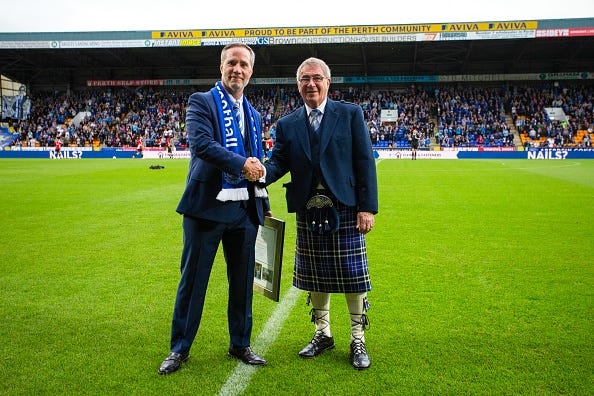
Hibernian are another club who have reaped the reward for holding their nerve. Bottom of the Premiership after one win in 12 games last season, chairman Ian Gordon was invited to Las Vegas for clear-the-air talks with former investor Bill Foley and his Black Knight Football Club lieutenants Ryan Caswell and Tim Bezbatchenko after complaints that their input into key decisions was being ignored. The future of manager David Gray hung by the slenderest of threads after a defeat to St Mirren.
“I remember thinking, ‘This has to calm’,” says Easter Road sporting director Malky Mackay of that period.
“My role was to make the place a stable ship and ensure that every message coming out of here is normal. What people expect. We had to become the club that we should be.
“There was a perception around the club where that wasn’t necessarily the case.”
In hindsight, a 96th-minute equaliser from Rocky Bushiri in a 3-3 draw with Aberdeen in November 2024 proved to be a sliding-doors moment. After defeats to St Mirren and Dundee, when everything felt dysfunctional and chaotic, Hibernian rallied. They lost just one of their next 14 games and Gray became a contender for manager of the season.
“People outside were seeing what was happening on the pitch,” explains MacKay. “I was seeing what was actually happened behind the scenes.
“We had a pretty imbalanced and bloated squad and we lost six games in the last five minutes. There were huge individual errors happening, we had four red cards in 12 games and we missed three penalties.
“No excuses, but everyone could see that anything that could go wrong was going wrong.”
While five clubs started the new Premiership season with a new head coach, Hibernian stuck with what they had. MacKay had been the manager of Watford, Cardiff, Wigan and Ross County. He had walked in David Gray’s shoes many times. He understood that the results of a manager could not be judged in isolation. More often than not they reflect the model and structure and recruitment of the club he represents.
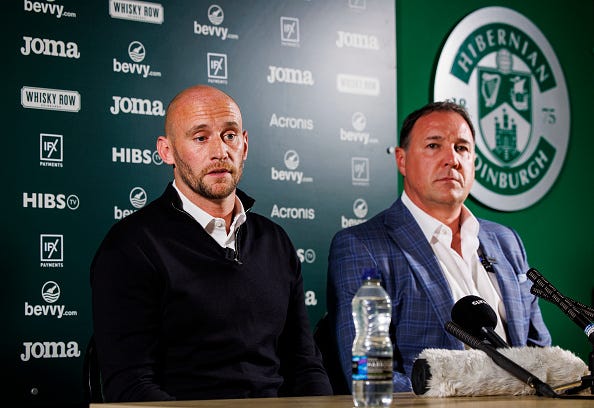
“You are judged every Saturday on 90 minutes and until you stand in those shoes and see the pressure that comes from players, staff, owners, press and the public you don’t know how that feels,” adds Mackay.
“Some of that is taken on these days by a sporting director, which is the way it should be now.
“But the role is still incredibly pressurised where you are being abused on a daily basis by fans and by social media. And that affects people’s lives. Back in the day when I was a young manager, you got two or three years to do your job.
“These days you are lucky to get 12 months. The situation is getting worse.”
Thanks for reading. If you enjoyed this, or have something to add, please leave a comment. 🗣️ Tomorrow: Part II — We explore the reasons why managers are now a disposable commodity with former league supremo Roger Mitchell and Falkirk boss John McGlynn.