

This article first appeared in Issue 24 of Nutmeg in June 2022, ahead of that winter’s World Cup in Qatar. It is free, but most of our content is paid. Don’t miss out… get a Nutmeg season ticket.
By Rob Haywood
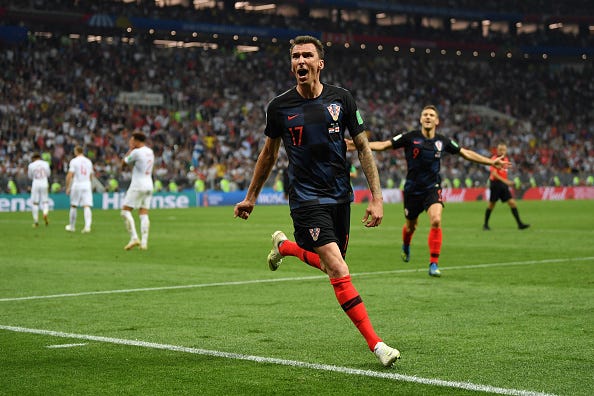
It was the prototypical battle of good against evil, black against white, light against shade. You get the idea. England’s all-white leather-on-willow garb; straight from the village green. Up against Croatia’s chequerboard tablecloth gone bad: black with satanic hints of red on the socks and numbers, unpronounceable names on the back. This was the World Cup semi-final 2018.
Retired referee Graham Poll later wrote that: “Croatia are the masters of the dark arts.” It had been widely accepted for centuries that Croats were the bogeymen under the bed and the monsters in the cupboard. “If you don’t behave, a Croat will get you,” was the threat given to small children from the Middle Ages onwards. Even the item that ties (pun intended) the name of the country with its most famous historical fashion item, the cravat or neck-tie, is something that grabs you around the neck. The stage was set.
The English media hinted strongly that Croatia would be tired after two extra-time games but seemed to forget that Columbia had also taken Gareth Southgate’s side the distance. If anyone had bothered to look at the numbers, they would have seen the truth: the average time played by each man in the starting line-up in the tournament to that point was for Croatia 398 minutes per player and for England 378 minutes. So Croatia’s players had played 20 minutes more football over the previous five matches. That’s just four minutes per match. No one should have been surprised when Croatia did not fade during the game.
These were simple numbers to find and study. Croatia themselves were involved in much more complicated analysis as the tournament moved on, and Scotsman Marc Rochon was at the centre of it.
Though Rochon grew up on the south coast of England and has the accent to prove it, his family roots are firmly planted in John o’ Groats. When his father took a job at Marconi in Portsmouth more than 30 years ago, Marc moved with him. A sports science degree at Solent University led to a work placement with Southampton (under manager Jan Poortvliet, the Dutchman who was nutmegged by Archie Gemmill in 1978 on the way to that goal), a year at Tottenham as an intern and then an analyst role at Portsmouth as they went into administration.
In December 2014, Rochon took a call from Ben Stevens, then the head of analysis at Newcastle, with whom he had worked at Southampton. He was told a club in the Middle East was looking for an analyst and asked if he was interested. Portsmouth were mired in the middle of League Two with no budget, so he was intrigued.
The club was Al Ain in the United Arab Emirates and he took the call. “When they explained what they were doing and how they were working, I was extremely excited,” recalls Rochon. “I had the phone call between Christmas and New Year and they called back on the 29th and asked if I could fly out the next day!”
He managed to negotiate a two-week window to get his affairs in order — which included getting married. “My [now] wife was pregnant and it would have been illegal for her to be there pregnant while unmarried. So within two weeks we upped sticks, got married and moved to the other side of the world.”
Rochon provided valuable insights for the incumbent head coach, the Croat Zlatko Dalic, as domestic trophies were won. It led to a trip to the final of the Asian Champions’ League. However, a narrow defeat to a South Korean club in that showpiece event and changes on the Al Ain board led to Dalic’s departure in early 2017 while Rochon stayed on.
Nine months later, the Croatia national team faced the prospect of missing out on qualification for the 2018 World Cup. Dalic was installed as interim head coach for the final group match away to Ukraine. A win was needed just to reach the play-offs. When Rochon heard the news, he contacted his old boss. “I sent him a message saying, ‘Congratulations on your appointment. If you need anything let me know’,” says Rochon. “He replied saying, ‘Let me know everything you know about Ukraine.’ They were not on my radar.”
Dalic was appointed on a Friday with the crunch game on the following Monday. “From the Friday to the Saturday evening, I basically spent the entire 24 hours watching Ukraine [videos], checking the data, writing a report on how they set up, what were their strengths and weaknesses,” says Rochon. “I constructed a report showing how they typically set up, who are their creators, who are the key players in their possession map, what are their set plays.” In the end, it was a 20-page document. Rochon sent it across and Dalic read it cover to cover.
Croatia won the game 2-0 and faced Greece in a two-legged play-off. Rochon was again asked to contribute and when Croatia won through, he left Al Ain at the end of that season to join the World Cup finals preparations, but without a contract in place. “Going into the World Cup it was just, ‘Let’s see how we go and we’ll take it from there’,” he recalls.
“That was the same for all of the staff and I believe for the head coach as well. So we went into a World Cup not having a contract, not knowing what would be happening after the tournament and with no guarantees what would happen during it. What we did go in with was an excited group of staff who were motivated to do anything we could and focused on taking it step by step.”
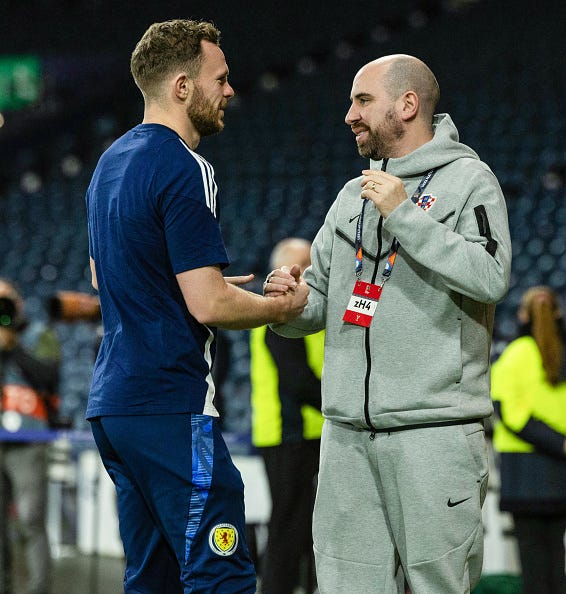
Rochon was left on his own to provide all of Croatia’s data and video footage, and had virtually no budget. He arranged to get video feeds from FIFA which he could edit and send to the bench during games. “For everything else I begged, borrowed and took things from other areas,” he explains. “I had access to a Wyscout account which I paid for myself because I knew if I didn’t have that I wouldn’t be able to provide individual clips to the players.”
It’s impressive that Rochon can remember much about the 2018 World Cup because he was surviving on two to three hours’ sleep per night. “Red Bull and Pro Plus were my friends,” he laughs. With Croatia enjoying a successful tournament, his sleep-deprived trip went on for longer than many expected. There were intense periods between the games and even more pressure during matches as he was doing the work of several people by himself.
“During games, I had live communication down to the bench,” he recalls. “I was in the press box with a separate desk and the opposition would have the same and then we all took feeds from the FIFA TV station. We’d have a camera which was slightly wider angle and just following the play, a high behind-the-goal angle, and cameras focused on each of the 18-yard boxes as options to be able to view. I was sat there with one laptop using [video analysis platform] Sportscode, preparing clips to show at half-time of a lot of different events that I thought would be of interest: passes between the lines that were causing us an issue or passes into certain areas where we were being overloaded or underloaded. I would run down to the dressing room at half-time and then run back up. In all I was using three laptops, two TV screens and a radio to talk to the bench.”
During Croatia’s knock-out games, they twice needed penalty shoot-outs to progress and Rochon had, of course, prepared for this eventuality. Videos of opponents’ previous kicks and shot maps showing placement were provided to Croatia’s goalkeepers.
In the last 16 against Denmark, Danijel Subasic saved the first kick from Christian Eriksen. Rochon explains: “[Afterwards] the Danish analyst asked, ‘Did you do analysis on our penalties?’ and I said, ‘Yes.’ He said they’d spoken to Eriksen before the penalties and said, ‘Please don’t shoot your normal way.’ Because on his map all his penalties for Denmark had gone in the exact same spot. So they said, ‘Please don’t shoot that way because they’re going to have watched you.’”
Playing England in the semi-final added an extra edge for Rochon. At the final whistle, he drew some strange looks as he jumped up and screamed out in English. Croatia became the smallest country in almost 70 years to reach a final.
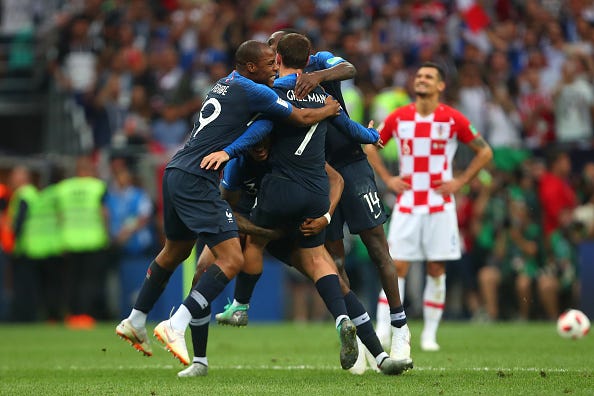
For much of the final, Croatia pushed France close. Ultimately, they were deflated by some controversial first-half decisions. “Looking back on it, I was too tired to take in what we’d achieved,” says Rochon. “My personal feelings going into the final were that we could have done a lot more. We hadn’t followed our usual procedure that we had with the other games, the extra attention and the extra rigmarole around a final meant there wasn’t the available time to do things, everyone was clamouring over a piece of the players. I took a picture on my phone when the ticket manager came in the dinner room and he was surrounded by 20 players, you couldn’t see him.
“There was an awful lot going on around that which I thought we could have done better and I would like to think that if we ever got to that position again, we’d manage that a bit better.”
At the next major tournament, the delayed Euro 2020, Rochon found himself pitted against his home nation in the group stages but the planned base at St Andrews was abandoned because of Scotland’s strict Covid guidelines. As it happened, the final group game between Croatia and Scotland was key for both nations. “Up until the game I was fully focused on the win just like any other match but hearing the national anthem was really heart-wrenching,” he says.
“When Scotland scored, I had to remind myself not to cheer for a brief second, but quickly focused on the game. I would have loved to see both qualify but I had to make sure my team qualified and on a personal level I wanted the people I worked with to win.”
Like this high quality of writing? You’ll get much more of it in the latest Nutmeg Magazine — our World Cup edition. Order your copy by clicking on the cover below.
