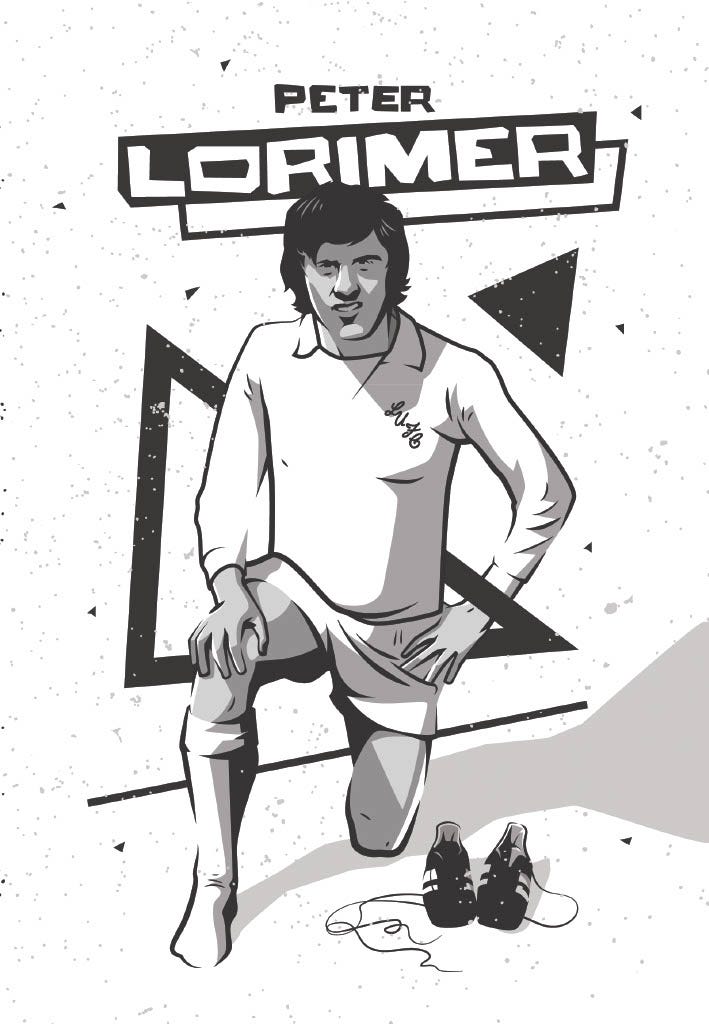
This article first appeared in Issue 20 of Nutmeg five years ago, after Peter Lorimer passed away. It is free, but most of our content is paid. Don’t miss out… get a Nutmeg season ticket.
By Patrick Barclay
Peter Lorimer was probably the most significant footballer ever to come out of Dundee.
There is a strong counter-argument for Jackie Mudie, friend and playing partner of Stanley Matthews in the Blackpool team who won the FA Cup in 1953. Like Lorimer, Mudie represented Scotland at a World Cup, scoring against Paraguay before the inevitable group-stage departure from Sweden in 1958, and his goals came at an even faster rate for both club and country (although neither was a full-time striker, each was as prolific a finisher as most who occupy that role).
A silly old sentimentalist brought up on the former Provost Road terracing of Dens Park could not let the debate pass without mention of Bobby Cox, Dundee’s captain when Scottish champions in 1961/62 and European Cup semi-finalists the following season, or of John Duncan, who followed the trail blazed by Alan Gilzean to Tottenham (Gillie, although the best player I ever saw in either of the Dundee shirts, was from the small Perthshire town of Coupar Angus, some 14 miles from Dens or Tannadice). And the heyday of Charlie Adam was hardly short of craft, style or spectacle. Through the decades there have been Ewan Fenton, who was with Mudie at Blackpool in 1953, Jimmy Gabriel, Bert McCann, Frank Munro, Derek Johnstone and David Narey.
But, to be serious, it is a choice between Lorimer and Mudie and, since trophies are a plausible guide to the magnitude of a career, the former’s achievements with the Leeds United of Don Revie break the tie: he won two English titles, an FA Cup, a League Cup and two Fairs Cups. And it could have been more because Leeds in their greatest era were frequent runners-up, most bitterly in the European Cup of 1974/75, when Lorimer believed he had legitimately put his side in control of the final against Bayern Munich with a volley only for Franz Beckenbauer to persuade first a linesman and then the referee that Billy Bremner had been in an offside position and interfering with play. As Leeds minds relived grievances instilled by dubious defeat at the hands of Milan in the Cup-Winners’ Cup final two year earlier, the players lost composure, fans rioted and Bayern, scoring twice, danced off with the European crown. Strictly speaking, the European Cup team was Jimmy Armfield’s, Revie having left for the England job. But the rancour was almost as familiar as the brilliance that took them to the brink of trophy after trophy.
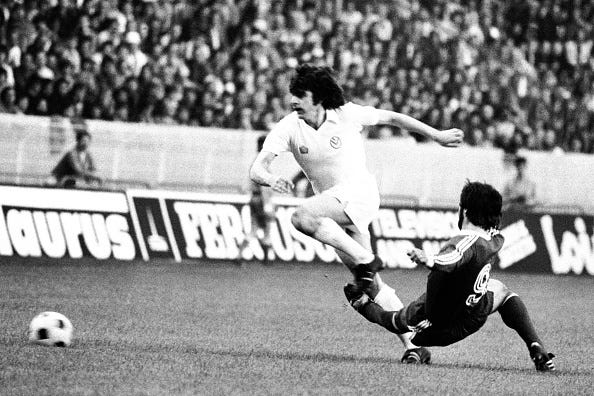
Revie’s Leeds, though magnificently gifted, could seldom be classed as light entertainment. Not that the players let on-field frustrations unduly interfere in a camaraderie that lasted almost to the end, in Lorimer’s case, despite a dwindling list of Elland Road chums. The deaths of Jack Charlton, Norman Hunter and Trevor Cherry in close succession at least left his best friend Eddie Gray, a fellow Scot (from Castlemilk) and adopted Yorkshireman. So close had they been that, after Lorimer passed away, Gray kept pausing to absorb that he would never see his pal again and every time found himself humming the tune of The Road And The Miles To Dundee. That was Lorimer’s number. Among the ways Revie liked to bond his team was with a good old singalong. Everyone needed a song and Lorimer went for the traditional ballad about a young man meeting a lassie keen to reach his home city. Revie, whose wife’s family were from Scotland, always insisted on Lorimer’s party piece.
Yet, although one of Lorimer’s testimonial matches was held at Dens Park — in 1977, between Leeds and a Scotland XI, Gray never heard him express allegiance to either Dundee club. If he retained affection for any club other than his great love Leeds, it was Hibernian, whose Famous Five forward line of Gordon Smith, Bobby Johnstone, Lawrie Reilly, Eddie Turnbull and Willie Ormond illuminated the Scottish game in the late 1940s and early 1950s. His mother, Janet (née Duncan), who came from Fife, and Uncle Paddy certainly supported Hibs and Lorimer fondly remembered trips to Easter Road that sprinkled a happy childhood by the wide estuary of the Tay.
Get 12 months of access to every post on Nutmeg FC PLUS a year’s subscription to the beautiful, 200-page print quarterly — delivered straight to your door.
Monthly digital-only subscription also available.
Peter Patrick Lorimer grew up not in urban Dundee but the seaside suburb of Broughty Ferry, with its former fishing cottages, pier and lifeboat station. His father, Peter, was often absent with the Royal Navy and spent much of his leave in pubs — Lorimer put his heavy drinking down to harrowing wartime experiences with the North Sea patrols. Janet, a nurse, also did domestic service in order to make sure that Peter and his elder brother Joe were well fed and clothed. The boys slept in the sitting-room of their first-floor flat in Church Street, there being only one bedroom, bathed in a tin tub and used an outside toilet. And yet how they scoffed at the ‘’oary’ (rough, almost chavvy) people who came from the cities to holiday on Broughty beach!
Joe was the more academic. Peter lived for Saturdays, when, watched by his mother — his father had little interest in football — he would play for his school in the morning and Broughty YMCA in the afternoon, scoring lots of goals even when he played in defence (the power of his shooting was extraordinary long before he became known as ‘Lash’ or ‘Hotshot’ throughout the English game). Leeds were in the Second Division but had a scout called John Quinn who saw Lorimer’s potential so early that he was receiving (illicitly) ten shillings (50p) a week at the age of 12. Every Sunday, Quinn would arrive with a £5 note for his father. Although in addition his mother would receive a bottle of Harvey’s Bristol Cream and a dozen eggs, these were not bribes; in order to build up her son’s strength, she had to send him to school every day fortified by a glass of sherry into which a couple of the eggs, raw, had been tipped. Whether this helped him eventually to become Leeds’ record goalscorer is not known, but it certainly left him with no aversion to a drink.
After scoring twice for Scotland Schoolboys against England at Ibrox, he became the most coveted youngster in the British game. Among the scouts who flocked to Broughty Ferry at an exciting time for local football — Dundee had just completed the city’s first League triumph with the famous win at Muirton Park, Perth — was Joe Armstrong, Matt Busby’s emissary from Manchester United, who left a briefcase containing £5,000. While Leeds could not compete directly, they came up with a formula by which the Lorimers would receive £800, doubling their combined income for the year, and Peter an enhancement to the normal apprentice’s wage, plus free digs and other benefits which enabled him to send £4 a week home. This and a sense of loyalty to Leeds did the trick. Revie was in such haste to complete the signing that police presented the Leeds manager with a ticket during the drive north. Lorimer soon became the youngest player ever to figure in the Leeds first team — at 15 years and 289 days, he was among five teenagers, including Bremner, who took part in a 1-1 draw at home to Southampton in the Second Division — and a further £2,000 arrived at Church Street when he became a full-time professional.
It was not all fun at first. Homesickness played a part and Lorimer had to wait two years for his next senior appearance — impatiently, for he and Gray were in a hurry. But now Leeds were in the First Division, making such an impact that they ceded the title to Manchester United only on goal average and were runners-up to Liverpool in the FA Cup final. Lorimer became a regular in the next season alongside Bremner and John Giles, Hunter, Charlton, Paul Reaney and Terry Cooper, and soon Gray joined him, occupying the left flank while Lorimer took responsibility for the right, sometimes crossing, sometimes drifting inside to enforce that shot. It was of such velocity that it was reckoned — indeed measured — to be equal to the fastest bowling of the likes of Michael ‘Whispering Death’ Holding, whose West Indies attack was instrumental in convincing batsmen the world over that an increasing array of protective equipment was necessary to preserve their safety.
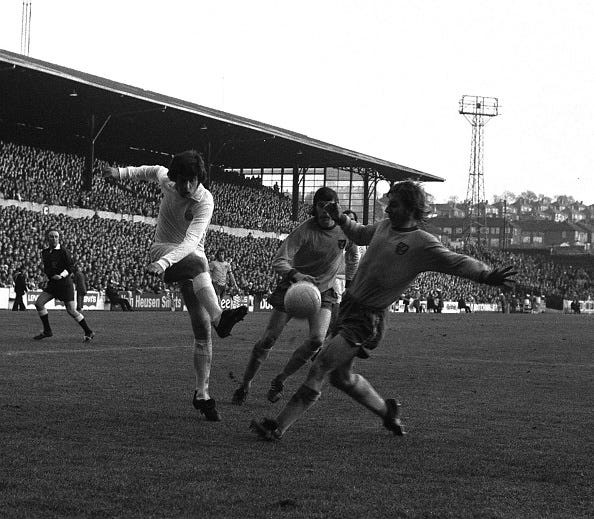
But Lorimer’s shooting was about more than power. His goals were as much the product of sumptuous technique. Often a helplessly clawing goalkeeper, upon landing defeated on his line, would find the ball spinning back out of the net to nudge and tease him. Connoisseurs of the all-time great goals will find pretty well everything in Lorimer’s immortal catalogue. To pursue the cricketing analogy, he could even impart the equivalent of reverse swing, once inducing the Ipswich goalkeeper to move optimistically to his right before the ball veered the other way to enter by his near post. He could do a gentle George Best lob, into the bargain cutting across the ball in a subtle variation on the Papiss Cissé theme, or if necessary a Karel Poborsky chip. Although the volleys were almost bread and butter to Lorimer, the one where he flips the ball into the air, waits and sends it dipping and swerving in a blur reduces even the best of Tony Yeboah to glorious pastiche.
Trophies were landed and celebrations savoured and yet this was an era — as Lorimer averred in a book published in 2002 bearing his name and subtitled Leeds and Scotland Hero — in which leading footballers’ earnings were insufficient to set them up for life. A few pints and a game of dominoes constituted his favourite recreation throughout his career at Elland Road and beyond, even though the book’s references to occasional excess include an unedifying tale of the shag-and-tell variety around the 1974 World Cup in West Germany; it was not unknown for Lorimer, during the first of his two marriages, to ask a lassie to show him a fair bit more than the road and the miles to Dundee.
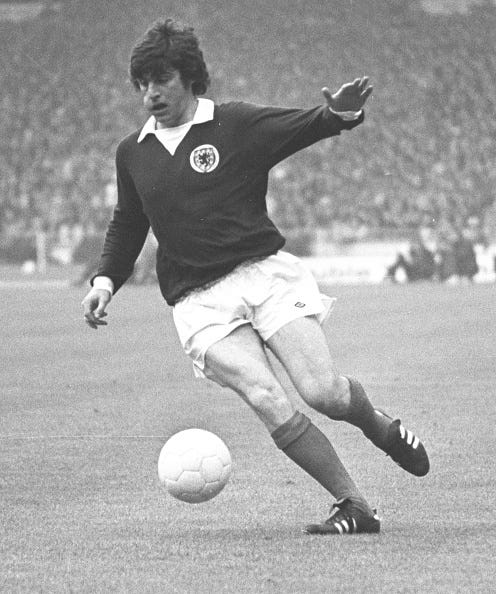
Tommy Docherty put him in the Scotland team, declaring in an introduction to the book that he believed Lorimer to be the best footballer in the world at the time, which was why he had persuaded the SFA to lift a life ban imposed after Lorimer spent a summer playing and coaching in South Africa in 1969, when apartheid was still in force. Lorimer played in all three matches in West Germany, a win over Zaire and draws with Brazil and Yugoslavia, ending up with 21 caps, which seems meagre until you factor in the ban and the much odder, in retrospect, tally of 23 rung up by Jimmy Johnstone, a partial contemporary. But for injuries, Eddie Gray would surely have got more than 12. It was Gray’s fitness record to which Brian Clough referred in the outrageous address to the players that conspired in ensuring his tenure as Elland Road manager would be short: “If you’d been a racehorse, they’d have put you down years ago.’’
Lorimer was taunted as a diver. Fair or foul? Suffice it to say he played in an era of refereeing in which players felt impelled to protect themselves. The methods chosen by Giles and Bremner, Charlton and Hunter — not to mention Reaney and Paul Madeley, and especially Allan Clarke, who was so fond of a battle he would blatantly wind up opponents such as Tommy Smith — meant that other teams would concentrate their aggression on the likes of Gray and Lorimer. So he bought the odd free-kick. He was, after all, equipped to make the most of them.
Yet Lorimer’s relatively routine hat-trick which began the celebrated 7-0 rout of Southampton in 1972 was from open play. Incidentally, because Revie was a close friend of the visiting manager, Ted Bates, he told his players to score no more goals, which is presumably why they instead contrived the ensuing multi-pass move in which Bremner performed keepy-uppy and heel flicks and Giles even did a rabona, all of which must have been much more wounding to Southampton than any number of goals. The following year at Wembley, it was Leeds’ turn to feel the pain, with Lorimer the victim of a revered save by Second Division Sunderland’s Jim Montgomery.
After 219 goals in the 618 matches of his main spell at Leeds, he returned in the mid-1980s to notch 19 in 87. In the interim, his aggregate was 49 in 159 for Toronto Blizzard, York City, Vancouver Whitecaps and University College Dublin. He went on to run The Commercial pub in inner-city Leeds, while remaining part of club life as director, BBC Radio Leeds broadcaster and columnist for the Yorkshire Evening Post. Lorimer lived near the racecourse at Wetherby and every year would join a party of about 20 in travelling to Scotland for the Perth Festival meeting, always staying at a hotel in Broughty Ferry. In the morning a hired bus would take them to the races, then back to socialise in the Ferry with old mates of Lorimer’s.
After his Yorkshire funeral, half of his ashes were kept in order that they may be taken north and laid next to the grave of his mother, the guide of his early life and career and dispenser — how the recollection made him laugh — of those sherry-and-egg breakfasts.