

Welcome to part II of Stephen McGowan’s observation of the life of a football club chief executive officer — Keith Lasley of St Mirren. Keith speaks ahead of tomorrow’s SFA summit which aims to work out how to encourage clubs to play young Scottish players. There are always competing interests to consider, but Keith believes there is now cause for cautious optimism.
By Stephen McGowan
By the end of tomorrow’s youth development summit in St Andrews, St Mirren chief executive Keith Lasley hopes to witness something as rare and unusual as a full eclipse of the sun. A unanimous show of hands among Scottish football clubs.
Between 9.30am and 3.30pm club owners, chairmen and chief executives will hear SFA chief football officer Craig Mulholland address the nation’s failure in the field of player production, before pitching their own views and ideas. Finger wagging, lectures or browbeating will be discouraged.
Recently promoted from the role of chief operating officer, Lasley has covered every base in Scottish football. He played over 400 games as a midfielder for Motherwell over two spells. Before he became a fixture in Premiership boardrooms, he did some coaching and, at the age of 46, he has been around the block often enough to know that persuading all 42 clubs to agree on anything at all is notoriously difficult.
The interests of Celtic and Rangers are not the same as those of St Mirren or Motherwell, just as the interests of St Mirren and Motherwell are not the same as Stenhousemuir’s or Stirling Albion’s. When club officials gather around the same table the question to the fore of most minds will be: ‘What’s in this for us?’
While a rule compelling clubs to field three under-21 players in every game might enhance Scotland’s hopes of reaching the knock-out stages of a World Cup finals, managers under pressure to reach the group stages of UEFA competitions might see less benefit to them.
In the Champions League play-off defeat to LASK Linz, only three Scots started for champions Celtic in a team filled with expensive Danes, Colombians, South Koreans, Germans, American internationals and Canadians. In their Conference League qualifiers, Motherwell started two, while Hibs started one. Unusually, Hearts won their play-off against Rapid Vienna with six Scots in Wouter Vrancken’s starting XI.
While most seem to agree that players between the age of 16 and 21 see nowhere near enough first-team minutes, doing something about it is fraught with difficulty.
“I feel — and maybe I am kidding myself on — that on the back of recent SFA reports and the new Scotland manager and European results there is a bit of momentum there to maybe find a consensus,” says Lasley, espousing an air of cautious optimism. “We need more of our own young players coming through for a number of reasons.
“So I want to come out that room and feel, firstly, that there is a general agreement that we need to do something here. And, secondly, that we have an action plan. A plan to say, ‘What are we going to do about it?’
“For me, that needs to be systematic. Whether that means mandating so many players in your matchday squad or incentivising clubs in monetary terms, we need one or two things that get all the clubs nodding around the table.


The rest of Part II is for paid subscribers. Been waiting for right moment to support the best football writing in Scotland?
“One of the problems in Scottish football is the different interests which exist within it. You can have loads of good ideas, loads of reports and then it comes to the crunch and it doesn’t really work.
“Look at most of the leagues around and most have mandated national player involvement rules or incentivisation or rules around how many non-national players are allowed in.
“I don’t want to say specifically what might happen, but I think there is an acknowledgement from everybody, whatever the size of the club, that we are not producing enough of our own players.
“The question is one of how do we get to something that helps with that?”
From the Ernie Walker group of 1995 to the Henry McLeish review of 2010, Scottish football has hosted more think tanks than the Adam Smith Institute.
Lasley sees all the problems first-hand in his working life. Scottish players in the crucial 16-21 transition phase see nothing like enough first-team minutes. Brexit has persuaded English teams, prohibited from signing 16-year-old players from Europe, to fish in Scottish waters instead. Paying minimal development fees, they offer young players and their families life-changing sums, longer contracts and more competitive games than they might get in Scotland.
Visas are another issue. Where England employs a points system to judge whether a player qualifies for a permit, the perception is that it’s harder to be knocked back for a governing body exemption in Scotland than it is to be waved through. Between 1998 and 2013, the old SPL mandated clubs to include at least three outfield players under the age of 21 in their 18-man matchday squad. Many treated the teenagers as ‘shirt fillers’ and the policy was quietly dropped.
Supporters working themselves into a frenzy over new foreign signings on deadline day have no tolerance for lectures on the need for their teams to blood young players. Neither, you suspect, do managers under pressure to win games in a 12-club Premiership.
“We can’t say, ‘Let’s do another report’ because we have the reports, we know the problems,” says Lasley. “What we need is a timescale from, maybe, the start of next season to get something implemented.
If it’s incentivisation, let’s go and study how we do it
“I don’t think we need to go straight to go. And, with the best will in the world, I don’t think we will. But I want to come out of that room this week with something. An idea. If it’s incentivisation, let’s go and study how we do it, what do we do and what are the options that we can implement from the start of next season.”
Incentives might see central grassroots funding handed down with specific provisos. The money might be allocated on the basis of first-team minutes for young players. Whether that would really make any difference to clubs with multi-million-pound turnovers like Celtic (£143million) and Rangers (£94m) is a tough question to answer.
“I am convinced now that it needs to be systematic,” says Lasley. “If it’s optional measures and you leave them to the players or the managers or the boards at each club then, personally, I don’t think we’ll get anywhere fast. There needs to be more than a new Scotland manager appointment to fix things.
“Having spoken to Craig (McLeish) about this I think that is there among managers. And I do feel it within the clubs as well. It’s the strongest feeling I have certainly felt and while I am not the longest-serving CEO by any means, I do feel as if it’s the greatest consensus there has been.
“I wouldn’t promise anyone that anything will change for sure — I have learned enough to know that. But I definitely feel as if there is at least the recognition that we need to do something.
“What that looks like I don’t know and I don’t want to speculate. But from a St Mirren perspective, we would be fully supportive of exploring that.”
Last year, the 503rd CIES Football Observatory post ranked teams from 65 leagues around the world according to the percentage of domestic league minutes played by footballers aged 21 or under in season 2024-25.
Owned by the City Group, Lommel SK in Belgium gave 69.4% of their first-team minutes to players under 21. The top-three teams in Europe’s big-five leagues were Strasbourg, Barcelona and Stade de Reims.
The picture in Scotland was less rosy. Top of the table were Dundee, a club who rewarded manager Tony Docherty’s willingness to giving 24.8% of his first-team minutes to under-21 players with a P45. Motherwell were second in the table, with 20.6%, while St Mirren were rock-bottom of the 12 teams with 0.8%.
The Paisley club recently published a new strategy document called ‘Our Progression’, laying out their targets and goals for the future. Intent on being the best community-centred development club in Scotland, giving kids a chance is central to that aim.
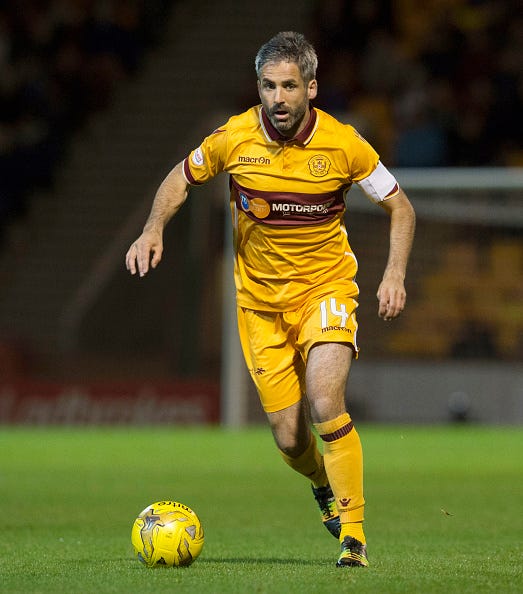
“There are two ways of doing it,” explains Lasley. “You either have a system which is incentivised and makes it happen. Or alternatively, it happens thanks to a crisis. That’s what happened to me. It was a Motherwell administration, essentially, that gave the likes of me and Steven Hammell and Stephen Pearson and James McFadden and David Clarkson a chance.
“Some of those guys had half-decent careers and when I look back it was administration that really accelerated that. There is always the chance that we would have made it through anyway. But I think it definitely accelerated the number of us who came through around the same time.
“So sometimes it can be an event like that which forces the issue and then, suddenly, you’re saying, ‘Oh, we do have some good young players.’ Or, in a more positive sense, it’s part of a strategic plan. History shows you that, generally, it is one of the two.”
In contrast with 2002, Motherwell are now one of the clubs St Mirren want to emulate. Selling Lennon Miller to Udinese for a record fee, the Steelmen also made decent money on Elijah Just, Elliot Watt, Callum Ward and Theo Bair. Utilising data, the Fir Park club have made equally impressive managerial appointments and are now using the fruits of that strategy to build new training facilities at Dalziel Park.
“Motherwell have been a shining example in the last couple of years,” says the St Mirren CEO. “Correct me if I’m wrong, but they have raked in substantial sums in the last couple of years. And you have to ask yourself: ‘What other way is there?’”
While St Mirren have nudged season ticket sales up over 4000 and increased commercial revenue, Lasley sees player production as the next step.
“Motherwell have set a really good example for all of the clubs of what best practice looks like and kudos to everyone there. From boardroom to dressing room there does seem to be clear alignment in how they are going about things.
“We are maybe not quite at that stage yet but that is our plan — to try and execute what they do on a similar level.”