

Welcome to Stephen McGowan’s observation of the life of a football club chief executive officer — Keith Lasley of St Mirren. Here, Keith explains the need for a fan-owned club to live within its means and have a joined-up approach, a strategic vision and the ability to adapt to any eventuality.
Today’s Part I is free, but most of our content is paid.
By Stephen McGowan
On a whitewashed wall facing the entrance to St Mirren’s Marbill Coaches Stadium is a black plaque. Inscribed in large letters is the date 27 July 2021, a significant landmark in the club’s history. As the lines underneath make clear, that was the day Buddies fans took ownership of the club and set about safeguarding its future.
A recent study by Off The Pitch, the football intelligence platform which publishes data on club finances, player values and salaries, declared the Paisley outfit the eighth-most financially sustainable club in Europe.
While Celtic’s fixation with sustainability drives their supporters to distraction, the Scottish champions led a top 10 also featuring Brann, Silkeborg, Napoli, Manchester City, Bayern Munich and Borussia Dortmund. St Mirren managed to nudge ninth-placed Serie A club Atalanta and French giants Lille down the list.
“It’s pleasing when you see that,” admits chief operating officer Keith Lasley. “I would be lying if I said it wasn’t. It’s not patting-yourself-on-the-back time, nothing like it, but it is good to see us mentioned in that sort of company. Some of those football clubs are very well established and mature in the way they are run. So for us to be mentioned in that company is pleasing.”
St Mirren’s place in the Off The Pitch top 10 is no accident. Like so many clubs up and down Britain, the Paisley outfit confront rising player salaries, increased operating costs and inflationary pressures on a daily basis. In a never-ending cost-of-living crisis items relentlessly rise in price and, to make supporters aware of the problems the club face, St Mirren recently published a strategy document called ‘Our Progression’.
Their goal is to become ‘the best community-centred development club in Scotland’ after St Mirren Independent Supporters Association (SMiSA) worked in conjunction with Paisley-based social enterprise Kibble to purchase a majority stake in the club from former owner Gordon Scott.
Answerable to the 1624 members of SMiSA, the club subsequently released the strategy document building upon the progress which saw them beat Celtic for their first major trophy in 12 years in last season’s Premier Sports Cup Final.
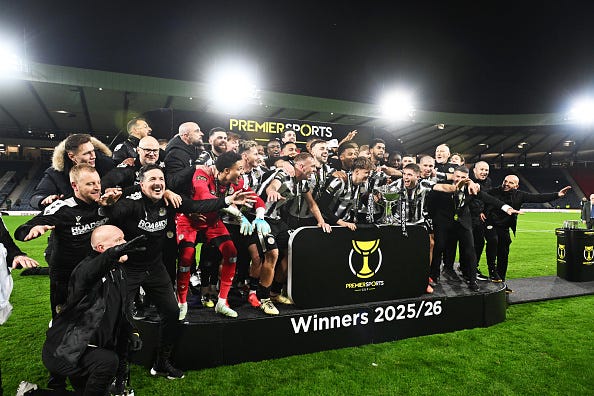
“Sustainability has to be one of the realities of being a fan-owned club,” explains Lasley. “What we have done in the last three or four years has been success for this football club. Top-six finishes, winning a national trophy and doing that while not losing money.
“The norm in this industry has now become that you lose a significant amount of money operationally. But a fan-owned club that doesn’t have a benefactor to underwrite that loss can’t operate like that. We need to compete on a break-even basis and that, in itself, in this day and age is actually an achievement in itself…
“So, yeah, hopefully on and off the park we have shown discipline and a plan which has borne some fruit.”
From time to time, the harvest has been less fruitful. The price of winning the League Cup was the loss of their previous manager Stephen Robinson to Aberdeen after three consecutive top-six finishes. By the time he left, the club were already battling to steady the ship after a choppy run of results in the SPFL Premiership.
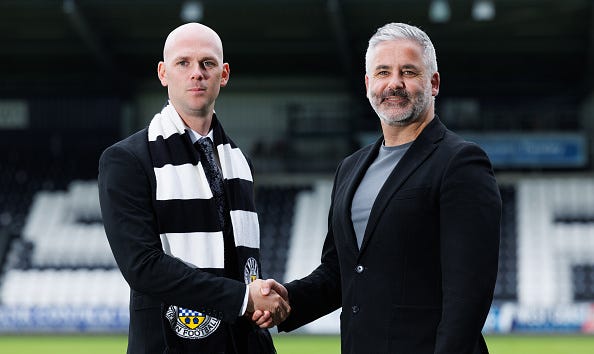
Interim boss Craig McLeish survived a two-legged relegation play-off against Partick Thistle to preserve the club’s top-flight status, securing the job on a permanent basis. The club’s former academy chief has since overseen a significant turnover of staff and a change to the style of play. The robust, direct football of before has been softened and, after three games, Saints sit second in the Premiership with seven points from a possible nine. Only an added-time equaliser from Motherwell stripped them of a 100% record.
“Listen, there have been some tricky times in there,” adds Lasley. “You don’t need to look too far back to the play-off last season and the tricky times we had around then.
“But as St Mirren we are going to have some bumps along the way. It’s never going to be a linear journey. It’s just not, given the clubs we are up against.
“But there is a plan there, there is a real alignment around the plan and the latest document was almost an update on the core strategy.
“I am into my fifth season now and one of the things I identified when I came in was that it was very disparate. It was very silo in nature from the boardroom to the fan ownership to SMiSA to first-team operations to academy operations — and it all felt as if someone had to say, ‘Listen, we need joined-up thinking.’
“A plan, essentially, and a bit of strategy which asked: Who are we? What are we doing? How are we trying to do it and why? And that’s when we launched our first strategy three years ago now called ‘Our Purpose’. We then fast forward into ‘Our Progression’, which is the latest document.
“When everything is going well, a plan is great. The hard part comes when the pressure hits and you lose three games in a row. You need to be strong. And it’s in those moments that a plan is most important.”
Key to the delivery of the plan is keeping supporters informed, a basic trick some clubs find inexplicably difficult to get right. A few miles up the M8 from Paisley, Celtic continue to draw flak for the lack of a two-way conversation with their own paying customers. When an information vacuum develops, people are quick to fill it with scuttlebutt and inaccuracies, and Lasley would prefer to let supporters hear what’s going on from the club themselves via fan engagement events and strategic reports.
“Football is essentially a game of incomings and outgoings. And those outgoings have progressively crept up and up and up. Whether it’s wage inflation driven by English clubs going for the same players as us and making them cost more; or some of the things we can’t control like national insurance rises, utilities, stewarding, police costs.
“You go through all of the costs you need to run a football club and they have all significantly increased. The job at the club then is to commercially keep up. And keep up on the football side of things. Outwith your core operation, things like player trading become so important.
“We want to be ambitious. We are not putting a document out just to say, ‘Aw things are tough.’ We don’t have the backstop of a benefactor, whereas some of the clubs we are competing with in the league do. That’s allowed and it happens but we just don’t have that.
“So, yeah, we need to update the fans on how tough it is getting. But we also want to retain that ambition and fire to keep pushing forward.
“Hopefully that is what the document does. And maybe you do set yourself up for a kick in the you-know-whats by setting out your targets but you have to believe. You have to believe that it’s the right thing to do, and over the medium to long term it will bear fruit.”
Lasley meets Nutmeg in the midst of a transfer window where the club have made nine new signings. As he speaks, speculation continues to surround the future of midfielder Killian Phillips after a strong start to the season and an unsuccessful approach from Aberdeen. For a football CEO, the end of a window can be a busy, unsettling and potentially frustrating few days.
“Every club has their own goals. We had a change of manager with Craig taking over in the summer,” says Lasley. “We knew there would be a big turnover with a change of style, a change of shape and a change of player profile with a lot of comings and goings.
“So we have had a pretty busy summer. We have brought a number in to date and expect to do a little bit more, both ins and outs. Gavin Miller has come in as head of recruitment from Motherwell and has really hit the ground running. Every day it’s about communication with a football board involving me, Gavin, the manager and others — and communication and alignment are key in a window.
“Any decision we make has gone through the same process. We want to make the club as systematic and as process-driven as possible. You need to be ready to react because someone can come in for a player tomorrow. Killian Phillips, for example, has had a great start to the season and we were never rushing him out of the door. He’s a character as well and I think you see that on the pitch.
“We are a development club and we know that our best players are going to get interest and you just need to be ready to deal with that when it comes along.
“But it’s always a balance between the value of the asset and their value to the team and what that might bring you in terms of a higher finish in the league.
“We want St Mirren to be a club which has a plan in place for any eventuality.”

Nutmeg Issue 41 is out now. Click on the cover image to buy or…