

By Stephen McGowan
In May 2006, a man going for an IT job interview at the BBC was mistaken for a prominent technology expert, pushed onto a studio sofa and asked to discuss an Apple legal dispute live on air. Days later, a binman in America uncovered a stash of documents detailing the movements of President George W Bush in a trash can. In a month of silly headlines, none were quite as ridiculous as Scotland travelling to Japan and winning the Kirin Cup.
In an era when Scotland’s national team repeatedly missed out on qualification for one tournament after another, Japan was an oasis in the desert. The 20th anniversary fell on May 13 and for anyone who was there, the memories remain as vivid and bright as the neon lights on Tokyo’s Shibuya Crossing.
There was a 5-1 victory over Bulgaria in Kobe, a sighting of Mount Fuji from a bullet train moving at 180 mph, a rain-soaked battering from Japan in Saitama and nights in Roppongi bars yelling over age-inappropriate music.
It was a trip which incorporated the greatest barman prank of all time, a boozy night out with Walter Smith and Ally McCoist, karaoke with Jim Duffy, long sleepless nights and chronic cultural displacement.
Lee McCulloch was transfixed by green tea, Gary Caldwell took fright in the hotel lifts, Lee Miller expressed wonderment at the heated toilets and winger Gary Teale compared the streets of Tokyo to a scene from Bladerunner. Through it all, nothing thrown up by The Land of the Rising Sun could possibly match the culture shock of Scotland winning a tournament.
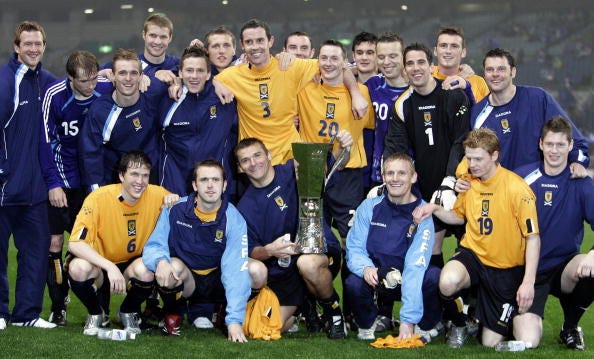
First contested in 1978, Argentina, France and Peru had all managed to wrestle the Kirin Cup from the hosts at some point. None were as surprised to win it as a Scotland side who managed to turn an end-of-season jolly into a voyage of discovery. The story of the team’s night of celebration should have been the script for a Netflix documentary.
“Japan was incredible,” recalls Steven Caldwell, a smile crossing his face. “Like something from a science fiction movie.”
Smith’s 20-man squad provided a mixture of experience and new faces and, when Caldwell sustained an injury in Sunderland’s final league game of the season against Aston Villa, he feared he might miss the trip altogether.
“I really wanted to go and see Japan. And to be with the boys. So, I went to the medical team half expecting the doc to say, ‘No.’ But he said, ‘You might be alright for the last game’ and I thought, ‘Yes, I’m going!’”
A nation of hyper-modern intensity, meticulous order and cultural subtlety, Japan was an assault on the senses from day one.
“It was a shock to the system,” Caldwell acknowledges. “Everything felt incredibly different to what we were used to.”
Chief medical adviser to the Scottish FA until March 2024, Dr John MacLean spent 25 years and 229 games attending to the needs of the national team. He is heading to this summer’s World Cup as one of seven Scottish medics drafted in by FIFA. Back then, he sensed that Japan would be different to the usual SFA travel package when management and team flew business class.
“We were in the lounges, then the nice big comfy seats and the players loved that experience. It was Japan Airlines and we took up pretty much all of the business class section. So, the party started a wee bit on the plane on the way out there...”
Travelling separately from the team, journalists began the end-of-season revelry paying for their drinks in economy class. Checking into a hotel in Osaka, Japan’s third-largest city of 2.8million people was known as the ‘nation’s kitchen’ on account of its street food. Keen to sample the taste and smells of Japan, a small group of four jet-lagged print journalists — this one included — dumped the suitcases and set off in search of culinary excellence. Asked to recommend somewhere suitable, reception staff ringed a venue on a city map. It was The British Pub.
Seeking a recommendation from the barman for a late-night drink after burgers and chips, there was a moment’s pause before some Japanese was scribbled on a piece of paper and handed over. At the nearby taxi rank, the driver scanned the instructions and a look of terror crossed his face. Scarpering into his cab, he revved up the engine and sped off into the night.
The taxi option gone, a bouncer stood outside a covered doorway in a lane round the corner was approached. Handed the note he, too, looked as if he had seen a ghost. What The Barman Wrote should have been commissioned by ITVX for an Agatha Christie adaptation. The episode remains as perplexing as the Washlet toilets which came with a heated seat and a control panel as complex as Artemis 2.
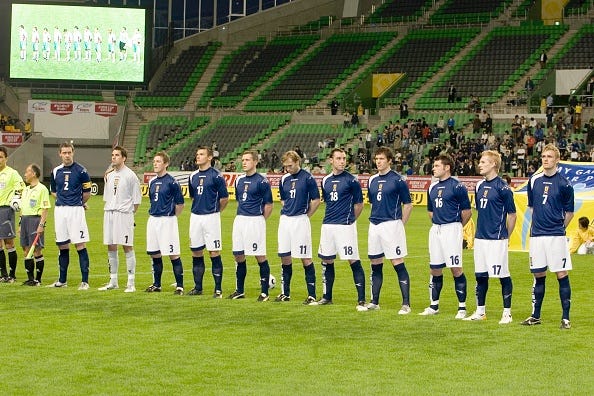
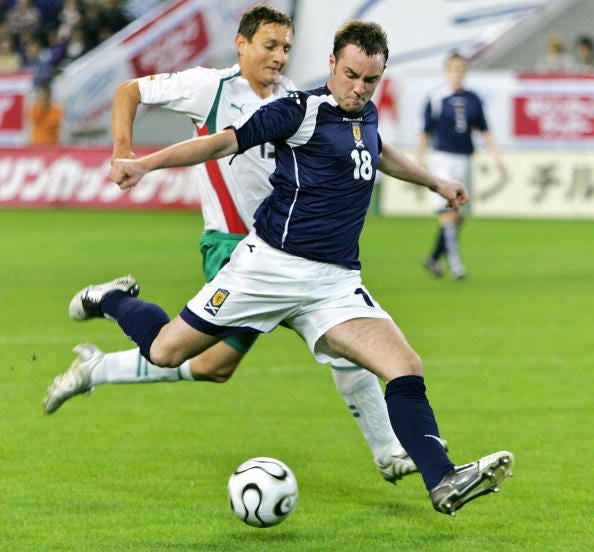
At least the football was straightforward. Before a crowd of 5,780 in the Kobe Wing stadium, Kris Boyd claimed a debut international goal against Hristo Stoichkov’s Bulgaria after 12 minutes. Undeterred by an equaliser, the Rangers striker added his second before half-time.
James McFadden made it 3-1 before a jetlagged Chris Burke was introduced with 15 minutes to play. After over an hour of yawning on the bench, the winger scored a stunning lob with his first touch, then made it five in the final minutes.
“There were some good players in that Bulgaria team,” Caldwell remembers. “But we scored five and played some decent football. Burkey did really well in that first game and a couple of others.
“We won that game handily, we were flying and feeling good. Everyone but me. I was trying to jog and when Walter saw me hobbling, he said, ‘Listen, don’t push yourself to play.’
“So I knew early that I wasn’t going to play and while that wasn’t great for my Scotland cap count it was nice to see Osaka and then go out and see Tokyo with no real pressure.
“I was a bit of a front-row mascot, hanging out and supporting the boys while knowing that I wasn’t going to see any action.
“I always remember walking the streets of Japan myself because I was not as focused on the games as the others and looking at all the neon signs and the baseball billboards and thinking, ‘Bloody hell, this is another world.’ I had never felt that before. It was very cool, very unique, very different.”
On the bullet train from Osaka to Tokyo, it pays to sit on the right side of the train. The view of Mount Fuji alone is worth the price of the ticket.
The blend of precision engineering and natural beauty makes the 320-mile journey between the two urban centres the most iconic in Japan. Buoyed by the unexpected ease of their 5-1 victory in Kobe, Scotland let the train take the strain as they swapped the relaxed vibe of Osaka for the manic intensity of the capital.
“The Japanese have this thing that they do where the supporters tidy up the rubbish in the stadia after games,” remembers team doctor MacLean. “We went into the dressing room after the final whistle and it was as clean as it was when we’d arrived four hours earlier.
“The bullet train to Tokyo was another amazing experience. They said to us to be at the station for, say, 13.11. You’d be standing there at 13.09 thinking, ‘This is going to be late.’
“Then you’d get to 13.10 and 45 seconds and you’re looking up the delay repay rules. Ten seconds later it would come round the bend, stop, people would get on and off and it would be gone by 13.11.”
Winger Teale remembers Scotland’s plush 43-storey hotel being surrounded by “cherry blossom trees in the middle of a metropolis” while defender Gary Caldwell learned that sometimes it’s better to travel than it is to arrive.
Due to a combination of claustrophobia and agoraphobia, Caldwell was terrified of lifts and the hotel elevator in Tokyo was like something from a Fritz Lang movie. Exacerbating the terror was the knowledge that he was sharing a room with his brother 40 floors up.
“The first couple of times he actually walked up and down the stairs,” recalls MacLean. “He had to leave his room half an hour before to get to team meetings in time. The only way he could go in the glass lifts was if he went in with someone else, closed his eyes and held on to the handle for dear life.”
For journalists, Tokyo brought the reassuring comforts of the Roppongi district, with its cosmopolitan nightlife, high-end dining and luxury shopping malls. Every trip ekes out an ‘HQ’, a bar where waifs and strays can always be found at the fag-end of a night — and the Hobgoblin pub ticked every box.
A favoured local for the Tartan Army, eyebrows were raised the night before the second game against Japan when manager Smith and assistant McCoist strolled in to join a stag night for the News of the World’s Kenny McDonald ahead of his nuptials in Slovenia a fortnight later.
Asked what he might like to drink, Smith replied: “A bottle of red.” The first of many, the night ended with a posse of Scottish hacks repairing to a karaoke bar to be serenaded by former Hearts and Dundee boss turned BBC pundit Duffy.
Like this high quality of writing? You’ll get much more of it in the latest Nutmeg Magazine — our World Cup edition. Order your copy by clicking on the cover below.

A fascinating travelogue. Great stuff - ready for part 2!