

Welcome to part II of award-winning sportswriter Stephen McGowan’s investigation series into the arrival of new talent at Hearts following the buy-in of Tony Bloom and his Jamestown Analytics data company. Yesterday we profiled Claudio Braga and Alexandros Kyziridis.
Today we get insights on midfielder Eduardo Ageu and forward Pierre Landry Kabore, hearing from Tynecastle head coach Derek McInnes and two sportswriters who were familiar with their earlier careers. In tomorrow’s final part, the focus turns to midfielder Tomas Bent Magnusson, full-back Harry Milne and defender Oisin McEntee.
Parts II and III are for paid subscribers. If you’ve been waiting for the right time to sign up, this is it. The latest issue of our quarterly magazine will be sent out within the next week — and an ‘annual’ season ticket will ensure it drops through your letterbox. Have a ‘virtual’ flick and then choose ‘annual’ below.
By Stephen McGowan
When Brazilian midfielder EDUARDO AGEU moved from the youth system of Cruziero to play for Santa Clara in Portugal, he struggled to make an impact until he went on loan to Alverca, the club 70% owned by a group of Brazilian investors, including Real Madrid superstar Vinicius Junior. Sportswriter SERGIO MAGALHAES remembers the player making a big impact in Alverca’s push for promotion to the Primera Liga.
“He scored seven goals and made four assists in 30 games, proving to be one of the most used players by coach Vasco Botelho da Costa. That strong influence in the Portuguese second division attracted the interest of several clubs, until Hearts came into the negotiations.
“He functions best as a kind of box-to-box player, without being a physical powerhouse. Although he is not especially tall, he has good aerial ability, so he is also an asset in that regard. He’s an interesting player.
“He was particularly important for Alverca in the second half of the season when he scored five goals and provided four assists in the last 16 games.
“Santa Clara never fully realised Eduardo Ageu’s value as a player and the margin for improvement he still has ahead of him. Selling a player to Hearts for €2 million, especially for 70% of his registration rights, was a deal that was practically impossible to refuse for a club from the Azores, but it was surprising mainly because of Eduardo’s lack of success there and also because a Scottish club was interested in a player who had been in the spotlight in the Portuguese Second Division, and who had completely bypassed the club that owned his transfer rights.
“The transfer fee was also surprising because, as I mentioned, it was a record amount for Hearts themselves.”
DEREK McINNES describes Ageu as a ‘Rolls Royce.’ His appearances restricted by niggling injuries so far, the Hearts boss remains excited by the potential of a 23-year-old who showed maturity beyond his years when they first spoke…
“He had a lovely manner. I felt he was really looking forward to the call, the same as I was. He was really engaging and positive and asked the right questions.
“He knew a lot about Edinburgh and had clearly done his homework. I always think that when you speak to players and ask them if they know about Edinburgh or Scottish football and they say ‘no’ when the situation has been ongoing for a while, it makes you curious as to why they wouldn’t look it up or do some research before speaking to a manager.
“But all that type of thing was good with Eduardo and I saw how he looked as a player on the video and on the presentation. And it would have been hard for me to find fault with the boy because I really liked him; the boxes were ticked from that conversation.
“He was appreciative of the fact that we were prepared to pay the money to bring him to Hearts and, like Braga, he was determined not to let anyone down. He wanted to make an impact and I think he will.”
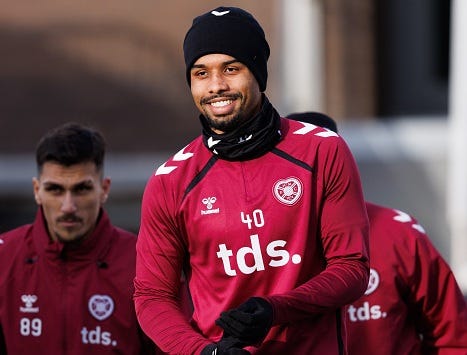
PIERRE LANDRY KABORE was a novelty when he played for Trans Narva. Players from Burkina Faso rarely find their way to Estonian league teams on the Russian border. And, when he arrived in the summer of 2024, RAUL OJASSAR, Editor-in-Chief of Soccernet Estonia remembers nothing remarkable, nothing especially striking about his early performances.
“He was definitely not a major success at first — more of an average player, really. He started playing better and scoring in summer 2024, after half a season. Eleven goals and five assists in 29 matches in his first season was eventually a solid output, but his first full season was marred by a lack of discipline.
“He led the league in both yellow cards — 16 in 29 matches — and red cards (2). Most of those yellow cards were for fouls, but a lot of them were for dissent as well. He eventually missed five matches due to suspensions last season and because he was sanctioned by the disciplinary board because of his last red card, he had to miss two matches from the start of the 2025 season as well.
“The leap between 2024 and 2025 was quite significant. The most important part was that he managed to contain himself on the field and avoid unnecessary cautions. The Trans head coach Alexei Eremenko (father of former Kilmarnock attacker Alexei junior) praised his change in attitude and mentality.
“Even then, I didn’t think that he would make a leap straight to the top of the Scottish Premiership. I would have predicted a more modest transfer because against the top Estonian teams, he wasn’t nearly as effective. In May, he basically scored three hat-tricks in a row against inferior opposition. That’s why I was quite surprised when he moved to Hearts.
“His biggest legacy is that he proved that players could make a very significant move abroad straight from Trans. It has usually not been the case — when someone plays well for Trans, they usually get snapped up by the bigger Estonian clubs before making a step abroad. His sale was a great moment in Trans history.”
Even DEREK McINNES queried whether a player from the Estonian league could make the jump to the Scottish Premiership. Reassurance came from the strong data ranking on the Jamestown supercomputer and was reinforced by two goals in a 4-0 rout of Dundee.
“Before the Jamestown arrangement, there were times when you would look at the players from outwith Scotland and look at level they were coming from and you would maybe be a little unsure.
“Even in the video presentation of Kabore, while his goal return was good and you could see his physical attributes, some of the venues he was playing at resembled junior grounds a lot of the time.
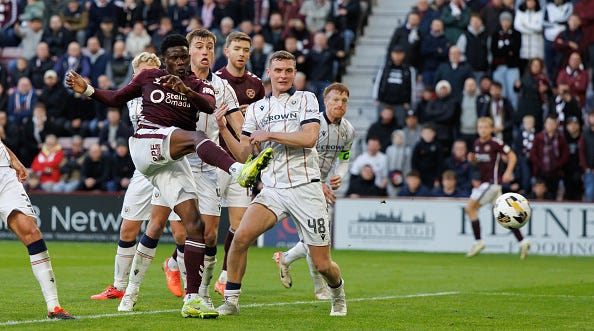
“But that’s not a player’s fault. Those were the circumstances he found himself in and he was clearly a good player. He was doing a lot right.
“So, when we got to the point of having a conversation with him, there was life in his eyes, he was smiley, chatting, knew everything about what we were trying to do and really appreciative of the interest.
“I came off the back of that call and felt better after speaking to the boy, and hopefully he heard the reassurance from me he needed to come here and feel good.”